Sakura at Himeji

As mentioned in yesterday’s blog entry, there were some blossoming trees on the Himejijo grounds during the first week of April.
|
The above will search Traveljapanblog.com. Concerts - Landscapes - Sports |
As mentioned in yesterday’s blog entry, there were some blossoming trees on the Himejijo grounds during the first week of April.
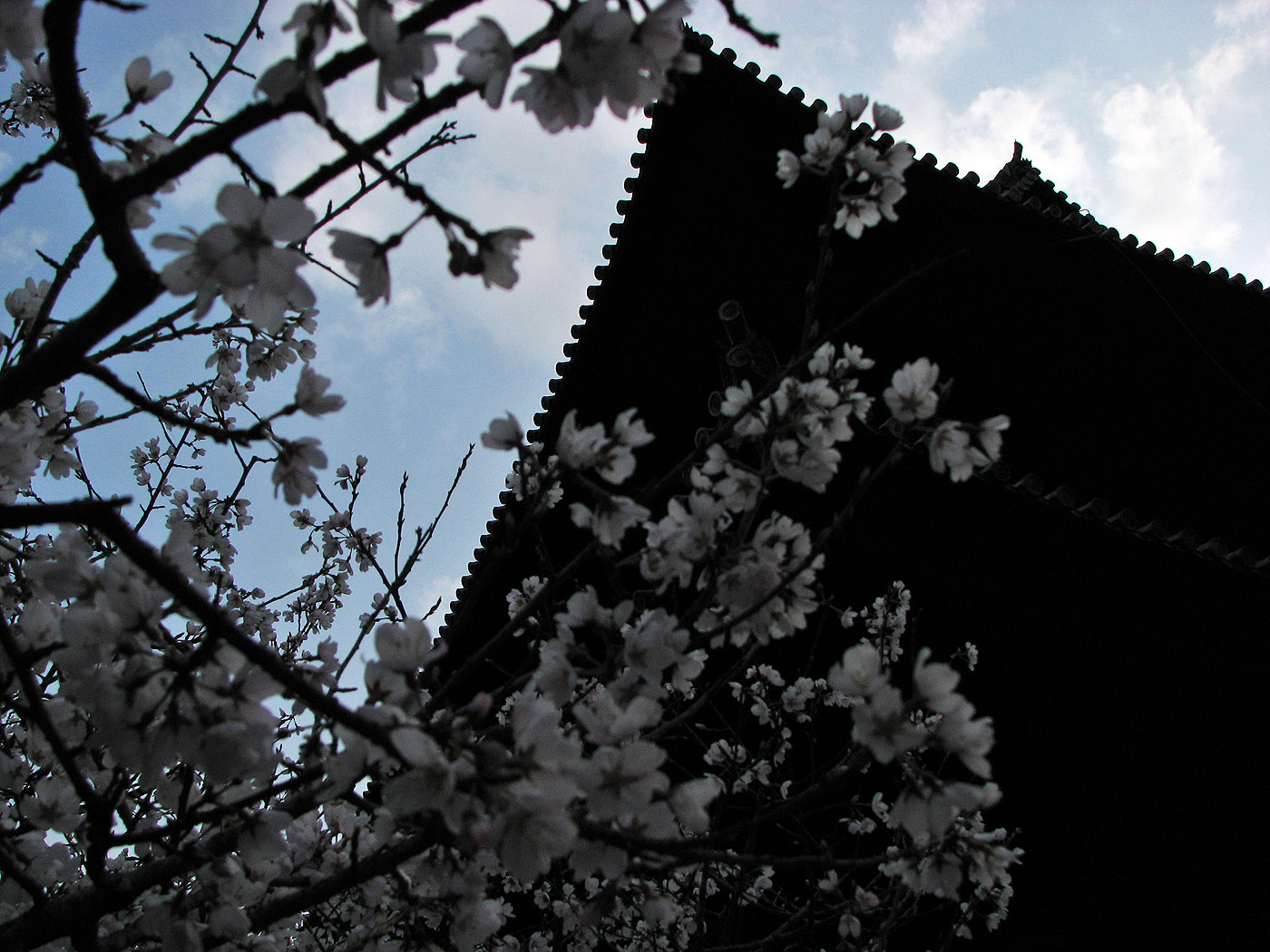
During our four days in Kyoto we had a grand total of about 5 minutes of blue sky. The above photograph captured those brief moments.
I don’t remember the name of this temple, but it was near the south side of the Path of Philosophy (if I remember correctly).

In the Arashiyama area of Kyoto we rented bikes and road mostly north into the Sagano area. The last line of homes before running into the mountains (just east of Adashino-Nenbutsu-ji (化野念仏寺)) consisted of some fine ones with a thatch roof. Farming was still going on in the surrounding neighborhood. That some properties also included cherry trees in full bloom put a smile on my face.

One of the more famous places in Japan for viewing the cherry blossoms is Maruyama Park (円山公園) in Kyoto. We didn’t plan to go there, but ended up in the thick of things anyway. We had a splendid little lunch of yakiniku with C.C. Lemon to wash it down next to these guys who were enjoying their Asahi Beer (advertised in yesterday’s blog entry).
Cherry blossom viewing parties (花見) are a common sight in late March and early April in most of Japan. This picture captures the essence of many of those parties: food, friends, beer, kimono, lanterns, and Mickey Mouse. Actual cherry blossoms are an optional bonus. We were lucky enough to have them on this occasion. We did a 花見 in Tokyo, which was just as crowded, without any blossoms yet on the trees.

“That trees, at least Japanese trees, have souls cannot seem an unnatural fancy to one who has seen the blossoming of the umenoki and the sakuranoki. This is a popular belief in Izumo and elsewhere. It is not in accord with Buddhist philosophy, and yet in a certain sense it strikes one as being much closer to cosmic truth than the old Western orthodox notion of trees as ‘things created for the use of man.'” (Lafcadio Hearn, 1894, Glimpses of Unfamiliar Japan, p. 358)

“There is one place in Japan where it is thought unlucky to cultivate chrysanthemums, for reasons which shall presently appear; and that place is in the pretty little city of Himeji, in the province of Harima. Himeji contains the ruins of a great castle of thirty turrets; and a daimyō used to dwell therein whose revenue was one hundred and fifty-six thousand koku of rice. Now, in the house of one of that daimyō’s chief retainers there was a maid-servant, of good family, whose name was O-Kiku; and the name “Kiku” signifies a chrysanthemum flower. Many precious things were entrusted to her charge, and among others ten costly dishes of gold. One of these was suddenly missed, and could not be found; and the girl, being responsible therefor, and knowing not how otherwise to prove her innocence, drowned herself in a well. But ever thereafter her ghost, returning nightly, could be heard counting the dishes slowly, with sobs…
Her spirit passed into the body of a strange little insect, whose head faintly resembles that of a ghost with long disheveled hair; and it is called O-Kiku-mushi, or “the fly of O-Kiku;” and it is found, they say, nowhere save in Himeji…
…the people of Himeji say that part of their city now called Go-Ken-Yashiki is identical with the site of the ancient manor. What is certainly true is that to cultivate chrysanthemum flowers in the part of Himeji called Go-Ken-Yashiki is deemed unlucky, because the name of O-Kiku signifies “Chrysanthemum.” Therefore, nobody, I am told, ever cultivates chrysanthemums there.” (Lafcadio Hearn, 1894, Glimpses of Unfamiliar Japan, p. 363)