TravelJapanBlog.com - Japan (07, 09-10, 13), Denmark (08, 11, 16-19, 21, 24), Korea (13), Poland (21), Mexico (14, 15, 19, 26), Iceland (17, 19), Hawaii (14, 17, 22), Czech Republic (16, 17, 19, 21)
The above will search Traveljapanblog.com.
Concerts - Landscapes - Sports


Posts tagged mangajin

Mangajin

Once again I have finished reading a number of Mangajin that I’d like to send to you (as my shelves are overflowing). The six issues pictured are 28, 29, 30, 31, 32, and 47. All are in great shape except 31 which has minor water damage and a crease in the cover. It is still completely readable though, and there are no torn or missing pages. There is no writing in any of them.

Make me an offer if you’d like them.

Managajin (漫画人) for sale

I have finished reading the above magazines so now they can be yours. All issues, previously mentioned, of Nihongo Journal (日本語ジャーナル) on this blog have been sold, but as of today all of the Mangajin issues are still available. The more you purchase at once the lower the price per issue.

These issues of Mangajin are Nos. 22, 25, and 26 from late 1992 and early 1993. The Nihongo Journal is from September of 1993.

You don’t have to be able to read any Japanese to enjoy these magazines. Mangajin is mostly in English. All parts that are in Japanese have been translated into English too. If you are learning Japanese they can be useful to your studies though.

Japanese magazines for sale

I’ve finished reading a couple more magazines that need a new home. If you want them, or the earlier items mentioned, let me know.

Nihongo Journal, August 1993 features articles and pictures on selecting a dictionary, J-league soccer, preparing for the JLPT, and much more. Clocking in at over 120 pages, this magazine can keep you busy studying the Japanese language for a while. Most articles include English translations. All include furigana. Some are aimed at beginners. Others target those at upper beginner and intermediate levels.

Mangajin, No. 24 is no longer available from the publisher and is quite difficult to find. This is one of the better ones I’ve read (not that the others aren’t good). There is much about mizu shobai in this issue. The Crayon Shin-Chan and What’s Michael? manga in this issue are absolutely hilarious. Mangajin expanded to about 100 pages starting with about issue No. 20. Good stuff!

Japanese reading material

After several months of off and on reading (I didn’t bring the book with me to Europe during the summer when I was away for more than six weeks) I have finished ハリー・ポッターと秘密の部屋. This was the first book I have read in Japanese in almost twenty years. Clocking in at almost 500 pages, I feel like I’ve accomplished something.

Although daunting at the outset, the reading was actually not that difficult and quite enjoyable. In addition, I picked up some new vocabulary/kanji and had a great review of other vocabulary, grammar, and kanji. Not all of the things learned will come in handy. After all, how often will I need to use words like 屋敷しもべ妖精 (house elf), 杖 (wand), or ほとんど首無しニック (Nearly Headless Nick) in real life? But overall this was a very enjoyable studying routine. I plan to continue it by reading a Japanese book on a daily basis from here on out (in addition to Mangajin, Nihongo Journal, and other things).

The Harry Potter book had furigana next to all of the kanji. For my next read I plan to read something without the furigana crutches. It will probably be slower going, but that is the norm while in Japan which is what I’m preparing for.

I also finished Mangajin #23 as well. If you are interested in purchasing either of these items from me (or the other things previously mentioned) make me an offer.

Japanese learning materials for sale or trade

Yesterday I finished the previously mentioned Kochi Kame. I thoroughly enjoyed reading this manga. It turned out to be not so Scooby Doo like after all. Only the first few episodes had similar storylines. The rest showed a wide variety of plots and were unpredictable so that was good.

After finishing I tossed the book into a drawer filled with other Japanese things I’ve finished (since my bookshelves are already overflowing). I realized then that I have too much to read in the next year before returning to Japan so there is no way I will revisit these again. That being the case, I’m willing to part with them for cash or trade.

japanese learning materials for sale mangajin nihongo journal genki benkyo

Here is what I have:
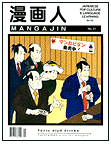
Mangajin cover
Japanese Business Glossary, 220 pages from 1983
Dictionary of Legal Terms, about 550 pages from 1993
– 5 issues of Mangajin, Nos. 9, 17, 18, 19, and 21 (Note that issues 9 and 19 are very rare and can no longer be purchased from the publisher for the normal $6.50 to $20 an issue plus postage. No. 21 is also rare and available for $20 + shipping from the publisher.)
Nihongo Journal, June 1993 (These are no longer available from the publisher and usually go for $20+ an issue when they show up on eBay.)
Kochi Kame, 190 pages, 158 kan from January of 2008.

All of these items include translations and/or furigana so you don’t have to have intermediate or advanced Japanese skills to benefit.

You can have them all for US$50 delivered in the U.S. If you don’t want everything, if you are outside of the U.S., or if you’d like to trade for these items, email me and we can arrange different terms.

Japanese enigma

As I’ve mentioned elsewhere, for the past year or so I’ve become a bit obsessed with Japan and relearning and improving my Japanese. I haven’t really stopped to wonder why, but last night, as I was reading, the answer came to me. I suppose part of the answer is simply that if you are going to be living somewhere for a significant period of time you become more interested in it. But there is more to it than that.

mangajinI was reading Mangajin, No. 19. The feature story was interviews with translators. Gerry Harcourt was asked (page 19), “What do you like most about the Japanese language?” Her response was a bit of a nirvana moment for me. She said, “It’s so different from English. It jolts my way of thinking. I enjoy the surprises.”

And just like that I realized why the thought of moving back to Japan has caused my mind to think of little else. I’ve been jolted. And I enjoy the daily joltings and surprises that Japan and its language provides. After all, I can already speak, read, and understand Japanese good enough to have a great time in Japan. So I’m not really studying it to get by. I’m doing so because it is such a rewarding and interesting challenge.

Without the challenge and joltings I’m quite sure I wouldn’t be expending the time and effort.