TravelJapanBlog.com - Japan (07, 09-10, 13), Denmark (08, 11, 16-19, 21, 24), Korea (13), Poland (21), Mexico (14, 15, 19, 26), Iceland (17, 19), Hawaii (14, 17, 22), Czech Republic (16, 17, 19, 21)
The above will search Traveljapanblog.com.
Concerts - Landscapes - Sports


Posts tagged Tokyo

Bon Odori – Day 2

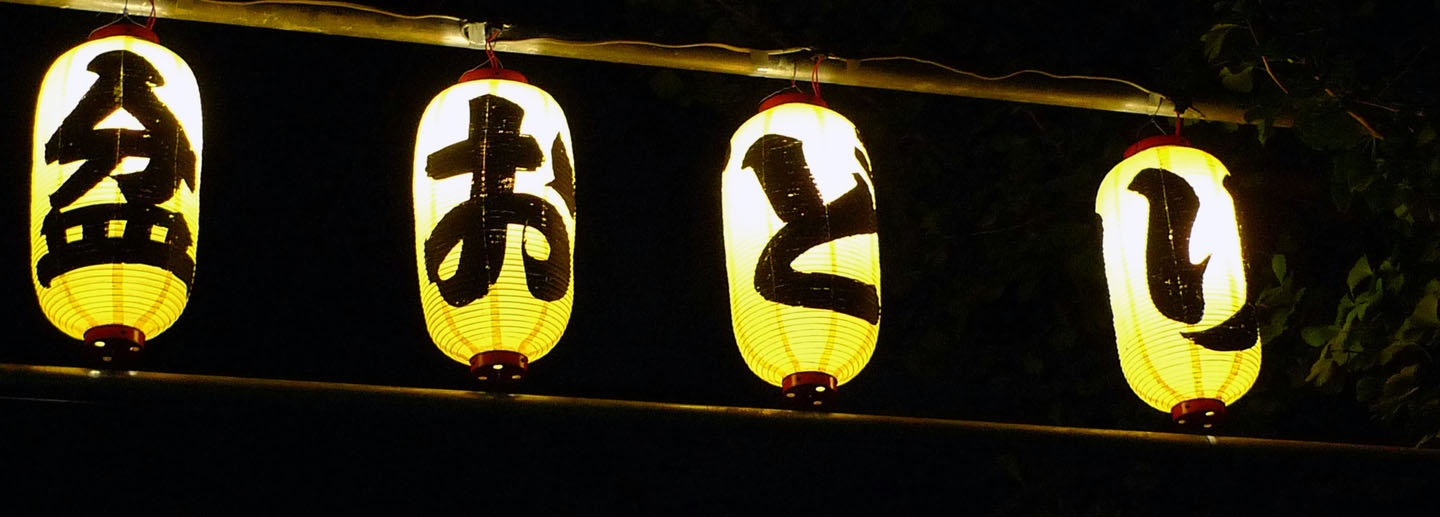
bon odori written in kanji and hiragana japanese

First a little Japanese lesson for you. Bon Odori can be written in three ways in Japanese–ぼんおどり (all hiragana), 盆おどり (kanji and hiragana like the lanterns on my street pictured above), or 盆踊り (mostly kanji).

Bon (or o-bon) means the annual summer festival which celebrates or brings to mind the deceased. O-bon happens in both July and August, usually around the 15th of each month. In some parts of Japan it is only celebrated once, rather than in both months.

Odori simply means “dance.” Odoru is a verb meaning “to dance.” Put Bon and Odori together to get something that loosely means “dance of the dead.” Viewing a Bon Odori doesn’t conjure up visions of a dance of the dead however.

bon odori tokyo japan august 2009

After the magic that was the first night’s dance I made sure my family came with on the second night, even though my daughter had already fallen asleep again. I brought her in a nearly comatose state so perhaps it was a dance of the dead after all. 😉

I think they really enjoyed it too, especially watching the little girls, all dressed up, trying to learn the dances from their mothers and grandmothers. The taiko drumming that accompanies the dance is fun to experience as well.

black and white bon odori picture japanese lanterns

After each song an announcer thanks everyone for their participation and then introduces the following number. They probably did a dozen different songs, or more, each night. Each song has a different dance with which it is associated. Some of the participants were amazing in their ability to remember the steps and movements in each of the folk dances. I don’t think they ever do the bon dances outside of the night or two each year.

shinjuku-ku nishi-waseda jinja bon festival matsuri

My wife and daughter were invited to join the dance, but they politely declined.

The songs remained in my dreams both nights, going through my head over and over again. Maybe we’ll still be around next year (in July anyway) to catch another Bon Odori or two.

盆踊り Bon Odori – Day of the Dead Dance – 1st Night

It has been 21 years since I saw my last Bon Odori. The dancers came right down the street I was living on at the time in Kofu, Yamanashi Ken. Fast forward to the present and the morning after we arrived in Japan. I saw an announcement that the local shrine in Nishi-Waseda was having a Bon Odori on that very night and the following evening as well. I was so excited!

bon odori torii

My family didn’t have the energy to attend, and my daughter feel asleep before the dance began, so I headed to the shrine on my own. It is only a two minute walk. The music began just as I arrived. There were only a dozen or so dancers. The dancers’ husbands were all sitting together, in matching yukata, fanning themselves.

bon odori dancer husbands

As the music reached the ears of our neighbors, they all seemed to creep out of their homes and make it to the shrine. By the time I left, an hour later, over a hundred people were in attendance, and the number of dancers had increased by several fold.

bon dance nishiwaseda tokyo japan august 15 2009

I was, of course, the only non-Japanese person there. The whole evening was enchanting. I felt as though I had traveled through time and space. The tall, modern, Tokyo buildings couldn’t be seen in the darkness. The light from the paper lanterns was dim, and the shrine in the background provided the perfect setting. My lack of a yukata and foreign looks seemed to ruin the authenticity so I stayed back in the shadows.

dance of the dead folk japan bon obon odori taiko drumming

時差惚け (じさぼけ = jisaboke = Jet Lag)

I’ve been in Japan for almost three days now, and my jet lag doesn’t appear to be going away anytime soon. As I type this it is 4:30 a.m., and I have been up for more than an hour. Oh well, it can’t last forever, right? The night before I slept a Benadryl-assisted 7 or 8 hours, but I woke up feeling like crap so I skipped the drugs last night. We’ll see if that was a good decision later today.

Backing up to the day of our arrival, our flight into Tokyo was painless enough despite the lack of leg room and our being stuck in the middle of the center row of coach seats on the plane. There was an announcement while in flight asking if there were any お医者様 (doctors) or 看護婦様 (nurses) on the plane. It turns out there were no doctors, but there were two nurses–my wife (pediatrics) and an anesthesiologist nurse. That’s probably not what they were hoping for, but what can you do at 39,000 feet? It turns out the co-pilot was knocked out of commission. I’m not at liberty to give more details than that. But we made it, safe and sound, into Tokyo.

The trip to our apartment was pretty hellish. It’s not a good idea to try to haul more than a single piece of luggage per person to your destination from the airport. The price to have it shipped from the airport to places in downtown Tokyo (over $150) seemed ridiculous so we moved our luggage via train ourselves. Maybe it wouldn’t have been so bad had we not just been sitting on planes and in airports for almost 16 consecutive hours. Or maybe it would have been better if it had not been extremely hot and humid on arrival. In any event, we made it through some taxing situations to finally stumble into our Court Nishi Waseda (コート西早稲田) apartment.

court nishi waseda sign at night

Our luggage literally filled the place. We couldn’t get the AC to work. Sweat was pouring down my face, and my body felt like it had just been dipped in syrup. I felt a mutiny from my family was about to take place, and to be perfectly honest, at that moment I could have joined them.

The next day things quickly looked shockingly brighter however. It’s amazing what a little sleep (only about 5 hours worth), an unpacking of the eight suitcases, and a stowing of them out of the way can do for one’s outlook. The apartment seemed to grow by about four or five fold, and it became apparent that we could do this after all.

Also, I had forgotten about the 蝉 (cicadas) in Japan. Hearing them gave me hope and brought a smile to my face. That first morning I also learned how to open our mailbox, use our AC, heat our shower and お風呂 (Japanese bathtub), I found the local market, and was greeted with a hearty おはようございます (good morning) by several of my new neighbors. Things were looking up. In fact, I couldn’t have been much happier, which couldn’t have been much more opposite from the way I felt the night before when I was at the lowest of the low.

I’ll leave you for now with this picture of the entrance to our apartment, コート西早稲田. Several friends and family members have asked for pictures of our apartment so I’ll get some interior shots up soon. First I have to take them though. 😉

コート西早稲田 court nishi waseda apartment tokyo shinjuku-ku

Good morning Tokyo!

first morning in tokyo

We made it to Tokyo! It was easy getting here for the first 15 hours or so, very difficult thereafter. We were one pilot away from not having any pilots left to fly the plane, but he held out on us. You’d think they would have upgraded us to first class for being one of the only two medical personnel on board who could work on the incapacitated co-pilot but no such luck. I’ll back up and give you a fuller story of how we got here beginning with tomorrow’s entry.

For now, just enjoy the photograph of the sunrise from my new apartment in Tokyo that I took at 4:37 a.m., a mere 2 hours after I woke up for good. Oh, the joys of jetlag

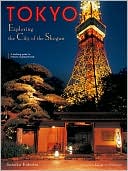
Tokyo: Exploring the City of the Shogun

tokyo exploring the city of the shogun

This beautiful book is actually many books in one. Tokyo: Exploring the City of the Shogun is a coffee table book, large with marvelous photography on every page. It’s also a guidebook, with maps and suggested routes for exploring historic neighborhoods in Tokyo. Finally, it is a work on the history of Japan–the Kanto (Tokyo, Edo) region in particular.

Each of the “chapters” includes a “Then” and “Now” section which explain what the area was like hundreds of years ago, how it has changed, and what you can expect to see and what to look for now.

I read a very similar book, Kyoto: Seven Paths to The Heart of The City, before we went to Kyoto two years ago. The maps appear much better in this one, but I haven’t actually tried them out yet. I will let you know how they are in a few months after following a few. This Tokyo version seems to be an improvement on the Kyoto version in every way.

Like the Kyoto book, the Tokyo edition includes seven tours of areas to explore on foot. They are:

Nihonbashi & Ningyocho: The heart of the old city
Ryogoku & Asakusa-bashi: The sumo quarters and environs
Fukagawa: In the footsteps of the haiku poet Basho
Tsukiji & Higashi Ginza: Fish, kabuki, and more fish
Atagoyama & Shiba: Samurai feats and traces of shoguns past
Asakusa: A classic temple district, with shops and festivities
Yanaka & Nezu: Strolling through a traditional Tokyo neighborhood

There is also one on the Imperial Palace and the surrounding grounds so I suppose there are eight in all rather than just seven.

Both the Kyoto and Tokyo books are problematic in one way however. They both do too much. What I mean by that is who wants to take a large picture book on a walk with them? My suggestion is to read this book before and after your walk. Make a photocopy of the map and directions for the walk itself though and bring only your photocopy along.

Should the publisher update these books in the future my suggestion would be to turn the publication into two books sold together–a large picture book with the history and background provided and then include a little, 7-page, pull-out book with the maps and directions to bring along on the walks.

Tokyo!

tokyo! the movie review I watched Tokyo! a couple days ago and figured I’d type my thoughts before they get too far away from me. The movie is actually three movies in one. Each is a bit over 30 minutes. Had any of the three been full length I’m quite certain I would have hated the result. As it is, each has some redeeming portions. Let’s look at them individually.

The first film is called “Interior Design” and is written and directed by Michel Gondry. I love the atmosphere in this one. As someone about to move from a 2,400 square foot home into a 700 square foot apartment in Tokyo with my wife and two kids, I can “feel” this movie more than many I suppose. The end is a little weird and doesn’t really make much sense to me. This movie, and the last one, seemed very Japanese to me. If I didn’t know it wasn’t a Japanese writer and director I certainly would have guessed Japanese authorship. Overall, I give it a 7 out of 10.

The second movie is by Leos Carax and is called “Merde.” The opening scene and newscaster scenes are outstanding. I laughed a lot when the old Japanese lady described the sewer monster. Beyond those scenes, however, there is nothing I find decent in this segment. I would give it a 1 or 2 out of 10, but because of those few moments that were really well done I award Merde a 5 out of 10.

The final picture was my favorite. “Shaking Tokyo” by Joon-ho Bong is excellent from start to finish. If you haven’t lived in Japan for a period of time then maybe you won’t get it, but I really felt this one. Seeing Japan’s streets totally empty and the main character’s house totally unkempt on the exterior was lots of fun too. 9.5 out of 10.