TravelJapanBlog.com - Japan (07, 09-10, 13), Denmark (08, 11, 16-19, 21, 24), Korea (13), Poland (21), Mexico (14, 15, 19, 26), Iceland (17, 19), Hawaii (14, 17, 22), Czech Republic (16, 17, 19, 21)
The above will search Traveljapanblog.com.
Concerts - Landscapes - Sports


Archive for Japan

Tokyo Sakura

On March 26 we visited Shinjuku Gyoen (新宿御苑) for the first time. It was still a week or so too early for the peak of the cherry blossoms (sakura), but a half dozen of the trees were in full bloom. Hanami was in full swing regardless. The best cherry blossom viewing time varies a bit each year, but this year, like most years, it looks like the first week of April will be the best time to view sakura in Tokyo.

Some didn’t care about the flowers. They were there to play on the grass.

Others came only for pictures of the flowers with some serious equipment.

ぼけ ボケ

There were other flowers in full bloom, like these Chaenomeles.

Norwegian Wood

I loved this book. I could picture each scene so clearly; it was more like a movie than a book. I frequently read Norwegian Wood while on the train in Tokyo and happened to be at the exact location Murakami was describing on more than one occasion. I read the part in which the narrator (Watanabe) visit’s Midori’s father in the hospital on my way back from Ochanomizu. I walked past the same hospital he describes from the late 1960s just 10 minutes before. On another day I read about him meeting Midori at Iidabashi at the same moment the train I was on stopped at Iidabashi.

Norwegian Wood has some similarities to Murakami’s other works, but the super strange and supernatural elements are missing. I rather like the super strange in his works, but I also like the omission of the supernatural.

The college scenes at Waseda University always brought a smile to my face as well. Things haven’t changed much, except the students don’t shut down the campus for five months like they did in 1969. Actually, much of this book is timeless. Murakami wrote it in the 1980s, although the setting is the late 1960s. He wouldn’t have to change much to make it fit in fine in 2010 though. Tokyo has changed much in the past forty years, but at the same time, on another level, it hasn’t changed at all.

Here are some quotes I copied while reading. I’ll have a few more in entries over the next month or so.

“Memory is a funny thing. When I was in the scene I hardly paid it any attention. I never stopped to think of it as something that would make a lasting impression, certainly never imagined that 18 years later I would recall it in such detail. I didn’t give a damn about the scenery that day. I was thinking about myself… Scenery was the last thing on my mind.” pp. 2-3

“I have to write things down to feel I fully comprehend them.” p. 4

“I can’t leave anything out. I’ve been doing the same thing every day for ten years, and once I start I do the whole routine unconsciously. If I left something out, I wouldn’t be able to do any of it.” p. 20

“‘What possible use is stuff like that for everyday life?’

‘None at all,’ I said. ‘It may not serve any concrete purpose, but it does give you some kind of training to help you grasp things in general more systematically.'” p. 232

Aerial view of Mt. Fuji

Unfortunately, the People’s Republic of China blocks those within China (including me at the moment) from accessing this and many other websites. This is my first, and only, post I have made or will make from China. I’m doing so by using an internet proxy. However, the proxies are very unstable and only last for a minute or two so rather than getting kicked off in the middle of a post and losing my work, I will put blogging on hold for another week until I am back in Japan. Thank you for your patience.

Today’s photo was my view of Mt. Fuji from the air on my way to Beijing.

Tokyo Marathon 2010 photos – Part 3

東京マラソン

For all of the Tokyo Marathon 2010 pics click here.

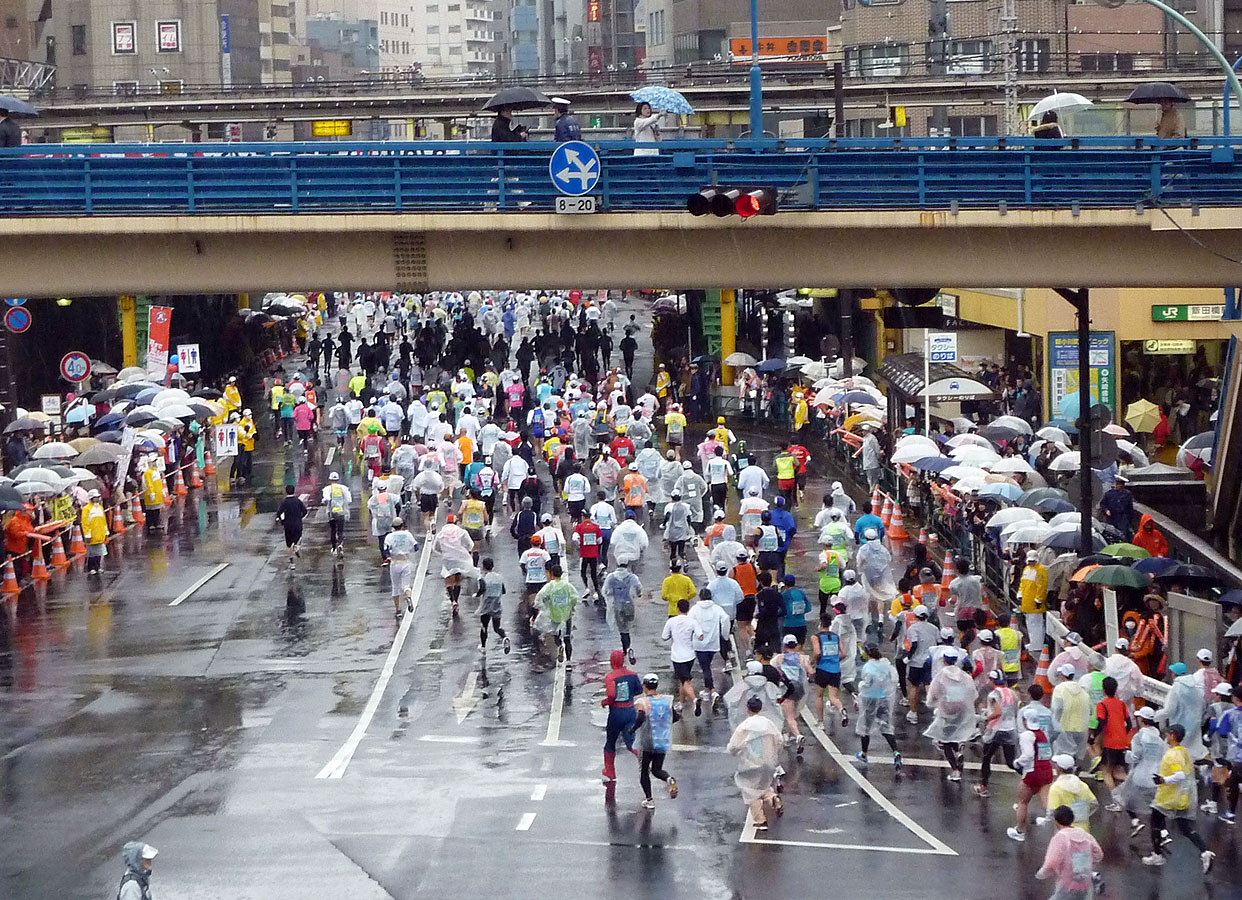
The above picture is my last of the day, just before heading into the Iidabashi Metro Station. I was very cold and very wet at this point. Watching the rest of the race in front of the TV provided a nice contrast. How often do you get to witness the same sporting event in person and on TV in your home and have them both be live?

I took this one from the steps leading up to the pedestrian crossing overhead.

The view from the crossing was great but police kept people moving.

Runners were in shower caps, wet suits, garbage bags, and anything else they could think of to try and keep dry.

More to come…

Chinatown 横浜中華街

横浜中華街

I’m in China now. Or at least I hope I am. I’m actually typing this a few days before heading to China, and scheduling it to post later, so today’s pics aren’t from China but from Yokohama’s Chinatown (横浜中華街).

Kamakura Daibutsu (Giant Buddha) hike

Last week I made my fourth excursion to Kamakura. I have taken a completely different route each time and still feel like I have much to explore and discover in this ancient capital of Japan.

We followed Yamaonna’s Kamakura Daibutsu Hiking Course 大仏ハイキングコース during the morning. I won’t repeat everything she said. Click the link for details.

We skipped Engakuji as I was just there at the end of November. Tokeiji (東慶寺), our first stop, was incredible. I’ll have more pictures from Tokeiji in future entries. The top picture in today’s entry is from there.

The trail itself was very cool and nearly empty. The second picture is of an “ordinary” house, and its fence, on the first part of the trail.

There are a few things I would add or change to Yamaonna’s write up of the Giant Buddha Hiking Course.

One is Jochiji’s admission fee, which has increase by 50 yen in the past few months to 200 yen. Strangely, the 200 yen sign looked very old. Maybe they change the price based on the season?

One item about the Daibutsu Hiking Course I would add is that there are views on this hike when you are near the top. The views to the right are of Mt. Fuji and those to the left are of the bay and the Pacific Ocean. Unfortunately, the morning was overcast and a bit hazy so we couldn’t see Mt. Fuji and could barely see the ocean when we sat down on the above, empty bench next to these four Japanese ladies.

If you aren’t tired after your walk and after visiting the Daibutsu, make sure to visit Hasedera if you haven’t before or if you aren’t planning on doing so on a future trip. From there you can jump on the train and go to Enoshima or you can walk the beach back most of the way to the Kamakura station, saving 250 yen and seeing much more than you can see from the train.

Also, a cheaper way to get to Kamakura is from Shibuya through Yokohama. Instead of the 780 or 890 yen quoted on Yamaonna’s blog, it is only 550 yen (although it takes a bit longer).

One final note, this hike can be very muddy if it has rained recently. It hadn’t rained in almost 48 hours but it was still muddy for us in places. I wouldn’t recommend this hike if it has rained in the past 24 hours.