Hasedera

Kamakura's famous Hasedera front gate with pine tree
|
The above will search Traveljapanblog.com. Concerts - Landscapes - Sports |
Kamakura's famous Hasedera front gate with pine tree

I know. It’s the wrong season for a picture like this, but my random desktop generator came up with this today, and you can’t argue with it. This is a scene from Kencho-Ji in Kamakura in late November.
In 1498 a giant tsunami washed away much of Kamakura, including the building that housed the giant Buddha. Since then the Daibutsu has remained in the open.
Having never visited Natori, or the other cities and towns completely wiped out by the recent tsunami, I imagined Kamakura, where I have been several times, when I saw the photos from the results of the Sendai quake and tsunami. The thought of a place like Kamakura getting hit by a tsunami large enough to reach the Daibutsu is chilling to my core.

One of the oldest, if not the oldest, structure in Tokyo, Gokokuji was one of not many buildings that made it through World War II. Gokokuji was built more than 330 years ago.
If you happen to be in Tokyo in the near future, they have a flower festival at Gokokuji on the first or second Sunday of April.

What’s being called the Tohokuchihotaiheiyookijishin (東北地方太平洋沖地震), or maybe the Sendai Earthquake for short, has been gripping the world for the past day and a half. The Japanese are resilient.
Being back in Oregon now, I missed this “big one.” Ironically, I was in Tokyo when the 1989 Loma Prieta Earthquake hit my old stomping grounds. Had I been “home” for that one I’m guessing I would have been at Candlestick Park awaiting the beginning of the World Series game between the A’s and Giants and would have ended up stranded in San Francisco that night, much like the scene in Tokyo yesterday with people having to wait out the lack of public transportation or walk home.
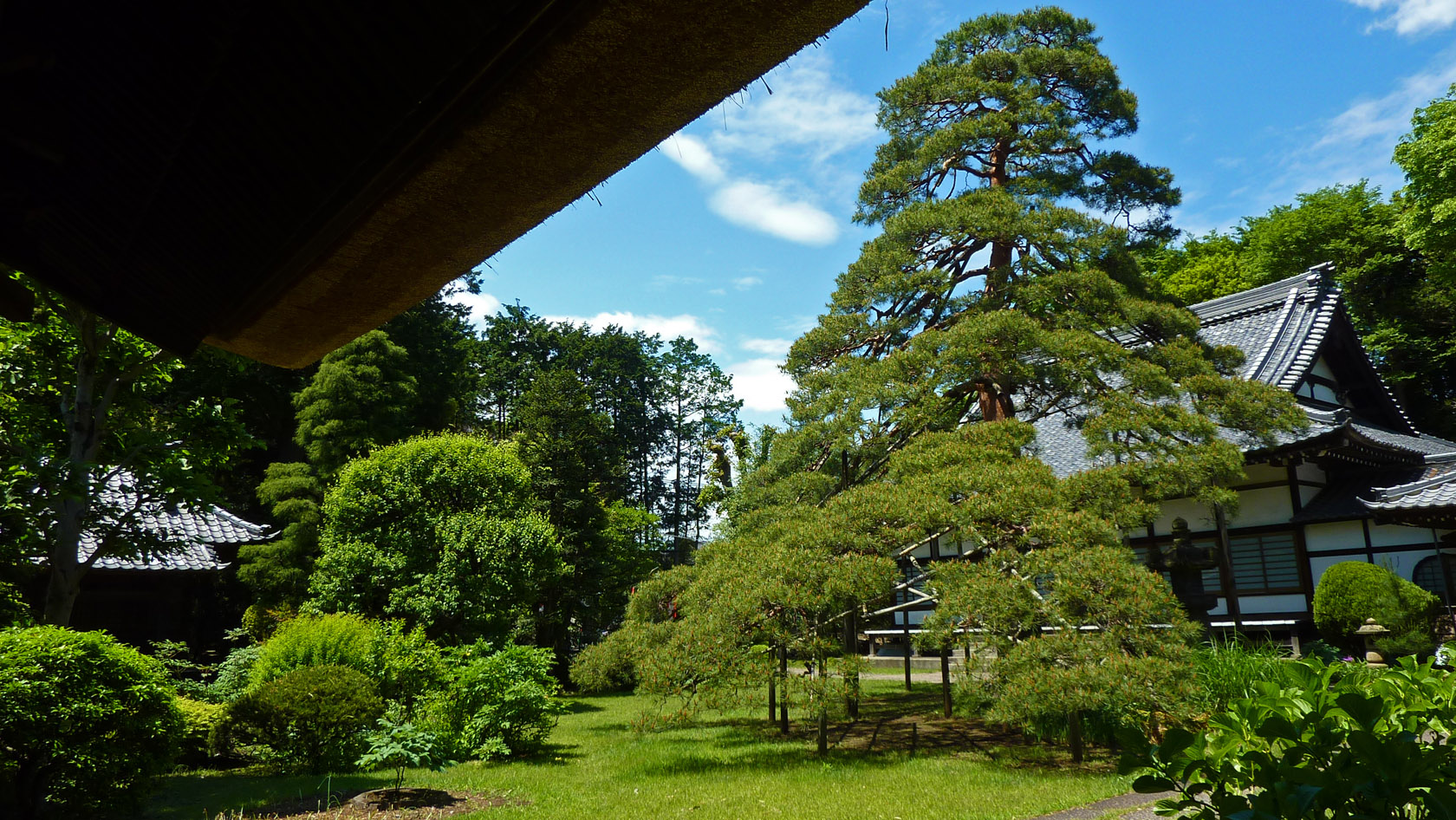
I’m a sucker for thatched roofs. While on water walk #8 I stumbled across this deserted temple. This view from under the old thatched-roof gate was breathtaking. I wandered the grounds for a long while without encountering another soul. Clearly the place was well maintained though. The loving care that went into this pine tree alone was remarkable. There was a lotus pond (photos coming someday). I lingered so long at Kaiganji that by the time I got to the Edo-Tokyo Open Air Architectural Museum in nearby Koganei Park I was starving. I opted to eat instead of go to the museum, something I now regret. Someday I will have to go back to make up for this blunder!

A cat is enjoying the shade of this temple porch in today’s photo.
Yakushido (the three larger characters on the sign, 薬師堂) literally means Hall of the Medicine Teacher. I believe this is in reference to the “Medicine Buddha” of Mahayana Buddhism.
This lovely building can be found in the complex of Gokokuji in Tokyo. Notice the paper stuck to the top of the posts on either side of the door. These are senjafuda (千社札) which I will deal with in more detail in a later entry.