TravelJapanBlog.com - Japan (07, 09-10, 13), Denmark (08, 11, 16-19, 21, 24), Korea (13), Poland (21), Mexico (14, 15, 19, 26), Iceland (17, 19), Hawaii (14, 17, 22), Czech Republic (16, 17, 19, 21)
The above will search Traveljapanblog.com.
Concerts - Landscapes - Sports


Posts tagged reviews

Generic 4GB mp3 player (iPod shuffle clone)
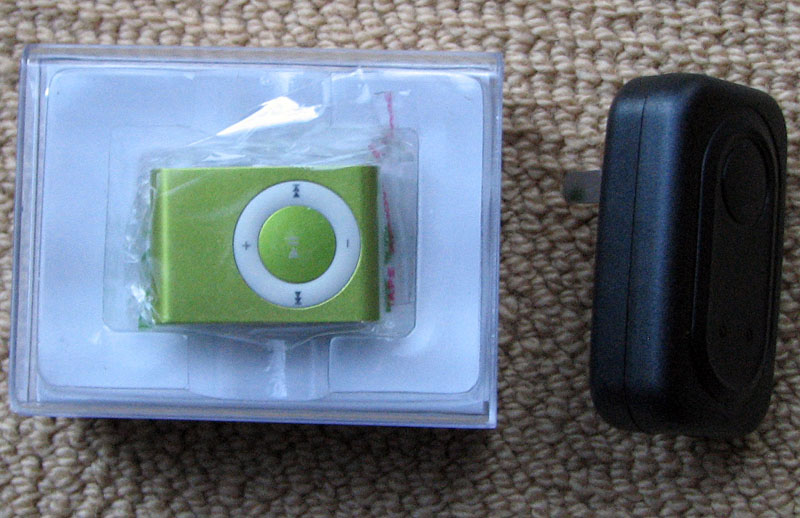
Let’s put this one in the “travel accessories” category.

Today my fourth mp3 player arrived in the mail. My first was an RCA Lyra RD1090A. It worked great, still does, but it is a bit bulky and requires an armband or a pocket. The on-board memory is meager at 256MB, but you can insert SD cards which is really nice. The problem is that the RCA unit has problems reading my cards larger than 2GB.

My second mp3 player was a 1GB Apple iPod shuffle. I loved the size of my first shuffle and the ease with which I could just clip it on. I could have lived with the shuffle forever were it not for the storage capacity issue–1GB is not nearly enough if you listen to lots of music. Apple recently came out with a 2GB version, but for $69 I passed. I would pay $69 for an 8GB iPod shuffle–not for a 2GB shuffle.

I sold my 1GB shuffle and purchased my third mp3 player, a 4GB generic shuffle on ebay for $36 a few months ago. My third mp3 player was horrible, defective even, so I returned it.

Today, the following package arrived:

I purchased it from mall.hk for a mere $17.47 which included free shipping. Here are the pros and cons:

Pros:
– Price!
– 4GB of storage (vs. iPod shuffle with a max capacity of only half or a fourth as much)
– Transfer speed (between 1.6 and 2MB per second–the last generic shuffle I had transferred files at 200-400k per second)
– Headphones actually work well (unlike the ones I received with my third mp3 player which were complete garbage)
– Wall charger included (iPod shuffle doesn’t even include a wall charger)

Cons:
– Although it looks like a shuffle, it doesn’t shuffle (randomize) the songs; songs are played in the order copied–I got around this somewhat by copying the songs randomly so I won’t have to hear the same artist’s songs back to back
– Shipping takes forever from mall.hk; the mp3 player pictured above took an entire month to arrive
– Picture on mall.hk is of a real iPod shuffle; as you can see from these photos the button layout on this knock-off version is different
– Unit is slightly thicker than a real iPod shuffle (not a big deal)
– When unit is turned on, first song is always played, followed by song #2, etc. This is a big pain in the ass I’m hoping the company can send me some software to fix.

I will comment on battery life once I’ve drained it a couple of times. Right now I’m somewhat happy with this purchase. Unfortunately, I’ve already filled up all 4 GB. It won’t be too long before I’m longing for an 8GB shuffle.

48 hours later update: I found a work around for the first song always being played on startup problem. I don’t turn the unit off. Instead I just hit pause. The battery doesn’t appear to be used when the pause is on and it starts right were it left off when I hit pause again hours or days later. The battery has not been used up so far. I’ve listened to probably 3 hours of music and had it on pause for another 24 hours+ so the battery life appears to be good.

With the workaround and at least decent battery, so far, I have to up my review from “somewhat happy” to “happy.”

Glimpses of Unfamiliar Japan


After the many quotes I’ve offered from Lafcadio Hearn’s classic I thought I’d wrap things up with a brief review of his two volume work, Glimpses of Unfamiliar Japan.

If you have never been to Japan, this book will probably be of little interest to you. The intended audience was foreigners who had never been to Japan (indeed very few had when it was written in the 19th Century). I don’t see how they could have grasped much of the contents though.

The parts I enjoyed the most were for places that I have visited or for places which brought back memories of other places I have lived in Japan. Oddly enough, most of the places Hearn describes are not places foreign tourists visit. Kyoto and Tokyo, for instance, are barely mentioned. Much of the book deals with areas east of Himeji (where I have never been, yet)–especially Matsue and areas near it. So, for that reason, it wasn’t as interesting as it could have been had he dwelt mostly on regions more familiar to me.

The parts I enjoyed the most were his impressions. For instance, the chapter entitled something like, “My First Day In Japan” is fun for those who haven’t been to Japan to read as well as for those who can reminisce. What wasn’t as interesting, for me, was his relating of Japanese tales, especially ghost stories, superstitions, etc. Some were entertaining, but most weren’t to me. Apparently he wrote numerous books on that subject after this book. I have no interest in reading them.

It takes an imagination to fully appreciate Hearn. I enjoyed imagining him in pre-car, pre-train Japan riding in a rickshaw and rowing around the country. He laments Japan’s rapid changes at the time. I wonder what he would think if he could see it now?

Kanken 2 for Nintendo DS (漢検DS2+常用漢字辞典)

My fourth DS game for learning Japanese arrived in the mail yesterday. Kanken DS 2 + Joyo Kanji Jiten (漢検DS2+常用漢字辞典) is the name of it. The thing that excited me the most about this DS title was the dictionary (jiten or 辞典). After messing around with it for an hour I have to say that the thing I am most disappointed with is the dictionary. However, everything else is much better than expected. I think this may even end up being a more useful tool than my previous favorite, Nazotte Oboeru Otona no Kanji Renshuu Kanzenhan.

Let’s take a brief look at some of the features with some screenshots I took.

The above screen is a practice test at level 9. There are 10 levels in Kanken 2 corresponding to the 10 levels of the Japanese Kanji Aptitude Test (Nihon Kanji Nōryoku Kentei Shiken, 日本漢字能力検定試験). Level 10 is the easiest level and level 1 is the most difficult.

The format looks fairly similar to the quizzes in Tadashii Kanji Kakitorikun Kanken Taisaku. However, Kanken 2 is far superior in my opinion. With the above on the top screen, the user writes らいしゅう, one hiragana character at a time, on the lower screen. After touching OK the next screen appears.

Now the user writes にちようび (日曜日) and so on. The quizzes are more interesting than those found in Tadashii Kanji… or Nazotte… as the content varies and is not the same format over and over again like those games. For instance, after filling in the hiragana for several kanji marked in red a different task is required as follows.

Now the user has to write the number of the stroke highlighted in red. What happens if you make a mistake?

In this case I wrote 10 instead of the correct answer of 9. One thing I really like about Kanken 2 is that instead of just taking me to the next task I am given the option of going to the dictionary for this character. If I click on the orange box I go to the dictionary.

The dictionary is usually three pages wide. Above I am showing you photographs of two of those three pages. As you can see the dictionary doesn’t offer much more than the Nazotte… dictionary. The dictionary has stroke order, on and kun readings, number of strokes, and radicals. That’s it. Nazotte… doesn’t have radicals, but it has all of the other items.

If a Kanken 3 ever comes out I hope Rocket Company (the software publisher) adds three things to the dictionary: example jukugo, a brief definition in Japanese, and two or three meanings in English. This would be very useful for both Japanese and gaijin users of the program.

Other than the addition of radicals, there are two other things about the dictionary that make it superior to those found in Tadashii Kanji… and Nazotte… The first I mentioned above in that you can leap to the dictionary whenever you miss something. The other is that you can look kanji up by sound. For instance, you can write kei (けい) and be taken to a screen with every kanji that has a kei reading. You can also click on any of the kei kanji to be taken to the dictionary screens for that particular kanji.

In summary, (although if there is interest I’ll post more screenshots and discussion of this title on this blog in the future) the games and quizzes in Kanken 2 appear to be much more enjoyable and varied than those in previously mentioned DS games teaching kanji that I’ve experienced. The character recognition is better than My Japanese Coach but not as good as Nazotte… However, Kanken 2 doesn’t give the false positives that Nazotte… sometimes does. Another complaint of Kanken 2 is the size of the characters on the screen. Nazotte… is much easier on the eyes. Still, my prediction is that I will be using Kanken 2 much more than Nazotte… in the future simply because it is more entertaining while accomplishing the same goal of kanji mastery.

Audition

audition dvd
I’m not sure how this movie made it into my Netflix queue. Perhaps I saw it in a list of “recommended Japanese movies” or maybe Netflix recommended it when I gave positive feedback on other Japanese movie titles. In any event, I had no idea what the movie would be like when I put it in my DVD player.

At first it seemed like a cutesie, chick flick with this perfect man and perfect son looking for the perfect female to enter their household to replace their long lost, and much beloved, okaasan who had died many years before when the teenager was just a small boy. I even called my wife in to watch as it seemed to be something more fitting to her tastes than mine. (She didn’t make it to the end.)

About halfway though the movie, or so, things suddenly took an abrupt turn to a darker and far more sinister undertone. My ten-year old daughter walked in the room just in time to see a sack lurch on the back of the screen. There may have been a strange sound emitted as well. I’m not sure. All I know is my daughter sprinted out of the room, and it was clear that this wasn’t just a chick flick.

Without giving too much away, I can say that you will have to be a fan of twisted movies to really enjoy the latter half of Audition. Takashi Miike borrows a page or two from David Lynch’s Lost Highway, one of my favorite movies. Movies like Audition and Lost Highway weigh on my mind for several days after viewing.

If you have seen Audition and want to understand it more, check out this. This movie isn’t really a horror movie, at least not in the classical or even modern sense of the word. It is different. It isn’t just for entertainment either. There are lots of uses for this movie. Here are a few that come to mind:

1) Use it on a bachelor when they decide to marry if you want to quickly convince them never to marry.
2) Use it on a child abuser to get them to mend their ways. Forget prison. This is way more effective.
3) Use it on someone who is into S&M for “fun.” They will no longer be into S&M for any reason. Period.
4) Use it on a person who sleeps too much. After this movie they will never want to sleep again.

Enjoy!

Akuma kun (悪魔くん)

akuma kun

When we were in Tokyo last spring our trip coincided with the Tokyo International Anime Fair on Odaiba at Tokyo Big Sight. We took the kids and had a great time. Unfortunately, my SD card in my camera crapped out on me and all of those pictures were lost. (As were all of my tsukiji pictures… arrggh…)

Amongst the tens of thousands of people at the anime show were a few foreigners, but my kids were the only foreign kids that I saw. With my daughter’s blond hair we really stuck out and got lots of attention. We even got to bypass the line to get in (which was, and I’m not exaggerating, over a mile long). Skipping the line had to do with the fact that we were a family rather than our foreignness or my daughter’s hair color.

At the fair a bunch of characters came up to us in costume for pictures. They weren’t familiar to me, but they looked great in a crazy way. They then pulled my kids into a baseball game of sorts that my son won by hitting the ball through someone’s legs. His prize consisted of some posters and gifts related to the anime or manga they were promoting. They’ve been hanging on his wall ever since. The title? ge ge ge no kitaro (ゲゲゲの鬼太郎)

Recently I became interested in the author of gegege, Shigeru Mizuki (水木 しげる), because of a biography on him in a magazine. I wanted to read some of his manga, which aren’t easy to come by in the states. However, through the university I’m affiliated with I can check out books located at virtually any college or university located in the northwestern portion of the U.S. The only one they had available with Mizuki San as the author was Akumakun Seikimatsu Taisen (悪魔くん世紀末大戦).

I read Akumakun Seikimatsu Taisen this past week and have mixed feelings about the content. The illustrations and characters are outstanding. However, the story is rather hit and miss. Occasionally it is brilliant, but at other times it seems like it was written by a 10 year old who ran out of ideas. For instance, at the end, using the magic flute to call one of the disciples (because he can’t stand the sound) is very clever. But then to use the same flute a few pages later to wipe out the numerous godzilla-like creatures who are coming out of the ocean to attack Tokyo lacks creativity. A few minutes of thought could have provided a more unusual and original way to take on those sea-dwelling monsters.

Anyway, it was mostly fun to read. I was even able to recognize, without a dictionary, some of the words that I learned by reading Harry Potter in Japanese that I never thought I would need to know again like tsue (杖) for magic wand or staff. This book lacks furigana so you’ll need to know a fair amount of kanji to read it without constantly referring to a dictionary.

Tokyo Story (東京物語)

Tokyo Story arrived from Netflix yesterday so I watched this classic last night. I don’t like to know anything about a movie before I watch it. I don’t want to know the story, the actors’ names, or even the kind of movie it is. I like it all to be a surprise. If someone recommends a movie to me and starts to comment on it I stop them right there. I then check imdb.com to see if it got at least 7 out of 10. If it passes the imdb test I add the DVD to my Netflix queue. If you are like me, read no more. Put this in your Netflix queue or pick up a copy through the link above.

I loved this movie. Others, looking for something more action packed, will certainly be disappointed. The movie is slow paced and gives the viewer plenty of time to take it all in and think. If you are a student of the Japanese language I think you will find this movie fairly easy to understand given its less-than hectic pace and dialogue. Other than the grandparents’ accents (which sound something like a cross between kyushuben and kansaiben–ending many sentences and phrases with a na) and the scene featuring the ramblings of drunk men at a bar, I had little problem understanding the movie in Japanese (although it came with English subtitles of course).

I enjoyed the subtleness of the interactions which cause the viewer to come to love the daughter-in-law and despise the other children as the characters become clearer through the movie’s progression. I found it a little unfortunate when the subtleties were broken with the exchange between the daughter-in-law and the youngest daughter. Basically, the daughter-in-law’s goodness is frankly contrasted, in words, with the wrongness of the other children for viewers not paying attention. I didn’t think this was necessary, and the scene would have been cut had I been the editor.

The final scene brought a tear to my eye. I wanted to jump into my TV to give grandpa a hug.

If you are interested in a look at Japan (especially, but not only, Tokyo) less than a decade after the war then this film is not to be missed.