TravelJapanBlog.com - Japan (07, 09-10, 13), Denmark (08, 11, 16-19, 21, 24), Korea (13), Poland (21), Mexico (14, 15, 19, 26), Iceland (17, 19), Hawaii (14, 17, 22), Czech Republic (16, 17, 19, 21)
The above will search Traveljapanblog.com.
Concerts - Landscapes - Sports


Posts tagged ukiyo-e

Kanazawa’s (金沢) Kenrokuen’s (兼六園) Karasaki (唐崎) Pine Tree (松)

kanazawa japan korokuen karasaki matsu pine tree

Japan has some amazing pine trees, and this is one of the better ones. The seed for this Karasaki Matsu (Pine Tree) is said to have come from the famous pine tree depicted in the ukiyo-e pictured below (Night Rain at Karasaki) by Hiroshige. The statue to the left is Yamato Takeru and is the oldest bronze statue in Japan, dating back to 1880.

hiroshige ukiyo-e

The meeting of the Fukagawa (深川) and the Sumidagawa (隅田川) – past and present

Thirty-six Views of Mount Fuji 富嶽三十六景 Fugaku Sanjurokkei ukiyo-e Japanese artist Katsushika Hokusai

While walking to my daughter’s soccer game in a shitamachi area of Tokyo called Fukagawa (deep river) I came across this marker of one of Hokusai’s famous scenes from his series “36 Views of Mt. Fuji.” The title of the ukiyo-e is “Under the 10,000 year bridge over Fukagawa.” The bridge is no longer there so I’m guessing its existence ended up being only a few hundred years at most.

Turning the corner a bit and looking down the Sumidagawa (a much larger and much deeper river than the Fukagawa–it’s the river in the background of the above which the Fukagawa is draining into) yielded the following modern view.

No chance of seeing Mount Fuji from here anymore with most of the buildings being over 10 stories high. Perhaps if you were on top of one of the buildings you may occasionally have a glimpse. The blue bridge in this image is the Kiyosu-bashi (清洲橋). You can still see fishermen (the guy in the bottom of the photo has three fishing poles in the water) though. Some things don’t change.

Japanese fisherman under Yunotaki (湯の滝)

japanese fisherman under waterfalls

I took today’s photograph on our trip to Nikko last month. I didn’t realize the base of a waterfall would be such a popular spot for fish, but he was catching (and releasing) fish after fish (or maybe the same one over and over again).

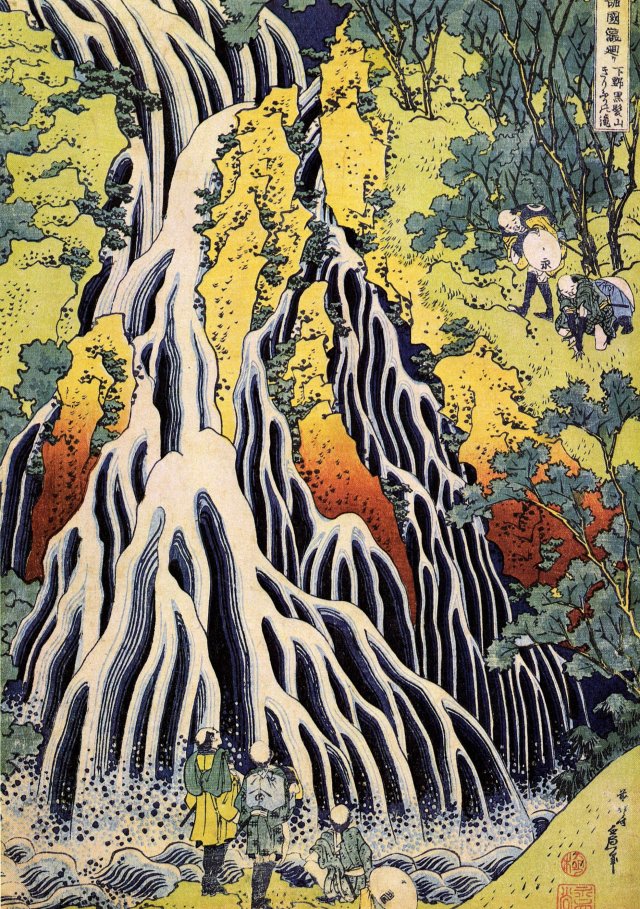
This waterfall reminded me a bit of Hokusai’s Kirifuri Waterfall.

Kanda River (神田川) – Then and Now

Kanda River 神田川 ukiyo-e

Things have changed since Hiroshige created the above scene (“Basho’s Hermitage and Camellia Hill on the Kanda Aqueduct at Sekiguchi, No. 40” (せき口上水端はせを庵椿やま) in “One Hundred Famous Views of Edo” (名所江戸百景)). I haven’t taken any photos of the Kanda River yet, as it is anything but beautiful these days. However, I will in spring when the cherry blossoms are out.

Basho’s hermitage (Bashodo or 芭蕉堂) is still here, but it isn’t easy to find (especially if you can’t read Japanese), and you have to go through a closed gate to enter the grounds.

This area along the river is still a great spot for a walk though. I take one or two here a week, and Linda takes one almost every day past Chinzanso. Our apartment would be in the distance on the left side of this ukiyo-e where the trees are, although at that time our apartment’s exact location was part of takadanobaba which Hiroshige also included in his “100 Famous Views of Edo.”

A few weeks back I witnessed a man throw a hefty bag of garbage into this water way. What a shame. From the looks of the current state of the water, he isn’t alone.

kanda river walking path tokyo japan

The above is the current path along the river, complete with elevated expressway on the other side and guard rail (the river is some 30 feet below).