TravelJapanBlog.com
TravelJapanBlog.com - Japan (2007, 2009-2010), Denmark and France (2008)
      
The above will search this blog.


Posts tagged fushimi inari

Shinto Pigeons

Fushimi Inari Taisha (伏見稲荷大社), The End

After five posts on the topic I will lay Fushimi Inari to rest and move on to something else tomorrow.

bamboo Fushimi Inari Taisha 伏見稲荷大社

In the above photo you get a glimpse of the bamboo groves. I don’t think they have shown up in any of my pictures so far, but there is lots of bamboo at Fushimi Inari. Although not quite as impressive as the bamboo around Arashiyama and Sagano (which I will show you at some future time), there is something magical about being surrounded by bamboo. I once lived in an apartment in Japan surrounded by bamboo groves, but that’s a story for another day too.

fudoThe banners say 腰神不動明王. 不動 (fudo) is the unmovable Buddhist god and 明王 (meio) means great king. 不動明王 means that this deity is the head of the great kings. He is pretty fearsome looking and usually is well armed. Needless to say, he is a good god to have on your side for protection. Don’t piss him off though.

The 神 character on the banner means god (kami) so there isn’t much mystery there. 腰 is a bit of a puzzle however. 腰 means waist or hips. Given that some of the other characters on the banner mean protection of the lower body, I’m guessing that this is some sort of offering place for those with bad hips and legs?

As you can see, you can get help for just about anything at Fushimi Inari. It’s your one-stop offering center for just about any wishes you need to have fulfilled.

fox statue kitsune Fushimi Inari Taisha 伏見稲荷大社

Along with tons of torii, there are tons of kitsune here. I’ve shown you only a few. The foxes usually have a red bib on. The red bibs are to ward off evil. Why bibs? You’ll see them on all kinds of statues in Japan, not just foxes. The bibs are related to children, particularly in keeping evil, disease, etc. from infants and small kids.

In the background you can also see some frog statues with the red bibs on. This place really covers all the bases.

The foxes usually have something in their mouths. As the symbol of the harvest (grains, rice, cereals, etc.), that something is frequently a key to the grain storehouse.

shinto prayer Fushimi Inari Taisha 伏見稲荷大社

In the above picture my daughter is getting into the Shinto way of things. I asked her what she wished for, and she said, “to come back to Japan.” It looks like that is going to happen so this Shinto stuff seems to work!

You can see some more shimenawa in this shot.

tanuki Fushimi Inari Taisha 伏見稲荷大社

My son immediately became a fan of tanuki (Japanese racoon dog) and now has one sitting on his shelf back home in Oregon. You can find a wide variety of lucky charms at Fushimi Inari. In this picture alone you can see tanuki, maneki neko (beckoning cat with raised paw), kaeru (frog), fukuro (owl), and daruma (達磨, dharma doll).

Fushimi Inari Taisha is about the only major shrine in the Kyoto area that is completely free. Directions are very simple as it is right next to the train station with the same name. Here is a map.

Fushimi Inari Taisha (伏見稲荷大社), Part IV of V

I finished sorting through my Fushimi Inari pictures and, although difficult to do so, cut the remaining pictures I will share with you down to seven. You’ll get three today and the last four tomorrow. (Remember that these pictures look far better if you click on them. Also, if you have a monitor with screen resolution settings of something higher than 1024 x 768 and your browser maximized you’ll have better results.)

restaurant Fushimi Inari Taisha 伏見稲荷大社

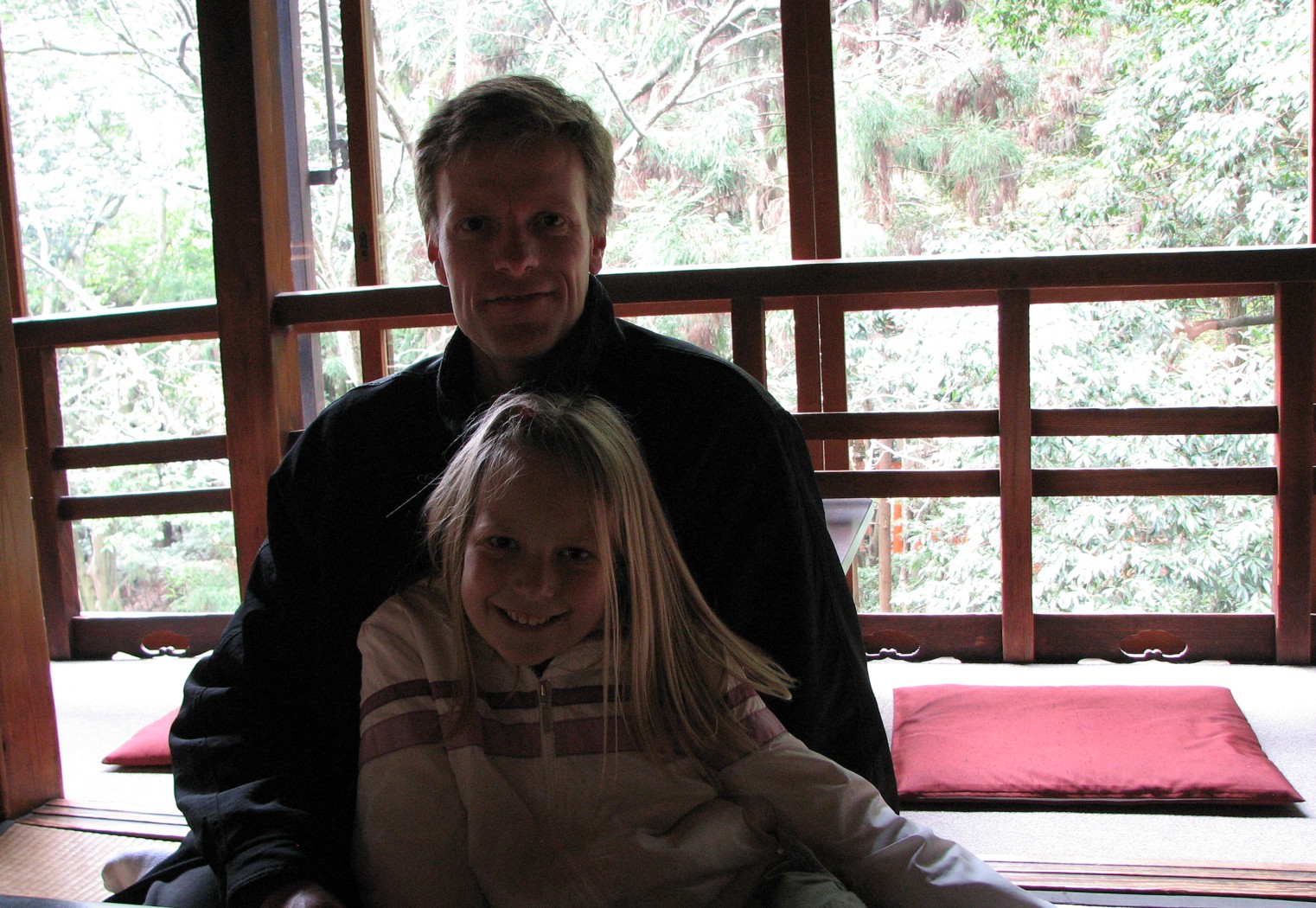
After walking (generally upwards) through a few hundred yards worth of torii we came upon an empty restaurant. We hadn’t eaten breakfast yet so this was perfect. The setting for the eating place was spectacular. We could look out over the groves of trees, bamboo, and torii gates while eating in this peaceful setting. We were perched slightly above everything so the views were wonderful.

In the above photograph you can see the tokonoma (床の間 or decorative alcove usually featuring a scroll) with ikebana (生け花 or flower arrangement) and also some reserved tables (予約席). The floor is made of tatami (畳) mats.

eating at Fushimi Inari Taisha 伏見稲荷大社

inarizushiThe lighting in the above picture is not so good, but you can sort of see how marvelous the views are from this restaurant.

What does one eat at the main Inari shrine dedicated to kitsune? We ordered inarizushi and kitsune udon of course.

kitsune udonThe food was good and my daughter (pictured above with me) now considers inarizushi to be her favorite food. I enjoyed talking in Japanese with the old lady from across the road. It was from her house that the food came. I said this was a restaurant, but it wasn’t in the typical sense as no food preparations went on there. All of the food was cooked and brought over from the house across the dirt path. This place was simply for eating.

Japanese Lantern Fushimi Inari Taisha 伏見稲荷大社

After eating we headed down the path instead of farther up. We didn’t actually make it to the main shrine at the top of the hill, but that just means we have to go back someday to explore in more detail. ;) We were departing the country in a few hours so we didn’t have time to take all of the paths.

The way down was a different path than the way up and featured many shrines (even a Buddhist one or two). The Shinto one pictured above has a plaque that says 玉姫大社 (jewel princess big shrine or tamahimetaisha). 玉姫 has to do with wedding places so I’m guessing this shrine has something to do with weddings; perhaps offerings are left here to wish for a successful marriage. Tamahime Taisha featured the first of the many Japanese lanterns we were about to see along this exit path.

Fushimi Inari Taisha (伏見稲荷大社), Part III

I have more noteworthy photos from Fushimi Inari than I originally thought. I don’t think this will be my last blog entry on the subject either. I hope you are enjoying the pictures. This shrine is my favorite so I got a little picture happy.

Fushimi Inari Taisha 伏見稲荷大社 torii 鳥居

This first one shows a torii with a plaque. The plaque says 稲荷大社 (Inari Taisha). Notice the rope around the sacred object under and behind the gate. This rope is called shimenawa (注連縄). You’ll find it around Shinto gods (kami) like rocks and trees. I’m pretty sure you can spot some in Hayao Miyazaki’s famous anime movies like My Neighbor Totoro (となりのトトロ). Sometimes you’ll see it on torii (like in the picture two down). When in the manner below it is to ward off evil spirits or indicate that you are entering sacred space.

Fushimi Inari Taisha 伏見稲荷大社 鳥居 torii sakura

Did I mention that you’ll see a lot of torii here? ;) Not all of the torii are for walking through. Similar to ema, people purchase these mini torii and then leave them as offerings to bring good fortune at the Shrine. I noticed that people put the date on the left side and their names on the right side of these torii. This is the opposite of what you see on the large torii you walk through. I don’t know the meaning or significance of this. It may just be a matter of the first person getting things backwards and then everyone else playing “follow the leader.”

The contrast of the bright torii, dull gray rocks and stones, white cherry blossoms, and vivid greens made every view breathtaking. I believe there was a large pond just beyond this scene. The intermingling of nature with this Shinto shrine is spectacular. As you can see from these last two pictures, the manmade artifacts are set beautifully in the groves.

Fushimi Inari Taisha 伏見稲荷大社 鳥居 Shimenawa gohei

As I suspected in my prior entry, the missing character was probably a 納. 奉納 (read right to left in Japanese on the torii) means “offering.”

Here we see more shimenawa. We also see some gohei (御幣, also called shide), the white paper hanging on the shimenawa.

More Fushimi Inari Taisha (伏見稲荷大社)

In our last Fushimi Inari episode the topic of ema came up. In addition to ema you can also find mikuji, otherwise known as omikuji, 御神籤, or おみくじ, at most Shinto shrines in Japan.

Fushimi Inari Taisha 伏見稲荷大社 mikuji sakura

These work differently than ema, although to a photographer or appreciator of Japan’s shrines they serve the same basic function of cool window dressing on the other beauties and wonders around every turn. Omikuji are purchased, like ema, but they are not written on. Instead, they already have writing on them. The writing is a fortune–sometimes good, sometimes bad. If you purchase one and it has a 吉 character then you have a good one. The character before the 吉 indicates how good your fortune or blessing is. If yours has a 凶 on it, then you have a curse. Ouch! The way to possibly avoid your curse is to tie it at the above location at the shrine. All those curses make for a work of art.

As you can also see from the above photo, the grounds are meticulously kept and cherry blossom season (sakura) makes things even prettier.

Fushimi Inari Taisha 伏見稲荷大社 torii gates

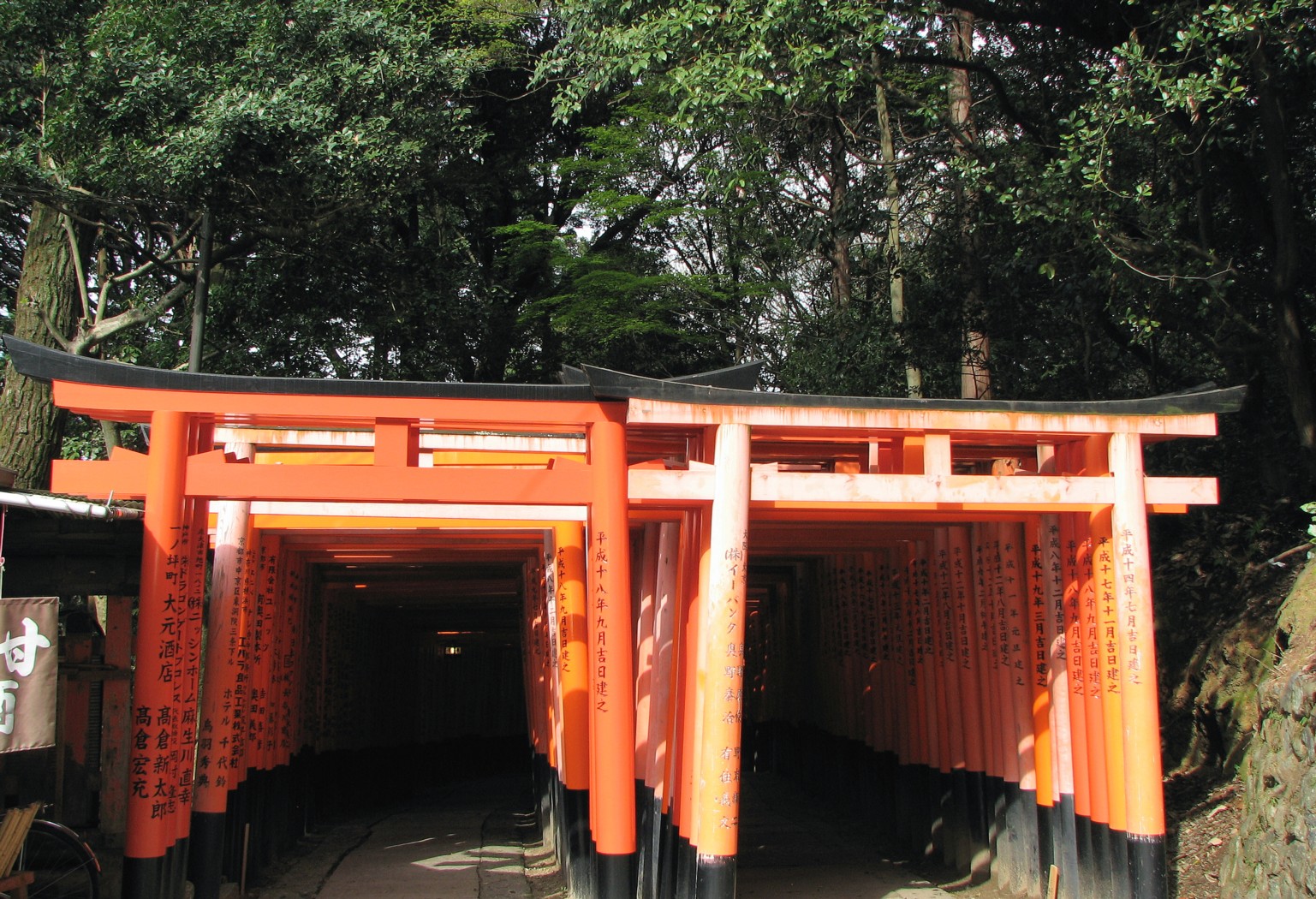
Fushimi Inari is the head Inari shrine. Other Inari shrines are all over Japan and feature Torii Gates, but Fushimi has the most. I don’t know the exact number, but it must be in the thousands. It’s a wonder to behold, especially if the paths beneath the gates are empty of tourists like they were when we were there. Again, get there before 10 a.m. for best results. Better yet, wear running clothes, get there by 8 or so and run through them all.

Fushimi Inari Taisha 伏見稲荷大社 torii paths kyoto

The writing on one side of the gates indicates what person, or more commonly, company, purchased the torii. On the same side, but other post, of the torii is the date it was purchased (or perhaps installed).

Prior to actually visiting Fushimi Inari, I was picturing one path of a few dozen gates. I was surprised when I got there to find seemingly countless paths of torii, some running parallel, or at least starting parallel, to each other. It’s a maze like no other.

Fushimi Inari Taisha (伏見稲荷大社)

If you are like me, you like blogs you are interested in to be updated daily or at least several times a week. Nothing is worse than those blogs of promise that only have new content once every few months. I get tired of waiting and stop visiting. To that end, I will blog “old” information at times–especially times like now when I’m not on the road.

So let’s flash back to our trip to Japan from last year. On our last morning in Kyoto we went to the famous Fushimi Inari Taisha which is one of my favorite places in the world. Like many temples and shrines in Japan, it is particularly nice in the early morning hours or at dusk. If you have seen the movie Memoirs of a Geisha then you have seen this place. It is famous for its Torii (鳥居) gates, of which it has a ton–seemingly as many as the rest of Japan combined. However, I’ll save the Torii pictures for another entry.

For this entry, let’s focus on a couple of other curiosities about the place. Inari (稲荷) is the Japanese god of foxes (kitsune, きつね, or 狐) among other things. Hence, you can find lots of foxes at this shrine. The one pictured here is near the entrance. (As always, maximize your window and click on any of this blog’s photos for a much better view.)

One of the beautiful things at Shinto shrines is the prayer card walls. The prayer or wish plaques are called ema (絵馬). I’m not sure if “plaque” is the proper term. I suppose they could just as easily be called cards, boards, or tablets. They are made out of wood. Ema means “picture horse” but these days they can have any or no pictures on them. I’ve seen some with popular manga pictures printed on the wood. They are frequently placed in such a way that you can get this kind of wonderful photo of them all lined up with a shrine in the background. This one not only had the wooden plaques lined up nicely but also had colorful origami cranes below.

Fushimi Inari Taisha actually contains multiple shrines. This next one has a specific purpose. The readable kanji in the lower right are 入学奉. I’m guessing that there is a fourth character that didn’t make it into the picture and that kanji is probably 納. 入学奉納 means “an offering to get into school.” Students come here (and you can see one in the above picture) to wish for acceptance into the high school or university that they are trying to enter. It’s easier and takes less time than studying. ;)

You can see the wish cards to the right and left of the center. A student would pull the white cord to ring the bell and summon the gods, clap their hands together twice, bow, make an offering of money, and then, perhaps, write their prayer on an ema to hang on the aforementioned wall.

Based on what I’ve read and conversations I’ve had, most Japanese don’t actually believe that the gods will get them into school. They do this more out of tradition and because it’s kind of fun. Although I’m no fan of superstition, I find these shrines and ema walls to be incredibly beautiful. The sights, sounds (of the bells, gongs, and hands doing quick claps), and smells (incense) really do make me feel something.