TravelJapanBlog.com - Japan (07, 09-10, 13), Denmark (08, 11, 16-19, 21, 24), Korea (13), Poland (21), Mexico (14, 15, 19, 26), Iceland (17, 19), Hawaii (14, 17, 22), Czech Republic (16, 17, 19, 21)
The above will search Traveljapanblog.com.
Concerts - Landscapes - Sports


Archive for Japan

Bobby Valentine

bobby valentine flags lotte chiba marines tokyo japan

The Chiba Lotte Marines‘ fans love Bobby Valentine. If you look at the Marines’ record with Valentine at the helm it isn’t very impressive. This year they finished out of playoff contention with a record of just 62 wins and 77 losses. They have won their league (of six teams) just once in Valentine’s six years.

bobby valentine 2010 lotte marines t-shirts

Valentine is done with managing the Marines despite the fans efforts (including signing petitions) to keep him around. Look for Bobby to be in front of a camera next year or maybe managing in the Majors. If the Marines improve next year (and it seems like they have nowhere to go but up) the fans will likely forget him soon.

bobby valentine signs lotte chiba marines game fans

But he is getting a nice send off, despite his mediocrity.

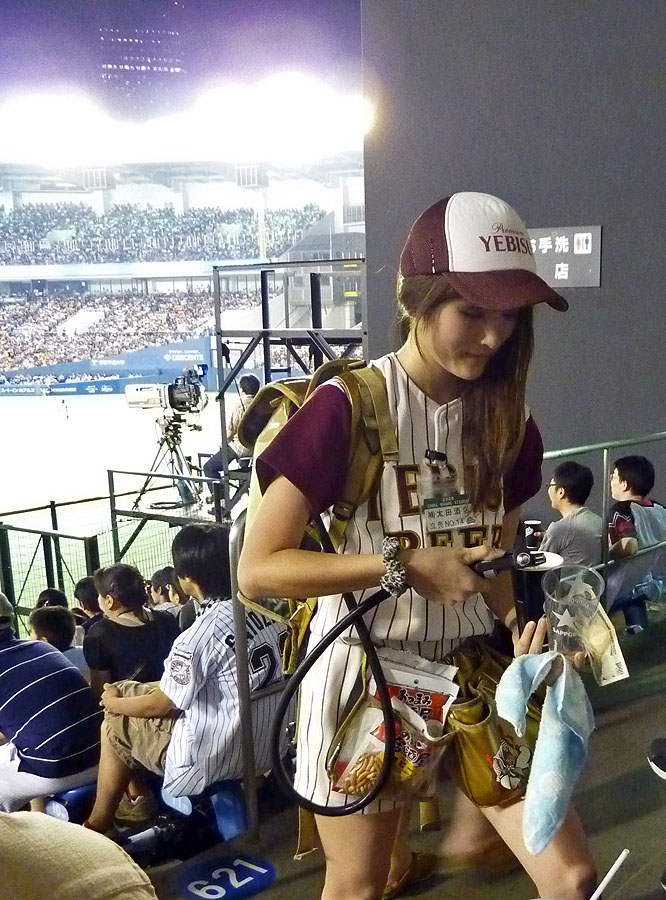
Beer girls – Part 1

beer girl chiba lotte marines japan baseball

As promised, today I have some photos of beer girls for you. These girls trot around the stadium with a smile on their face and a keg of beer on their back.

ebisu premium beer girl japanese baseball

I have been to three different stadiums now and the beer girl situation is very different at each. At the Lions’ games there are almost as many selling whiskey as selling beer. Whiskey was not available from the mobile vendors at the Marines’ or Swallows’ games.

japanese beer girl baseball game

Kamakura – Part 2

“Kamakura.


A long, straggling country village, between low wooded hills, with a canal passing through it. Old Japanese cottages, dingy, neutral-tinted, with roofs of thatch, very steeply sloping, above their wooden walls and paper shoji. Green patches on all the roof-slopes, some sort of grass; and on the very summits, on the ridges, luxurious growths of yane-shobu, the roof-plant, bearing pretty purple flowers. In the lukewarm air a mingling of Japanese odors, smells of sake, smells of seaweed soup, smells of daikon, the strong native radish; and dominating all, a sweet, thick, heavy scent of incense, — incense from the shrines of gods.


Akira has hired two jinrikisha for our pilgrimage; a speckless azure sky arches the world; and the land lies glorified in a joy of sunshine.”


(Lafcadio Hearn, 1894, Glimpses of Unfamiliar Japan)

kamakura jinrikisha

Even though it has been almost a year since I read Hearn’s observations on Japan, and I only read his book once, passages flooded back into my memory as I wandered around Kamakura. I was reminded of the “jinrikisha” Hearn mentioned in the above quote when I saw this one parked outside this more traditional Japanese home. While Hearn was pulled around Kamakura and over to Enoshima via a jinrikisha in an age before automobiles, the Hybrid Prius in the above photo provides quite a contrast in transportation.

Kamakura’s one big downside (I suppose there are two–the other being the number of tourists. Go on a weekday that isn’t a holiday, like I did, and you can avoid most of the tourists.) is that the government should have passed some housing regulations twenty years ago (better yet 50 years ago). All new or reconstructed buildings should be required to be built in a more historical style. On some streets you can’t tell whether you are in Kamakura, Monterey (California), or Park City (Utah). There are boutiques and other souvenir shops catering to the tourists that do nothing to add to the charm of the city. The new buildings aren’t even remotely Japanese in nature and frequently have more writing and signage in English than Japanese. It’s a shame really.

Should you ever visit Kamakura enter within the temple and shrine boundaries as quickly as possible to avoid all of the nonsense that has sprung up around them.

Sumo – Part 3

yamamotoyama flag ryogoku tokyo japan

The flag to the left is for 山本山 (Yamamotoyama) the largest Japanese sumo wrestler ever. Many sumo wrestlers have mountain (yama) in their name, but Yamamotoyama has it in his name twice–he’s that big. His other name is 龍太 (dragon fat), very fitting. Weighing in at almost 600 lbs. he is hard to miss.

山本山 龍太 yamamotoyama sumo wrestler japan

Entering the day I saw him he had four wins and just one loss. But on this day he was a pushover for his much smaller opponent.

yamamotoyama 山本山 龍太 sumo wrestler largest japan

During the September 2009 tournament he was easily defeated every time I saw him (once in person and three times on TV). Maybe I’m just bad luck or something as he ended the tournament with a decent record of 9-6. On the days I witnessed his bouts he seemed to need much more strength to eventually be able to contend with the best.

chiyonofuji sumo wrestler japan 千代の富士

Speaking of strength and the best… perhaps the greatest sumo rikishi ever was Chiyonofuji. I saw him win in person back in 1988 and followed him until his retirement a few years later. He was incredible. Even though he was smaller than nearly all of his opponents he seemed several times more powerful than them all.

He is now doing commentary for NHK during their live coverage of the tournaments. It seems wrong somehow to hear Chiyonofuji talk about his secrets, strategies, and successes. To me, it seems like he should be above sumo at this point, living in a castle somewhere like the emperor. I suppose it would be like hearing Babe Ruth do color commentary for Fox Sports, just not right. Legends, somehow, shouldn’t appear before the public.

Kamakura – Part 1

giant buddha kamakura daibutsu

I recently visited Kamakura for the second time in my life and first time in over 21 years. The Daibutsu (大仏) hadn’t changed, unlike Shinjuku, but it was great to be in its presence again. Photographs can’t impress the feeling that comes from actually standing at the base of this giant.

kamakura japan daibutsu history sign giant buddah

Mt. Fuji Sunset from Enoshima

mt. fuji san japan sunset enoshima

I visited Enoshima (江ノ島) for the first time during my second trip to Kamakura. I arrived at about 4 p.m. to see the sights and take in the sunset. Strangely, as the weather was perfect and the skies were clear, nearly everyone was leaving the island. After walking up hundreds of stairs I reached the top and began my descent to the back side of the island. Although there was space (and restaurants with stunning views) for thousands of tourists only a few of us were there; half were fishing.

How a place (稚児ヶ淵, chigogabuchi) with such an incredible sunset could be so deserted on a warm, Friday evening in September with a population of 15+ million living less than an hour away baffled me. I didn’t complain though. The experience, like many sunsets, seemed surreal. Many of the restaurants mentioned above sat completely empty or were closed. Either this place is something of a secret or the numbers change dramatically on the weekend.

The giant hawks at this place (photos coming here soon) were a welcome change from the typical sea gulls at places like this around the world.