TravelJapanBlog.com - Japan (07, 09-10, 13), Denmark (08, 11, 16-19, 21, 24), Korea (13), Poland (21), Mexico (14, 15, 19, 26), Iceland (17, 19), Hawaii (14, 17, 22), Czech Republic (16, 17, 19, 21)
The above will search Traveljapanblog.com.
Concerts - Landscapes - Sports


Archive for Japan

Tenso Jinja Matsuri – Part 3

japanese friends at matsuri tenso jinja tokyo japan

If nothing else, this festival got our faces known in the neighborhood. Most Japanese are hesitant to say anything to a foreigner, in part because they don’t know if the person can speak Japanese. However, once that initial wall comes down they are the friendliest people on the planet. We made lots of friends during the day’s events.

The people in the above picture are serious festival lovers. They weren’t local. Rather, they travel around and participate in whatever weekend festival is currently taking place. We chatted for a long time and swapped numbers. I assumed that would be the last we’d hear from them, but they have already called to invite us to other matsuri.

They carried the mikoshi nearly all day and were in on the final demonstration which looked like a mosh pit. This picture was after they had freshened up about a half hour after the mikoshi had been placed. If you think they look spent and sweaty here, you should have seen them 30 minutes before!

My shoulder was seriously bruised for days and my quads were killing me the next day, yet I only carried it for about ten minutes. I can’t imagine what hours under it would have been like, let alone wanting to go at it again every weekend.

tenso jinja mikoshi wagasa

Here is a close up photo of the mikoshi (with wagasa) during one of the brief rests.

food and drink party after the mikoshi matsuri nishiwaseda

After all was said and done we went to return the Happi Coats we had borrowed on the prior day. Our neighbors insisted we join them for food and drink on the street corner. They stuffed us really good with gyoza, pizza (with toppings of squid and shrimp), and yakitori. Every time I took a sip of my drink it was immediately refilled by one of the many people sitting nearby.

Sorry about the quality on the above picture. It was taken after most people had left and the rest of us were parting. It doesn’t quite capture the mood and scene from 20 minutes before, but my son and I were pinned in and couldn’t take a photo any earlier. I enjoyed the dialogue with my neighbors. Now they know who the local foreigners are, that we’ll be here for a year, and that we can actually converse with them.

The above video is of the approach and entrance of the mikoshi back to its home after spending the prior seven hours going around town on the shoulders of its carriers. There was a men’s chorus, who you will hear and see at the beginning of the video, leading the mikoshi back through the torii gate. Hang in there until 1:40 in the video where things will pick up. The mikoshi will now rest away, out of view, for the next three years before its next journey.

Sumo – Part 2

sumo square off tokyo ryogoku japan rikishi

These two makuuchi (top division of 42) wrestlers (Toyonoshima (豊ノ島) on the left and Takamisakari (高見盛)) are an instant away from smashing into each other. The referee stands between them with his gunbai. You can also see one of the five shinpan (judges) to the left of the referee in this picture. Don’t miss the expressions on the faces in the crowd either.

sumo pillow seat cushion

One thing I hadn’t noticed when I first witnessed sumo in person 21 years ago, nor have I seen on the NHK broadcasts of sumo, is that the higher ranking sumo wrestlers each have their own special cushion to sit on while waiting for their bout. Most are brightly colored and feature the sumo’s theme. For instance, the wrestler with this orange pillow (武州山 隆士, Bushuyama) may also wear an orange kimono into the stadium (pictures of the top sumo wrestlers entering the stadium forthcoming) and may also have an orange, embroidered apron (keshomawashi) to wear during the ring-entering ceremony before his matches.

It seemed a bit silly to see the colorful seat cushions trotted in and out on a continual basis.

advertising at sumo match ryogoku tokyo japan mcdonalds makudonarudo

The advertising between matches was also somewhat ridiculous. You sort of miss it on TV as NHK usually switches to commentators or have writing over the ads featuring the upcoming wrestlers’ names and records. You can’t miss it in person though. The ad for Ozeki Sake before the ozeki matches seemed somewhat clever and brought a smile to my face, but ads for McDonalds and one for a place to have your pet cared for are very much out of place. The ads are walked around the ring, sometimes after the wrestlers are already in the ring, and can actually prevent the sumo guys from getting into the ring or back to their corner.

I understand the sponsored bouts feature more prize money due to the advertising; the money is presented to the winning wrestler in an envelope on the gunbai immediately after victory. I’ll show you a photo of that performance in a future blog entry.

Sumo – Part 1

sumo rikishi throws salt into ring september tokyo japan ryogoku 将司 昂親 masatsukasa koshin

After a break of “just” 21 years I finally had the chance to see sumo in person again earlier this month. I was extremely excited, especially after watching it on NHK the prior evenings. I went on the sixth day of the fifteen-day tournament, arriving at 8 a.m. to be sure I could get a ticket. As it turned out, I probably didn’t need to arrive so early as there were many empty seats. Should you ever attend, do get there at 8 (or earlier) to purchase the cheap (2,100 yen) tickets on a weekend or you may not get in. I went on a Friday, early in the tournament, so those may be the main reasons it wasn’t crowded.

The above sumo wrestler (力士 or rikishi) is 将司昂親 (Masatsukasa Koshin). He was 5-0 going into day six. His spectacular salt toss (most 力士 don’t throw nearly as much) was supposed to purify the ring. On this evening it did not work well for him, and he fell to 5-1.

flags in front of ryogoku tokyo japan Asashoryu's flag

The day started out as a beautiful, mostly blue-sky day. The banners/flags of the sumo stars out front looked wonderful, and until about 8:30 a.m. a drummer (who was more than a bit off beat) worked the drum up in this tower. I was enchanted and ready for action. Unfortunately, it wasn’t easy to continue this high for 10 straight hours until the top wrestlers performed.

The flag on the far left is that of 白鵬翔 (Hakuho Sho), the most recent tournament winner. He is Mongolian and one of only two current 横綱 (Yokozuna, the top rank in sumo). On this night Hakuho lost his first bout of the current tournament to a guy who had zero wins and five losses in the first five days. It was shocking to say the least. Spectators picked up their seat cushions and hurled them in Hakuho’s direction, an incredible sight.

ryogoku early in the day tokyo japan sumo ring

I was alone, or I could have had pictures taken with many of the sumo dudes, but I did take this one, self portrait four hours into the day.

Gokoku-ji 護国寺

Gokoku-ji 護国寺 stairs gate sunset tokyo japan

tokyo japan buddhism Gokokuji 護国寺 buddah

While riding a bus for the first time one day in an unknown area I passed the 護国寺 bus stop. The place looked huge and my bus stop wasn’t very far beyond the 護国寺 stop. So after I finished my business I walked back to this Buddhist temple. A funeral was underway. The person must have been very important as there was an unbelievable number of people in attendance. A line of more than a hundred people were waiting to get in while the inside already looked full of hundreds of people to me. Rather than have one or two places for people to check in, there looked to be more than a dozen.

Of course I didn’t take any pictures of the funeral or the people lining up, but the size of the event meant that many of the typical photos of this place wouldn’t work either as the grounds were covered in automobiles. The cemetery went on forever so I took quite a few pictures while strolling through it as the sun went down. It was one of those magical moments that can only happen when you are by yourself (which isn’t often in public in Tokyo). Other than myself there were only crows–lots of big black ones.

Not having done my homework beforehand, I had no idea how famous this place is, that it is Japan’s Imperial Mausoleum, that Emperor Meiji’s remains are here (I figured they were at Meiji Jingu), and that Gokokuji is the head temple for the Japanese tea ceremony.

I didn’t realize until I did research after taking these photos, but the third and last picture in this entry (with the crow on the torii) is of Okuma Shigenobu’s grave. Okuma Shigenobu was the founder of Waseda University and was a former, two-time Prime Minister of Japan. I actually gave a speech in the Okuma Auditorium, named in his honor, last week. Others who have given speeches in that exact same spot include Bill Gates, Albert Einstein, Bill Clinton, and Nelson Mandela. Maybe someday they will be as famous as I. 😉

Gokokuji is about a 30 minute walk from the Ikebukuro Station, or you can catch a bus in the Nishi Waseda area that will take you right there. There is also a Gokokuji Station on the Tokyo Metro.

Gokoku-ji 護国寺 japanese cemetery torii crow tokyo japan

Near the top of the Mori Tower

tokyo tower view from mori tower japan

The guidebook in our apartment (copyright pre-2003) said there is no point in going to Roppongi unless you are going at night. Well, we had no plans one Sunday morning so we went anyway. It turns out things have changed since the Mori Tower was built in Roppongi Hills (六本木ヒルズ森タワー) and now there is plenty to do any time of the day or night.

My son went to a movie in Mori Tower with his friends, my wife went shopping in and around Mori Tower, and my daughter and I went up the Mori Tower to the top. It isn’t free to get to the top. On this day it was 2,000 yen for adults and 700 yen for kids, but there are several things to see at the top. The “Tokyo City View” offers a very nice 360 degree view of the city. Unlike the free views in Shinjuku, there are no other skyscrapers in the area to block your view. You’re also close enough to the Tokyo Tower to get a really good angle on it.

Sky acquarium mori tower roppongi hills tokyo japan

Currently there is a Sky Aquarium at the top included in admission. The various fish and their tanks would have seemed quite cheap with the music turned off and the houselights on, but in this environment they were very Japanese–mysterious and somewhat magical.

mori tower bar 52nd floor roppongi hills tokyo japan

One of the nice things about the views from the top is that you aren’t just pressed up against glass like you usually are from typical observation points. Instead, you can get a drink, sit, relax, and enjoy the view. Besides the bar setting, there are somewhat private bench sitting/viewing places, rooms with built in seats around the edge, and a variety of other options as well.

I’ll show you some more pictures from the top as well as some of the museum, which is also included in admission, on a later date.

Atsugi Naval Air Facility

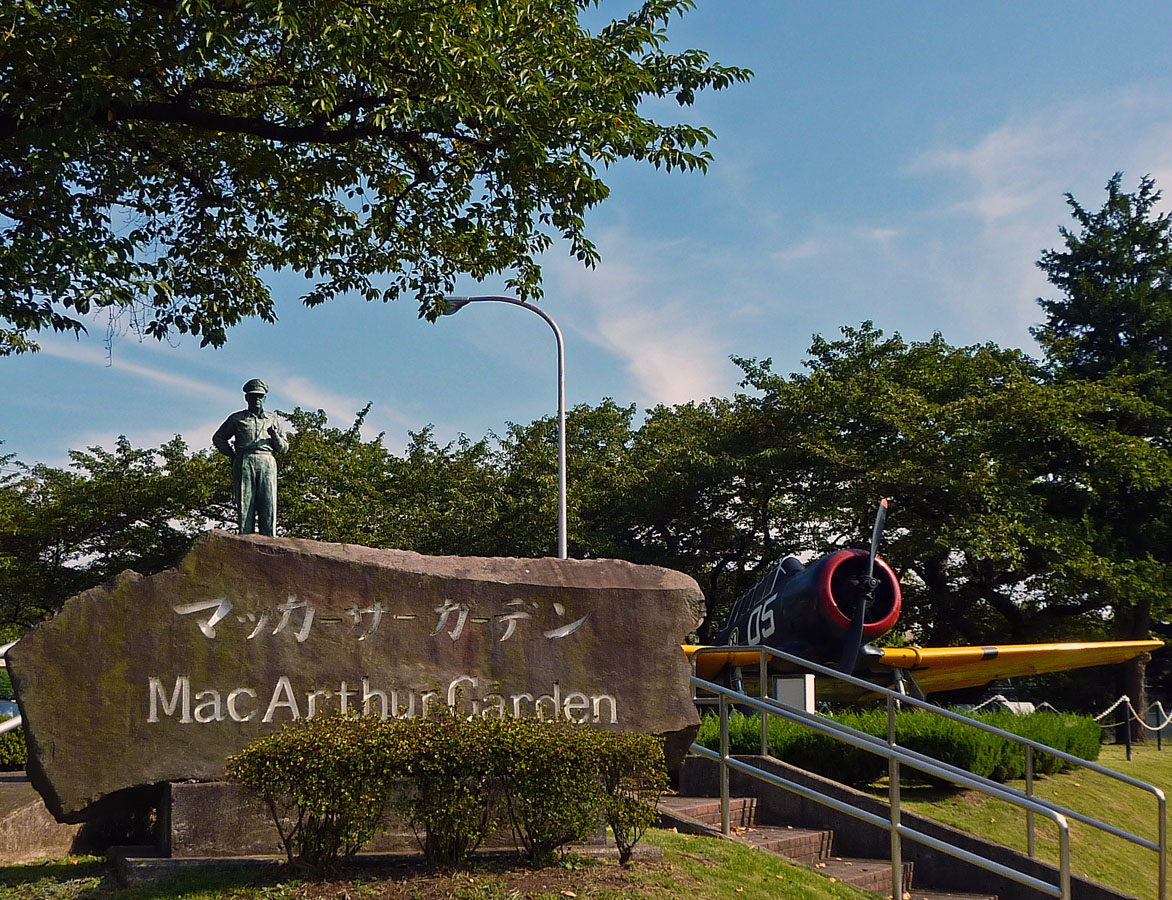
douglas macarthur garden atsugi japan

As previously mentioned I ride the Odakyu Line a couple times a week down to the Atsugi area to teach a course for the University of Maryland University College Asia on a military base. The Atsugi Naval Air Facility (厚木海軍飛行場) has an interesting history. The first time Douglas MacArthur set foot in Japan was here.

The history is far more intriguing than just that though. This was a kamikaze training center. 33 of the pilots refused to give up with the rest of the country and went on a final mission rather than hang around for MacArthur’s entrance. Where they went was never known. Nor have their planes ever been found.

The Japanese expected this area to be bombed by American B-52s, so extensive underground caves were built. I haven’t seen them, but I guess that was the point.

Lee Harvey Oswald was stationed at Atsugi, as was the infamous U2 spy plane.

日本の民主々義の生みの親マッカーサー statue of general douglas macarthur atsugi naval air station

This statue of MacArthur in the MacArthur Garden is a fairly new addition (1990s I think). Under the statue it says 日本の民主々義の生みの親マッカーサー which translates to something like “MacArthur parented the birth of Japan’s democracy.”

atsugi japan buddhist catholic protestant church

Another strange thing about this facility is the church. It looks Buddhist from most angles but is not. Four congregations meet here–all different and none Buddhist. One is Catholic; another is “Traditional Protestant”; the others are “Contemporary Protestant” and “Word of Victory Protestant”. I’d be interested to know the history of this building if anyone knows.