TravelJapanBlog.com - Japan (07, 09-10, 13), Denmark (08, 11, 16-19, 21, 24), Korea (13), Poland (21), Mexico (14, 15, 19, 26), Iceland (17, 19), Hawaii (14, 17, 22), Czech Republic (16, 17, 19, 21)
The above will search Traveljapanblog.com.
Concerts - Landscapes - Sports


Archive for Japan

Changing dollars into yen – update

Air Flight-GenericbuttonAs mentioned in a prior entry, my results from two years ago are now somewhat out of date when it comes to the best method to maximize the amount of yen you receive when converting your US$ (and possibly other currencies as well) into Japanese yen.

Here are my results for August of 2009 followed by a brief analysis:

ATM 48,000 yen received / ($503.83 + $5 Wells Fargo fee) = 94.334 on 8.14.09 when market rate was 95.27
SFO 83.12 on 8.13.09 PST
NRT Cash rate of 92.12 on 8.14.09
NRT TC rate of 94.12 on 8.14.09
Post Office TC 46,730/500 = 93.46 on 8.17.09 when market rate was 94.46

I asked at the post office in Japan what their rate was on international postal money orders, and the answer was the same rate as that given for traveler’s checks. My bank (Wells Fargo) won’t let me pull out more than $510 a day.

Conclusion:
1. Do not change US$ into Japanese yen in the USA. You will have far fewer yen to spend on your trip. The rate can be more than 10% worse than the rates offered in Japan. I checked this rate at more than one place in the SFO airport. I think Forex is the company ripping people off in the US airports. As an example, had I converted $10,000 in the US instead of in Japan I would have had the equivalent of US $1,000+ less to spend in Japan!
2. Cash is not good to exchange. Not only do you receive an inferior rate, if you lose it there is no way to get it back.
3. If you can get free traveler’s checks from your bank this is a good option. TCs give you a better exchange rate, and if they are lost or stolen you can get them replaced.
4. International postal money orders are better than TCs if you have to pay for TCs.
5. Wells Fargo is giving the market rate on ATM withdrawals (something they didn’t do with wire transfers). The $5 per withdrawal fee can be painful, however, especially if you have a limit below $500 on daily withdrawal amounts.

A few other items to note… The Japanese post office cash rate was the same as that found at the banks in the airport (i.e., 2 points worse than TCs). Most Japanese banks still do not accept foreign ATM cards. Citibank, Mitsui, and 7 Bank are the only ones that I have found that do. Mitsui and 7 Bank ATMs only give out 10,000 yen notes so if you are trying to get, say, 49,000 yen then they aren’t the way to go. Japanese post offices do accept foreign ATM cards. There are Citibank and 7 Bank ATM machines near the second set of escalators heading down to the Keisei Line in Terminal 1 of the Narita airport. Get your daily ATM withdrawal amount raised with your bank to more than $500 before going to Japan. Withdraw your maximum amount, less frequently, to avoid fees. Credit cards should not be used in Japan now that the credit card companies are all charging at least $3 per transaction plus a 3% foreign currency charge.

Life Style With Dog

When a foreigner first visits Japan they will undoubtedly be surprised by the differences. Some of these anomalies may even seem more than a bit wacky. After a while the wackiness becomes commonplace and the shock factor wears off. Soon it would seem strange for things not to be so consistenantly out of the ordinary.

With that intro, I’ll present to you one of the countless crazy shops we have encountered. This one, called “Howl’s Cafe & Shop: Life Style with Dog,” is a mere stone’s throw from our apartment in Nishi-Waseda (which is in Shinjuku-Ku which is in Tokyo). These kinds of places (and associated Engrish) will be passé for those living in Japan but still may be of interest to those abroad.

howl's cafe & shop life style with dog

As we were heading home the other night this Japanese girl and her dog were enjoying their ice coffee in this doggie cafe. She jumped at the chance of a photo op and beckoned my children to join her, passing her dog off to my son. Her dog immediately started to lick my son’s face (I have a picture of that too that I may post someday).

It is good to be considered a cute dog in this land of cuteness.

明治神宮 (Meiji Jingu) – Part 1

明治神宮 meiji jingu shrine torii tokyo japan

This was my first time back to 明治神宮 since New Year’s Day of 1989. It was much warmer and much less crowded on this day. One of these days I’ll head down there early in the morning when there are few people around to really enjoy the atmosphere.

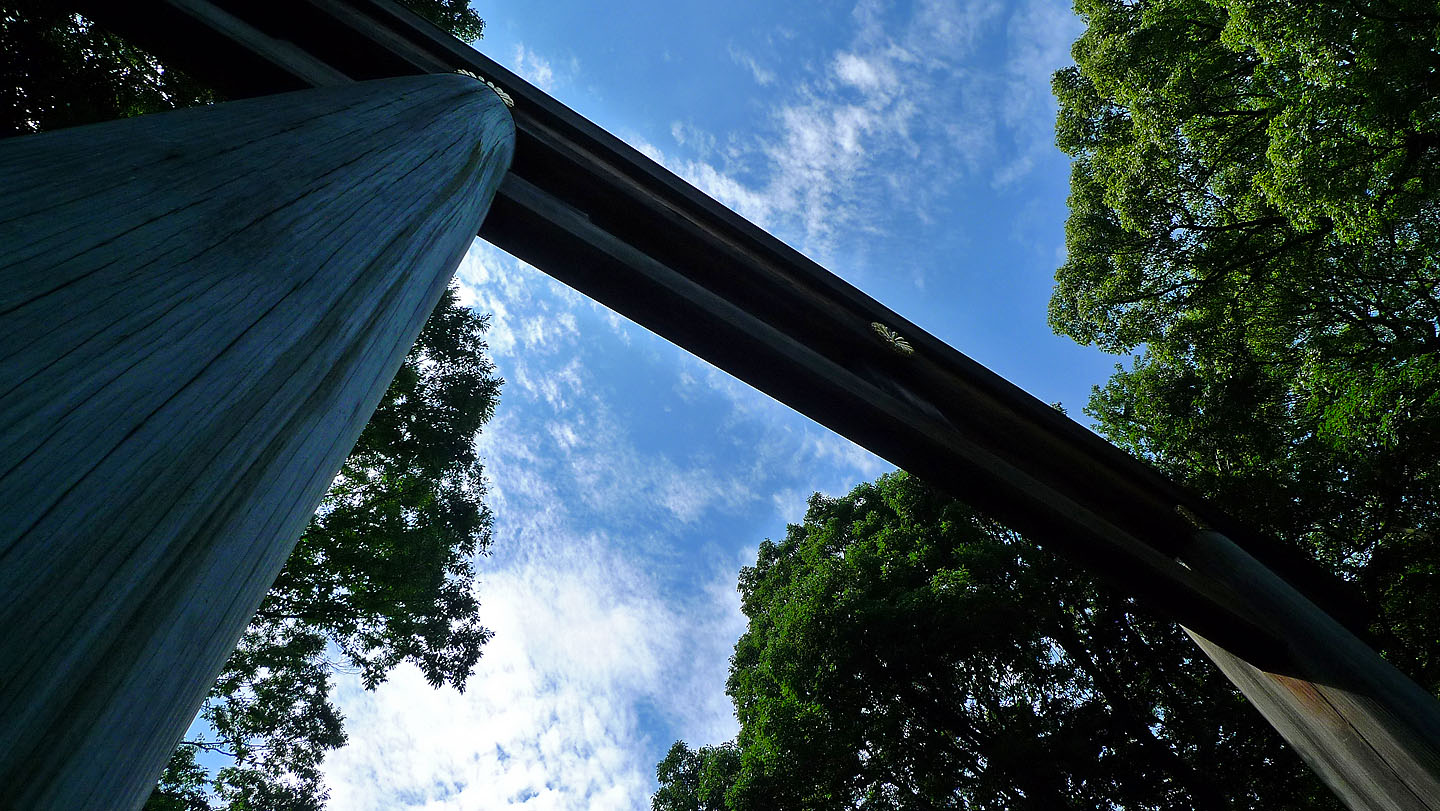
Lest the above photo doesn’t impress (since you can’t tell how large this torii and these trees are without some sort of frame of reference) I’ll also present another angle, taken from six feet off of the ground looking upwards.

meiji jingu torii looking skyward blue skies clouds tokyo japan

The sky was a photographer’s dream on this day. So far the sky in Japan this time of year has been mostly white. Completely blue can get a bit boring too. But this contrast of white and blue with the green of the trees and brown of the structures was heaven sent.

meiji jingu shrine inner gate tokyo japan 明治神宮 写真

The photo above is of the gate to the inner sanctuary where the Meiji Emperor is enshrined. The picture below is of the inner sanctuary (内拝殿) itself. I didn’t see the sign saying you can’t take pictures of the inner sanctuary until after I snapped this one. Oops. If you look closely (perhaps after clicking on the image to make it larger) you can see the Shinto priest in white.

明治神宮 内拝殿 meiji shrine inner sanctuary shinto priest tokyo japan

築地 – Tsukiji – Part 1

I’m writing this at 4 in the morning on our 5th day in Japan. When will I be able to sleep like a normal human being again? I don’t know. Hopefully soon. What are the causes you ask? It’s a combination of factors I suppose. Jet lag is probably the biggest one. My excitement over each day is another. A pillow I have yet to become fond of is also a possible contributor. Finally, I get too hot without the AC on, yet I can’t sleep with any sort of fan blowing on me either. Am I tired? You betcha. Can I sleep? Not to save my life. Oh well, this will pass at some point.

Yesterday morning I was also up by 4. My daughter has usually been up by 4 as well. Since there is nothing else to do at 4 in the morning, my daughter and I decided to go to the world’s largest fish market. We went to Tsukiji once before, two years ago, but I felt rather unfulfilled since we never found the tuna auction on that morning, my SD card of pictures from the day (including the Tokyo International Anime Fair) went bad and I lost all the photos in the process, and we didn’t sample the sushi. This time we succeeded on all three accounts that we failed before.

takadanobaba metro station first train tokyo japan

The first train doesn’t run until 5 in the morning. We were on that first metro, leaving Takadanobaba at 5:06. I’m not sure why they don’t begin earlier as many people need to get to Tsukiji before 5:30. The first train was packed by the time we got there, standing room only, and Tsukiji workers were literally running to their jobs at 5:30 a.m. It was quite a sight considering the early hour. Surprisingly, thousands of people were already at Tsukiji. I wondered how they all got there without the trains yet running. I suppose some live in the area, but then I spied one of the large, motorbike/motorcycle parking lots.

motorcycles at tsukiji tokyo japan

The seemingly endless rows of fresh seafood and the variety are staggering. I’ll share a few of the 100+ pictures I took in this Tsukiji series.

octopus tako tsukiji market tokyo japan

The characters for Tsukiji (築地) mean “build earth.” That is because this neck of the Tokyo woods (and indeed many coastal areas in Japan) is artificial land or land reclamation. I read a book on Tsukiji before visiting last time, and that helps to make Tsukiji more meaningful to me than it may be to some.

tuna auction tsukiji tokyo japan maguro

The tuna auction was the highlight of our trip this time. I’ll show you a video of it in a future post in this series.

Bon Odori – Day 2

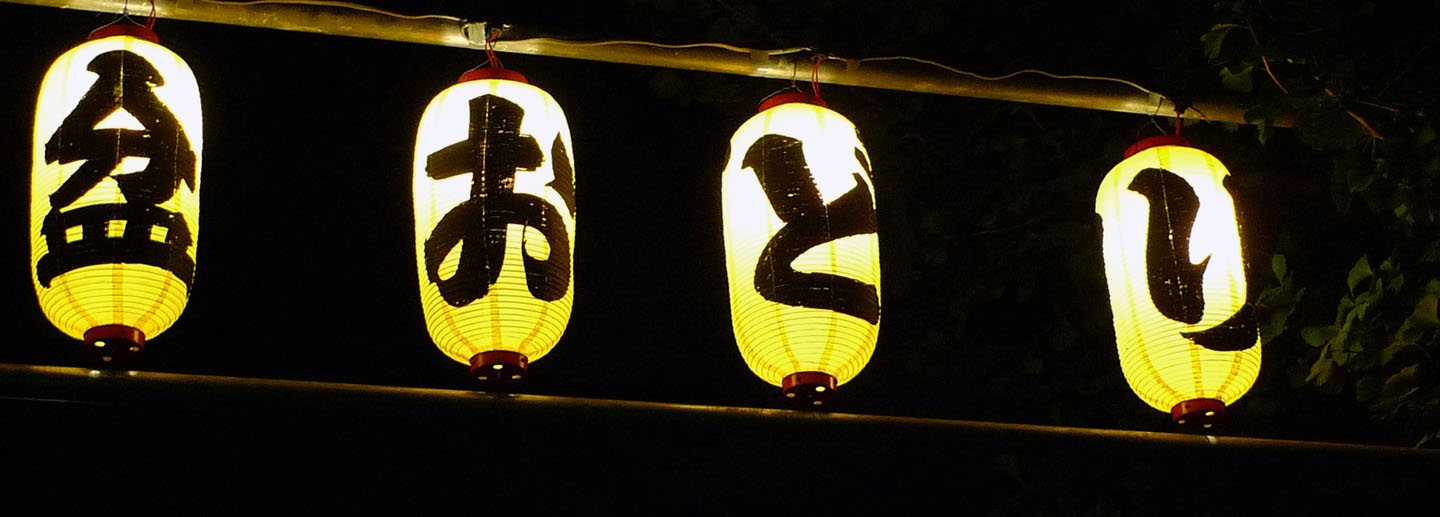
bon odori written in kanji and hiragana japanese

First a little Japanese lesson for you. Bon Odori can be written in three ways in Japanese–ぼんおどり (all hiragana), 盆おどり (kanji and hiragana like the lanterns on my street pictured above), or 盆踊り (mostly kanji).

Bon (or o-bon) means the annual summer festival which celebrates or brings to mind the deceased. O-bon happens in both July and August, usually around the 15th of each month. In some parts of Japan it is only celebrated once, rather than in both months.

Odori simply means “dance.” Odoru is a verb meaning “to dance.” Put Bon and Odori together to get something that loosely means “dance of the dead.” Viewing a Bon Odori doesn’t conjure up visions of a dance of the dead however.

bon odori tokyo japan august 2009

After the magic that was the first night’s dance I made sure my family came with on the second night, even though my daughter had already fallen asleep again. I brought her in a nearly comatose state so perhaps it was a dance of the dead after all. 😉

I think they really enjoyed it too, especially watching the little girls, all dressed up, trying to learn the dances from their mothers and grandmothers. The taiko drumming that accompanies the dance is fun to experience as well.

black and white bon odori picture japanese lanterns

After each song an announcer thanks everyone for their participation and then introduces the following number. They probably did a dozen different songs, or more, each night. Each song has a different dance with which it is associated. Some of the participants were amazing in their ability to remember the steps and movements in each of the folk dances. I don’t think they ever do the bon dances outside of the night or two each year.

shinjuku-ku nishi-waseda jinja bon festival matsuri

My wife and daughter were invited to join the dance, but they politely declined.

The songs remained in my dreams both nights, going through my head over and over again. Maybe we’ll still be around next year (in July anyway) to catch another Bon Odori or two.

盆踊り Bon Odori – Day of the Dead Dance – 1st Night

It has been 21 years since I saw my last Bon Odori. The dancers came right down the street I was living on at the time in Kofu, Yamanashi Ken. Fast forward to the present and the morning after we arrived in Japan. I saw an announcement that the local shrine in Nishi-Waseda was having a Bon Odori on that very night and the following evening as well. I was so excited!

bon odori torii

My family didn’t have the energy to attend, and my daughter feel asleep before the dance began, so I headed to the shrine on my own. It is only a two minute walk. The music began just as I arrived. There were only a dozen or so dancers. The dancers’ husbands were all sitting together, in matching yukata, fanning themselves.

bon odori dancer husbands

As the music reached the ears of our neighbors, they all seemed to creep out of their homes and make it to the shrine. By the time I left, an hour later, over a hundred people were in attendance, and the number of dancers had increased by several fold.

bon dance nishiwaseda tokyo japan august 15 2009

I was, of course, the only non-Japanese person there. The whole evening was enchanting. I felt as though I had traveled through time and space. The tall, modern, Tokyo buildings couldn’t be seen in the darkness. The light from the paper lanterns was dim, and the shrine in the background provided the perfect setting. My lack of a yukata and foreign looks seemed to ruin the authenticity so I stayed back in the shadows.

dance of the dead folk japan bon obon odori taiko drumming