TravelJapanBlog.com - Japan (07, 09-10, 13), Denmark (08, 11, 16-19, 21, 24), Korea (13), Poland (21), Mexico (14, 15, 19, 26), Iceland (17, 19), Hawaii (14, 17, 22), Czech Republic (16, 17, 19, 21)
The above will search Traveljapanblog.com.
Concerts - Landscapes - Sports


Archive for Japan

Views from the top of Tokyo International School

tokyo international school tis

A couple days ago my kids began their school year as students at Tokyo International School. Beyond the track and field area is the school’s swimming pool.

aerial view buddhist cemetary tokyo japan

The school is four stories high and includes a playground on the roof. Also from the roof one can observe the Buddhist cemetery which sits right up tight next to the school. I don’t think I’ve seen one from this angle before.

basketball and hopscotch among the skyscrapers

On the roof, playing basketball or hopscotch between the skyscrapers is something us country bumpkins aren’t used to, but my kids will quickly adapt.

soccer and skateboarding five stories up on the roof

You can also play soccer (football) or skateboard on the roof, not your typical location for such activities.

flags in the gym

The school has students from over 40 countries, and no single country makes up more than 20% of the total so everyone is a minority. The gymnasium has flags from all represented countries hanging from the ceiling.

My daughter’s home room teacher is from Singapore. On one of their field trips they get to go to Hiroshima and Miyajima. My son’s home room teacher is from Australia and has taught in Thailand and other places around the world. On one of their field trips they are going to Cambodia. You can read about those trips after they happen here.

Tsukiji – Part 2

entrance to tsukiji fish market tuna auction

Tsukiji is huge. If you tried to walk down every aisle in the place it could take a week. So it’s no wonder that we never found the tuna auction on our first trip. The auction is tucked back and out of the way. To find it you will need a map. We made a beeline for it, with map in hand, as we came off the first train of the morning, and I’m glad we did. The above sign will let you know that you’ve found it. I was surprised that we weren’t first in line. I don’t know how the others got there before us, but the line quickly grew very long behind us.

tsukiji fish auction maguro tuna rules time

Only a few people are let in at a time (and there have been occasions when the auctions have been banned to the public for viewing). If you arrive after 6 a.m. your odds of getting in are very slim indeed.

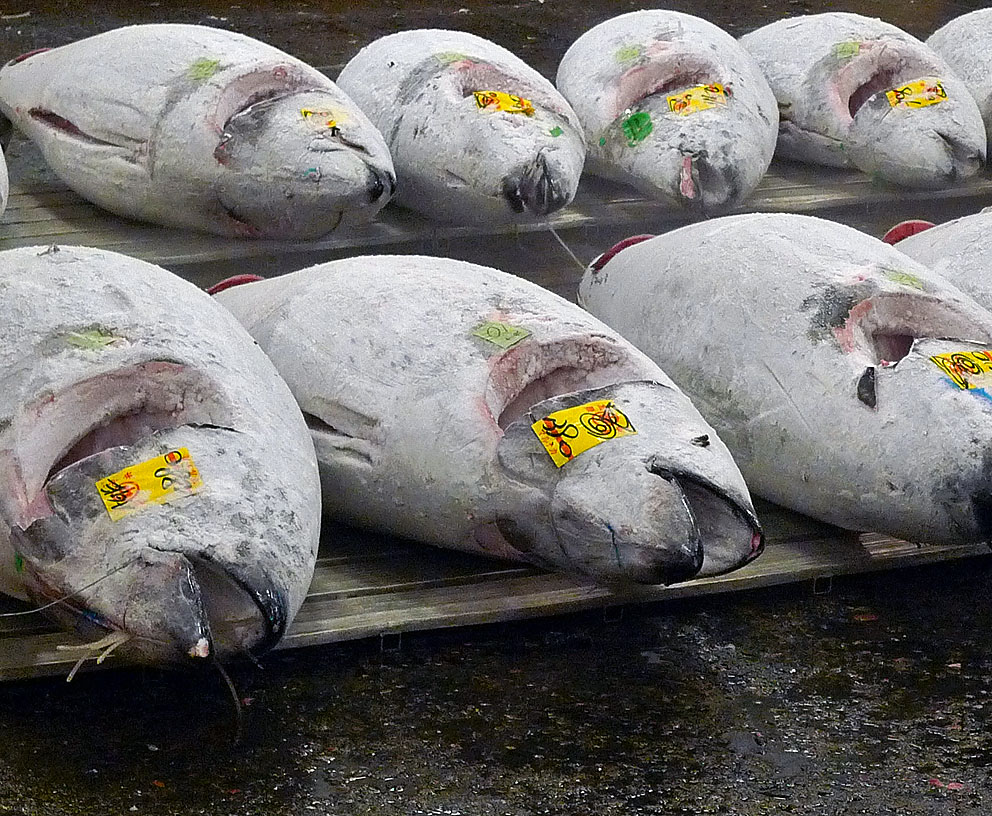
frozen tuna maguro at tsukiji fish market tokyo japan

The freshly frozen tuna, with tails cut off, are lined up in row after row. Potential bidders are allowed the chance to poke around in the tuna’s cut off portion. They were diving in with all manner of poking devices to check for quality before bidding I suppose. Then, at just after 6 a.m., the bells started ringing and the auctions began in a flurry. I shot a 1 minute video of this scene below. The quality isn’t great as I was being jostled about by the other tourists. It wasn’t all that different from a rock concert.

Friends in the neighborhood

亮朝院 日蓮宗

From my apartment window I can see the top of a Buddhist temple not far away. It took me almost a week to actually pay the place a visit. The Nichiren sect temple is called Ryochoin (亮朝院). The structure and grounds are set a bit above the rest of the neighborhood. At this link you can see an old Edo Period drawing of the place.

Kongorikishi

These two guys are the Nio guardians of the Buddha. Usually they are in the sides of the gate leading to the temple and made of wood, but at this temple they are out in the open, past the gate, at the top of the stone stairs, and made of stone. I posted some more typical pictures of them previously.

nio

I imagine I’ll be taking many morning walks through these temple and burial grounds in the coming year. It’s nice to have so much protection nearby. 😉

This last protector is on the roof of the bell tower at 亮朝院.

bell tower roof ornament

First day of school

ryan and ellie first day of school tokyo international school

The kids just left for the train station to get to Tokyo International School (notice the uniforms) for their first day of school in Japan. I took the above photo in front of the front door of our apartment before they left. We thought they’d be sitting for most of the train ride (of 26 minutes), but they ended up standing for all but one stop.

Hopefully they’ll start blogging more so you can hear directly from them.

早稲田通り Waseda Street

waseda doori from takadanobaba train station

This is the view each day as my kids walk home down Waseda Doori toward our apartment halfway between Takadanobaba Station (高田馬場駅 – just behind me when I took this picture) and Waseda University.

Changing dollars into yen – update

Air Flight-GenericbuttonAs mentioned in a prior entry, my results from two years ago are now somewhat out of date when it comes to the best method to maximize the amount of yen you receive when converting your US$ (and possibly other currencies as well) into Japanese yen.

Here are my results for August of 2009 followed by a brief analysis:

ATM 48,000 yen received / ($503.83 + $5 Wells Fargo fee) = 94.334 on 8.14.09 when market rate was 95.27
SFO 83.12 on 8.13.09 PST
NRT Cash rate of 92.12 on 8.14.09
NRT TC rate of 94.12 on 8.14.09
Post Office TC 46,730/500 = 93.46 on 8.17.09 when market rate was 94.46

I asked at the post office in Japan what their rate was on international postal money orders, and the answer was the same rate as that given for traveler’s checks. My bank (Wells Fargo) won’t let me pull out more than $510 a day.

Conclusion:
1. Do not change US$ into Japanese yen in the USA. You will have far fewer yen to spend on your trip. The rate can be more than 10% worse than the rates offered in Japan. I checked this rate at more than one place in the SFO airport. I think Forex is the company ripping people off in the US airports. As an example, had I converted $10,000 in the US instead of in Japan I would have had the equivalent of US $1,000+ less to spend in Japan!
2. Cash is not good to exchange. Not only do you receive an inferior rate, if you lose it there is no way to get it back.
3. If you can get free traveler’s checks from your bank this is a good option. TCs give you a better exchange rate, and if they are lost or stolen you can get them replaced.
4. International postal money orders are better than TCs if you have to pay for TCs.
5. Wells Fargo is giving the market rate on ATM withdrawals (something they didn’t do with wire transfers). The $5 per withdrawal fee can be painful, however, especially if you have a limit below $500 on daily withdrawal amounts.

A few other items to note… The Japanese post office cash rate was the same as that found at the banks in the airport (i.e., 2 points worse than TCs). Most Japanese banks still do not accept foreign ATM cards. Citibank, Mitsui, and 7 Bank are the only ones that I have found that do. Mitsui and 7 Bank ATMs only give out 10,000 yen notes so if you are trying to get, say, 49,000 yen then they aren’t the way to go. Japanese post offices do accept foreign ATM cards. There are Citibank and 7 Bank ATM machines near the second set of escalators heading down to the Keisei Line in Terminal 1 of the Narita airport. Get your daily ATM withdrawal amount raised with your bank to more than $500 before going to Japan. Withdraw your maximum amount, less frequently, to avoid fees. Credit cards should not be used in Japan now that the credit card companies are all charging at least $3 per transaction plus a 3% foreign currency charge.