
I don’t own an iPhone, iTouch (iPod Touch), or iPad. I like a big screen and a keyboard with keys that are the same size as my fingers. However, my son has an iTouch. He learned hiragana a while ago and has been stalled out on katakana. Since he rarely sets his iTouch aside I figured if I could mingle katakana and his iTouch somehow he would learn the latter.
I have now downloaded eight free apps which I will provide brief reviews of in no particular order.
1 ) Kotoba! is a decent dictionary that resides on the iPhone or iTouch itself after downloading so you don’t need an internet connection to use it. The iTouch (or iPhone) is a horrible device for dictionaries however as you’ll more often than not misspell the word you are looking for with the extremely tiny keyboard. You can’t input kanji, but kanji is shown with the word you look up. If you have an internet connection you’ll be better off with jisho.org.
2 ) Wa is another decent dictionary. With this one you can look up kanji, but not by drawing the kanji. Again, the biggest limitation is the horrible keyboard you have to use to input.
On both of these dictionaries you can download a Japanese keyboard that helps a bit, but not much. A qwerty keyboard was never made to be less than one inch by one and a half inches.
3 ) Kanji Sensei features a little Japanese reading and writing tutor. The writing tutor doesn’t work correctly. The reading tutor shows you a kanji and then gives you three English definitions to choose from in a sort of quiz. The number of kanji are small and so this will get really boring, really quickly unless you happen to be working on these very basic kanji.
4 ) Kanaquiz (a screen is pictured up and to the left) is one of the most useful free apps I have found so far. Although stroke order is not taught, the quizzes are good for reviewing both hiragana and katakana. You can take a hiragana quiz, a katakana quiz, or a quiz featuring both. High scores and number correct are saved so you can have something to shoot for in mastering your kana. You can also take quizzes with differing numbers of characters (25, 50, or 100). If you just finished learning hiragana and/or katakana this is a great way to practice and speed up your recognition time.
5 ) Kana Strokes beautifully shows you how to write all of the hiragana and katakana. This free app along with Kanaquiz, above, are all you need to master hiragana and katakana. Once you know stroke order for the kana there is nothing of value in this little app.
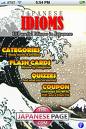
6 ) Beginning Japanese Words & Phrases and Japanese Idioms are nice for beginners to learn some words and phrases. These programs (the latter pictured up and to the right) have audio so you can hear a native Japanese speaker say everything. After learning a few things, or everything, you can quiz yourself. These are probably the highest quality programs for learning Japanese that are completely free and contains a decent amount of content for the iPhone and iTouch at the moment. Click here for more.
7 ) Hiragana Lite is a hiragana flashcard program. One of the nice features is that you can include just the hiragana you are currently mastering. You don’t have to study them all at once. This app is easy to use. I think you have to pay to get the katakana flashcards and maybe some other features.
8 ) ShinKanji Lite is an app for the iPod Touch I thought I may be able to learn something from. This app features thousands of kanji. However, the menus are difficult to work through. Sometimes they don’t seem to work at all. There appear to be almost daily updates on this one so maybe it will work OK someday. It was more frustrating than useful for me.
9 ) My Japanese Coach is also available for download to the iPod Touch. I didn’t bother to download and try the free version. I’m guessing it is the same as the problematic My Japanese Coach for the Nintendo DS. Only this version could be worse given the more limited control devices on the iTouch and iPhone.
Are there any free ones out there that I have missed that are good?
Posted on June 23rd, 2009 under Japan. Tags: japanese language, Japanese Language Study Methods, my japanese coach. Comments: 13


