TravelJapanBlog.com - Japan (07, 09-10, 13), Denmark (08, 11, 16-19, 21, 24), Korea (13), Poland (21), Mexico (14, 15, 19, 26), Iceland (17, 19), Hawaii (14, 17, 22), Czech Republic (16, 17, 19, 21)
The above will search Traveljapanblog.com.
Concerts - Landscapes - Sports


Archive for Japan

Hiragana and Katakana quizzes
hiragana quizzes

My son finished learning hiragana and katakana a week or so ago. Now he has moved on to kanji with the hope of learning almost a hundred before we arrive in Japan in less than 6 weeks. My daughter is just about through with hiragana. One problem I found with teaching her hiragana (other than the obvious lack of motivation on her part) is that finding an online quiz that was just at her level was difficult. She was much more receptive to an online quiz than any coming from me so I persisted. At last I found one.

On Josh Gemmell’s site he has created three sets of quizzes for both hiragana and katakana. The really nice thing about Josh’s quizzes is you can be quizzed based on just the kana you have learned rather than all of them at once. So, for instance, my daughter just finished learning ma, mi, mu, me, mo. Instead of testing her on all of the hiragana (in which case I would have to tell her the answer for ya, yu, yo, ra, ri, ru, re, ro, wa, particle o, and n) I can select just “a” through “mo” to be tested.

If you are really good at multiple choice quizzes, and that is why you are getting them all correct, have no fear. Go to quiz 2 and now you will have to actually type in the sound.

Anyway, check it out if you are currently learning hiragana or katakana. I’ll show you how my son is learning kanji soon.

Baseball balloons have returned!

balloons at Japanese pro baseball game seibu lions

To say that the Japanese overreacted to the Swine Flu scare is more than a bit of an understatment. A group of educators were supposed to come to my university in Oregon, but they all canceled due to the H1N1 hysteria. Never mind that there are far fewer cases in my neck of the rural woods than there are in densely populated Japan (meaning they would have been safer here than at home) or that the death rate from this flu bug is less than it is for the regular flu (which inflicts far more people anyway).

One of Japan’s Swine Flu “precautions” was the prohibiting of balloons at professional baseball games. I’m happy to report that this ban has finally been ended, just in time for my arrival and attendance at Japanese ball games. Yeah!

Let the launchings begin…

balloons in flight at seibu kyujo japan baseball game

Tokyo!

tokyo! the movie review I watched Tokyo! a couple days ago and figured I’d type my thoughts before they get too far away from me. The movie is actually three movies in one. Each is a bit over 30 minutes. Had any of the three been full length I’m quite certain I would have hated the result. As it is, each has some redeeming portions. Let’s look at them individually.

The first film is called “Interior Design” and is written and directed by Michel Gondry. I love the atmosphere in this one. As someone about to move from a 2,400 square foot home into a 700 square foot apartment in Tokyo with my wife and two kids, I can “feel” this movie more than many I suppose. The end is a little weird and doesn’t really make much sense to me. This movie, and the last one, seemed very Japanese to me. If I didn’t know it wasn’t a Japanese writer and director I certainly would have guessed Japanese authorship. Overall, I give it a 7 out of 10.

The second movie is by Leos Carax and is called “Merde.” The opening scene and newscaster scenes are outstanding. I laughed a lot when the old Japanese lady described the sewer monster. Beyond those scenes, however, there is nothing I find decent in this segment. I would give it a 1 or 2 out of 10, but because of those few moments that were really well done I award Merde a 5 out of 10.

The final picture was my favorite. “Shaking Tokyo” by Joon-ho Bong is excellent from start to finish. If you haven’t lived in Japan for a period of time then maybe you won’t get it, but I really felt this one. Seeing Japan’s streets totally empty and the main character’s house totally unkempt on the exterior was lots of fun too. 9.5 out of 10.

The pure water (清水) at Kiyomizudera (清水寺)

pure water waterfall drink kiyomizudera kyoto japan

When I visited Kiyomizu Dera for the first time, I hadn’t read anything about the place in a guide book. Therefore, I had sort of a “Duh” moment when after following around the packs of tourists we actually arrived at the kiyomizu that makes up its name. I hadn’t really thought about why it was named as it was or what the significance of the name was until this point. Duh!

Anyway, I bet you can’t tell which of these kiyomizu samplers is my daughter. 😉

Taiko and sake (太鼓と酒)

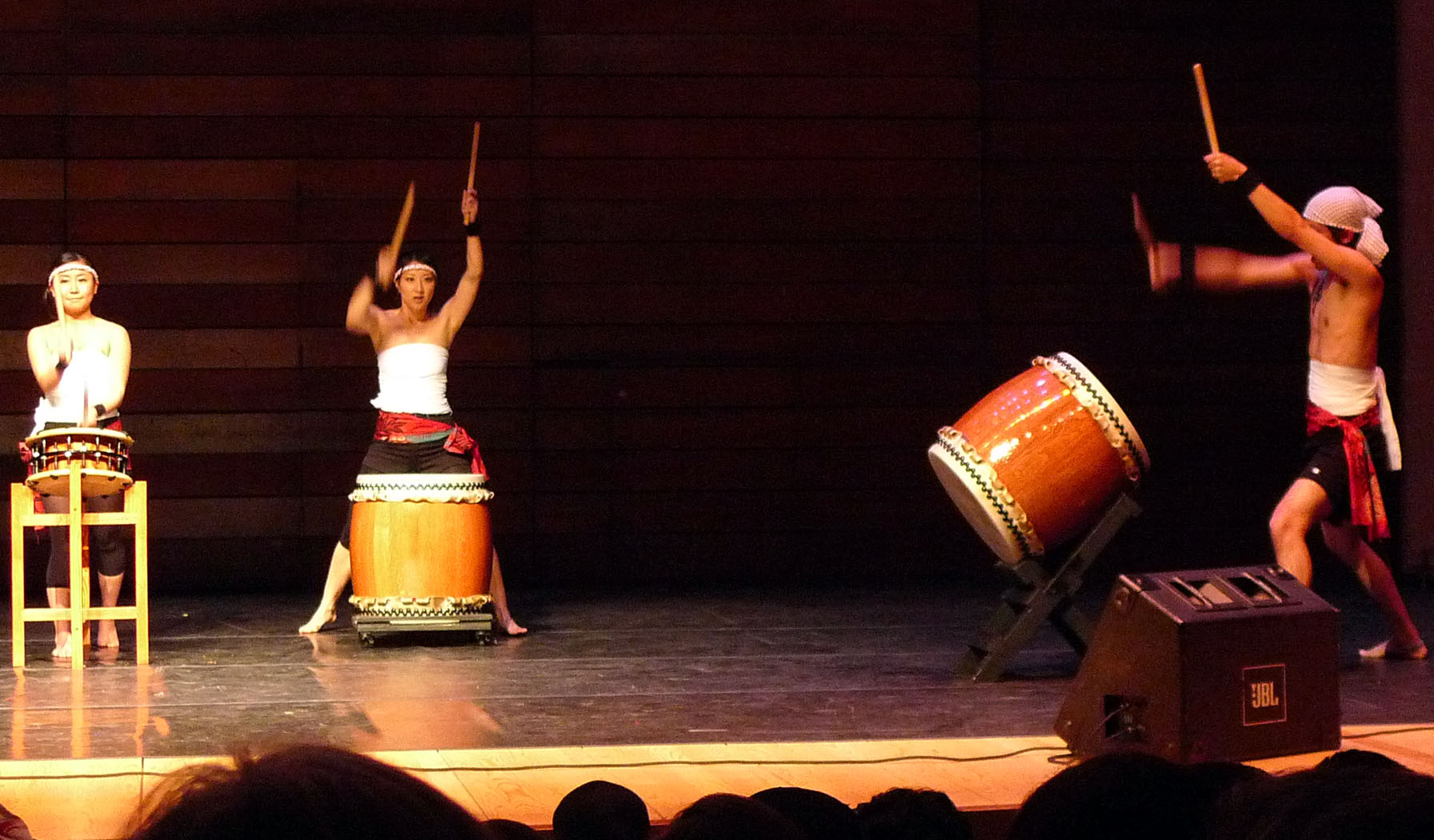
taiko drumming

“The taiko is an instrument that demands more than technique. It is an obstinate instrument. It will resist and resist the drift of the music until the sheer energy of the man who plays it at last excites the god in the drum, and the rhythms then flow naturally from him till his arms grow weak with exhaustion. The wise player circumvents the drum’s resistance by taking so much sake into his body that the god in the drum has no alternative but to assume command at the outset.

I have to suppose that the god in the drum can also read minds, for as I moved in and out of the crowd, past the lanterns and the benches and the crates of bottles, a young man wearing a white plastic raincoat came up and thrust a paper cup of sake into my hand and asked me if I would like to play. I said that I would, but that I would require more sake. More sake came. The crowd around us began to bubble. Three drummers offered me the use of their sticks, and after I had drained a third paper cup I took my place by the side of a drum and waited for the right-hand drummer to tire. Then, when my turn came, I stepped up to the drum, saluted it with the sticks, and whacked it.

The crowd went silly. “Look at this! Look at this! A gaijin! A gaijin playing the taiko!” Flash guns went off, crates were upended, parents pushed their children forward and craned their necks and stamped and clapped, and I felt the sake curl in my stomach and grinned at the drummer on the left of the drum, a middle-aged man who said “Yah!” and grinned back, and the god in the drum was kind to us both.

I have no idea how long I played. Twice the left-hand drummer changed and twice the drumsticks slipped out of my hands. When I came away I was drenched in sweat, and I sat on a bench with a towel round my head, guzzling sake and laughing like an idiot.”

(Alan Booth in The Roads to Sata p. 78-79)

Kyoto shopping

kyoto shopping mall ginza arcade kawaramachi shijo dori

Shopping centers in Japan frequently have a similar look and feel to them. Some are called ginza, some are out of doors, but a common look is the one above–sort of a covered arcade of sorts.

This one is one of the largest, if not the largest, for this variety in Japan. You head down one of these lanes off of Kawaramachi Dori (河原町通) or Shijo Dori (四条通) in Kyoto and when you get to the end you can turn the corner to head down another mega-long street loaded with nothing but more shops and more shoppers.