TravelJapanBlog.com - Japan (07, 09-10, 13), Denmark (08, 11, 16-19, 21, 24), Korea (13), Poland (21), Mexico (14, 15, 19, 26), Iceland (17, 19), Hawaii (14, 17, 22), Czech Republic (16, 17, 19, 21)
The above will search Traveljapanblog.com.
Concerts - Landscapes - Sports


Archive for Japan

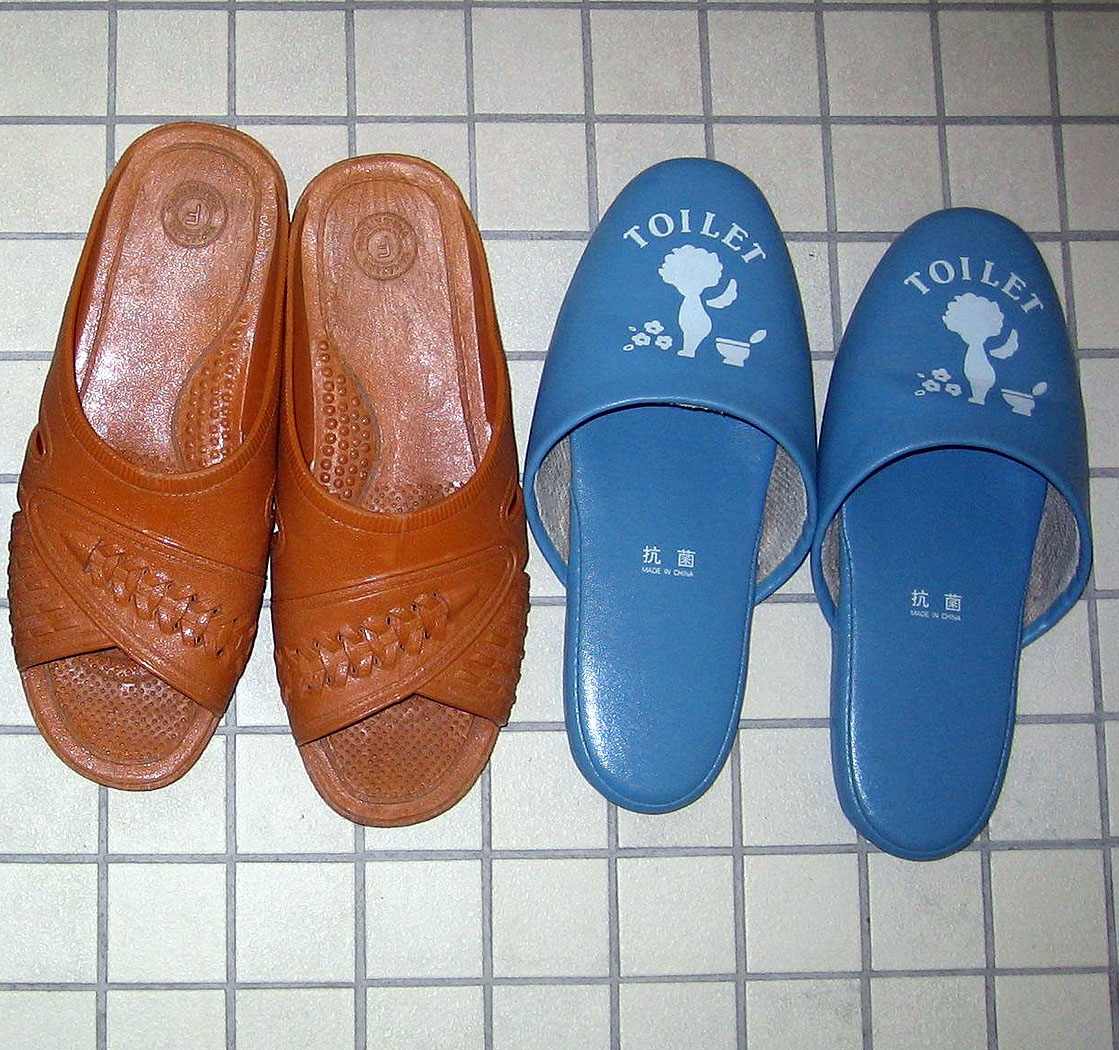
Toilet slippers

toilet slippers

“In the night I made the beginner’s lavatory mistake. Whatever the style of Japanese lavatory–whether Western or the traditional hole in the floor–you never go into it wearing the same pair of slippers that you wear along the corridors. Another pair of slippers–often helpfully marked ‘lavatory’–is laid out for you there, and you change into them as you enter. The beginner’s lavatory mistake is this: stumbling half-pissed into a hole-in-the-floor-type lavatory at night, he kicks one of the lavatory slippers down the hole. This, I suppose, happens fairly regularly, but for a veteran of seven years to commit this blunder was an immediately sobering embarrassment. In fact, it was so embarrassing to be left hopping about in a single lavatory slipper that I kicked that down the hole to follow the first. My plan was to disclaim all knowledge of the slippers so that the maid would be accused of having forgotten to lay them out. This, I congratulated myself, was a cast-iron defense, but in the searing light of morning it struck me that I might well be resorting unawares to an instantly recognizable ‘beginner’s lavatory feeble ploy,’ so I avoided not only the downstairs guests but the entire domestic staff as well.”

(Alan Booth in The Roads to Sata p. 88)

One month to go!

We will be boarding a plane for Tokyo in a mere month (as of today). I’m quite excited. The only two pieces of unfinished business are my visa (which will hopefully come this week) and renting our house.

Today’s picture was taken just yesterday by a friend and old college roommate of mine who is currently in Japan. Kamakura appears to have been in a picture perfect setting with a nice mix of clouds and blue sky when he took this.

Electricity (power converter, adapters) for Japan

power supply electricity volts watts hertz conversion japan usa canada converter plugs outlets

Some of the most often asked questions on the travel Japan boards are “Will my electronic devices work in Japan?”, “Can I bring my hair dryer to Japan?”, “Do I need an outlet converter or adapter when traveling to Japan?” and other similar ones. The answer depends on where you are coming from and what you are bringing.

Japan’s electrical outlets work on 100V and either 50 or 60Hz. The outlets are two pronged like those in the US and Canada. Most devices (NiMH or camera battery chargers, AC adapters for laptop computers, games, small appliances, etc.) will run and plug in just fine in Japan if you purchased them in North America. To be sure check the back. I’ve shown a few examples in the photo above. Notice that all four items (computer AC adapter, DS game AC adapter, rechargeable battery charger, and camera battery charger) were made in China for both Japanese and North American consumers. North America works on a slightly higher volts 110V instead of 100V in Japan. Even if your device says 110V-240V it should work fine at 100V.

Hair dryers may not heat up well in Japan if they are made to work at 110V or 125V. If you are going to be in Japan for an extended period of time you may want to purchase your hair dryer there. They can be had for under $20. In addition to possibly functioning better, it will be one less thing you have to cram into your suitcase.

If you are going to Japan from a high voltage country (Australia, Europe, China, etc.) then you will need a converter for some devices. You will also need a plug adapter.

One final note, three prong plugs are less common in Japan than they are in Canada and the USA.

Sulfur hot springs

Owakudani hakone hot spring vents steam japan

Note that these images are not from Tamagawa, the place Booth describes below. Nor do I have any of the naked Akita bijins he mentions. 🙁 However, when I read the passage below I was reminded of these photographs that I took at Owakudani, near Hakone.

Owakudani river

Owakudani hot springs water

“Outside, in the hissing bed of the stream, metal pipes and a wooden trough stained bright yellow by the sulfur carried the hot spring water to the baths. The water is a bare two degrees below boiling when it comes out of the earth, and so the stream is practically invisible, shrouded day and night in billows of white vapor. The smell of the springs is overpowering, and in the huge wooden bathhouse where you grope your way to the pool of your choice through a permanent curtain of cloying steam, the stench is so heavy it chokes your throat till, after a while, you learn to breathe very gently and regularly as in a sauna.

But perhaps the most remarkable thing about Tamagawa is the fact that men and women bathe together. This was often so before ‘Westernization,’ and its survival here must be one of the reasons why the Japan Travel Bureau is so sniffy about ‘primitiveness.’ I found nothing primitive about it. I thought it a joy to lie and watch old women with breasts hanging down to their bellies giggling like schoolgirls while they scrubbed their husbands’ backs and eyed the one or two muscled young men who skipped self-consciously from pool to pool dangling hand towels in front of their crotches. The beauty of the Akita bijin does not appear to suffer much with age; the grandmothers’ faces were often as radiant as sixteen-year-olds’. The younger bijin stayed irritatingly out of sight–though, on reflection, that was probably just as well, since it enabled my enthusiasm for the primitive to continue at a cerebral level.”

(Alan Booth in The Roads to Sata p. 81-82)

Tanuki (狸)

狸 タヌキ tanuki raccoon dog

Until recently I thought tanuki (usually rendered in katakana, タヌキ, in Japan) were a mythological creature. It turns out there are real raccoon dogs in Japan although I haven’t seen one. The renditions you see in, and in front of, shops in Japan don’t look much like the real thing though. The real thing looks pretty much like a raccoon.

My kids really liked the tanuki statues they encountered frequently in Japan. So much so that we purchased one, and it has rested on my son’s shelf at home in Oregon ever since.

During the past week Gail has posted a couple of well-crafted blog entries dealing with a part of the tanuki anatomy my kids never recognized as such. For more on tanuki 金玉 see her posts here and here.

How to turn off a Japanese girl

japanese children carp koi

“The ryokan I stayed in that night was an unusual one… Before I took a bath, the very attractive twenty-three-year-old daughter of the ryokan went with me for a stroll in the elegant garden, where we watched the black carp swimming about in their pond and netted the one I was to dine on. Later on, in the bathroom, I noticed a black carp staring glumly at me from out of a glass tank set into the wall. It struck me as a perverse idea to have the dinner survey the diner like this, and although I couldn’t absolutely swear it was the same fish, I spent less time wallowing in the tub than I might have if the tank had contained a couple of tiddlers.

But there was another reason for skipping smartly back to my room: the daughter had promised to serve me dinner. We sat with the screens ajar, she in a sleek dark dress, me in the ryokan’s extra-large yukata, and talked for a long time… We drank a good few cups of sake as I nibbled my carp, and by the time the girl had cleared away the dishes, had seated herself again on the soft cushion opposite me, and resumed the story of her life in a voice that grew more melodious the more sake I sipped, I had begun to sense the possibility of a tasty sequel to the meal.

Woe to that carp (since I am convinced now it was the occupant of the bathroom tank that I had been blithely dipping in mustard sauce)! Because that half-digested creature chose this extremely critical moment–this delicate irretrievable moment of deciding how to maneuver a mattress out of a wall cupboard without appearing overly forward–to have his own back with a vengeance.

‘Isn’t it quiet,’ I murmured to the girl and farted louder than I have ever farted in my life. The girl dissolved in helpless giggles and disappeared rapidly in the direction of her sitting room. I hurled my own mattress down onto the tatami. Her brother served me breakfast.”

(Alan Booth in The Roads to Sata p. 168-169)