TravelJapanBlog.com - Japan (07, 09-10, 13), Denmark (08, 11, 16-19, 21, 24), Korea (13), Poland (21), Mexico (14, 15, 19, 26), Iceland (17, 19), Hawaii (14, 17, 22), Czech Republic (16, 17, 19, 21)
The above will search Traveljapanblog.com.
Concerts - Landscapes - Sports


Archive for Japan

After Christmas Mangajin blowout sale

My supply of previously-read Mangajin is getting out of control. So I’m prepared to make you a great deal if you purchase 20 different issues from me. The issues are Nos. 17, 18, 21, 28, 29, 30, 31, 32, 36, 37, 47, 49, 54, 55, 56, 57, 58, 61, 65, and 66. The 10 not previously pictured are shown above.

If you were to purchase these 20 issues from the publisher the cost would be $160+. If you live in the USA and purchase them all at once from me the cost is only $80, and I will pay the shipping–not you (free shipping). Outside of the US the price will be a bit more for the extra shipping. Single issues are also available for $5 each plus shipping.

Email me today if you are interested in taking these 20 issues off of my shelves.

Japanese Gardens

I’m back from my winter vacation, although it seems strange calling it a vacation when I went from a cold, snowy place to a colder, snowier place. Hopefully you enjoyed the Italian offerings of the past couple weeks. We’ll turn back to Japan now.

On my trip I finished both volumes of Glimpses of Unfamiliar Japan. I’ll share a few quotes and thoughts on the book here in the next week or so. To go along with the following quote I present the above photo which I took at ginkakuji in Kyoto last year.

“Now, a Japanese garden is not a flower garden; neither is it made for the purpose of cultivating plants. In nine cases out of ten there is nothing in it resembling a flower bed. Some gardens may contain scarcely a sprig of green; some have nothing green at all, and consist entirely of rocks and pebbles and sand, although these are exceptional. As a rule, a Japanese garden is a landscape garden, yet its existence does not depend upon any fixed allowance of space. It may cover one acre or many acres. It may also be only ten feet square…  Therein are created minuscule hills with minuscule houses upon them, and microscopic ponds and rivulets spanned by tiny humped bridges; and queer wee plants do duty for trees, and curiously formed pebbles stand for rocks, and there are tiny toro, perhaps a tiny torii as well, – in short, a charming and living model of a Japanese landscape.

Another fact of prime importance to remember is that, in order to comprehend the beauty of a Japanese garden, it is necessary to understand – or at least to learn to understand – the beauty of stones… Until you can feel, and keenly feel, that stones have character, that stones have tones and values, the whole artistic meaning of a Japanese garden cannot be revealed to you. In the foreigner, however aesthetic he may be, this feeling needs to be cultivated by study. It is inborn in the Japanese; the soul of the race comprehends Nature infinitely better than we do, at least in her visible forms. But although, being an Occidental, the true sense of the beauty of stones can be reached by you only through long familiarity with the Japanese use and choice of them, the characters of the lesson to be acquired exist everywhere about you, if your life be in the interior… At the approaches to temples, by the side of roads, before holy groves, and in all parks and pleasure-grounds, as well as in all cemeteries, you will notice large, irregular, flat slabs of natural rock, mostly from the river beds and water-worn, sculptured with ideographs, but unhewn. These have been set up as votive tablets, as commemorative monuments, as tombstones, and are much more costly than the ordinary cut-stone columns and haka chiseled with the figures of divinities in relief. Again, you will see before most of the shrines, nay, even in the grounds of nearly all large homesteads, great irregular blocks of granite or other hard rock, worn by the action of torrents, and converted into water-basins (chodzubachi) by cutting a circular hollow in the top. Such are but common examples of the utilization of stones even in the poorest villages; and if you have any natural artistic sentiment, you cannot fail to discover, sooner or later, how much more beautiful are these natural forms than any shapes from the hand of the stone-cutter. It is probable, too, that you will become so habituated at last to the sight of inscriptions cut upon rock surface, especially if you travel much through the country, that you will often find yourself involuntarily looking for texts or other chiselings where there are none, and could not possibly be, as if ideographs belonged by natural law to rock formation. And stones will begin, perhaps, to assume for you a certain individual or physiognomical aspect, – to suggest moods and sensations, as they do to the Japanese. Indeed, Japan is particularly a land of suggestive shapes in stone, as high volcanic lands are apt to be; and such shapes doubtless addressed themselves to the imagination of the race at a time long prior to the date of that archaic text which tells of demons in Izumo “who made rocks, and the roots of trees, and leaves, and the foam of the green waters to speak.” (Lafcadio Hearn, 1894, Glimpses of Unfamiliar Japan, p. 345)

Kanken 2 for Nintendo DS (漢検DS2+常用漢字辞典)

My fourth DS game for learning Japanese arrived in the mail yesterday. Kanken DS 2 + Joyo Kanji Jiten (漢検DS2+常用漢字辞典) is the name of it. The thing that excited me the most about this DS title was the dictionary (jiten or 辞典). After messing around with it for an hour I have to say that the thing I am most disappointed with is the dictionary. However, everything else is much better than expected. I think this may even end up being a more useful tool than my previous favorite, Nazotte Oboeru Otona no Kanji Renshuu Kanzenhan.

Let’s take a brief look at some of the features with some screenshots I took.

The above screen is a practice test at level 9. There are 10 levels in Kanken 2 corresponding to the 10 levels of the Japanese Kanji Aptitude Test (Nihon Kanji Nōryoku Kentei Shiken, 日本漢字能力検定試験). Level 10 is the easiest level and level 1 is the most difficult.

The format looks fairly similar to the quizzes in Tadashii Kanji Kakitorikun Kanken Taisaku. However, Kanken 2 is far superior in my opinion. With the above on the top screen, the user writes らいしゅう, one hiragana character at a time, on the lower screen. After touching OK the next screen appears.

Now the user writes にちようび (日曜日) and so on. The quizzes are more interesting than those found in Tadashii Kanji… or Nazotte… as the content varies and is not the same format over and over again like those games. For instance, after filling in the hiragana for several kanji marked in red a different task is required as follows.

Now the user has to write the number of the stroke highlighted in red. What happens if you make a mistake?

In this case I wrote 10 instead of the correct answer of 9. One thing I really like about Kanken 2 is that instead of just taking me to the next task I am given the option of going to the dictionary for this character. If I click on the orange box I go to the dictionary.

The dictionary is usually three pages wide. Above I am showing you photographs of two of those three pages. As you can see the dictionary doesn’t offer much more than the Nazotte… dictionary. The dictionary has stroke order, on and kun readings, number of strokes, and radicals. That’s it. Nazotte… doesn’t have radicals, but it has all of the other items.

If a Kanken 3 ever comes out I hope Rocket Company (the software publisher) adds three things to the dictionary: example jukugo, a brief definition in Japanese, and two or three meanings in English. This would be very useful for both Japanese and gaijin users of the program.

Other than the addition of radicals, there are two other things about the dictionary that make it superior to those found in Tadashii Kanji… and Nazotte… The first I mentioned above in that you can leap to the dictionary whenever you miss something. The other is that you can look kanji up by sound. For instance, you can write kei (けい) and be taken to a screen with every kanji that has a kei reading. You can also click on any of the kei kanji to be taken to the dictionary screens for that particular kanji.

In summary, (although if there is interest I’ll post more screenshots and discussion of this title on this blog in the future) the games and quizzes in Kanken 2 appear to be much more enjoyable and varied than those in previously mentioned DS games teaching kanji that I’ve experienced. The character recognition is better than My Japanese Coach but not as good as Nazotte… However, Kanken 2 doesn’t give the false positives that Nazotte… sometimes does. Another complaint of Kanken 2 is the size of the characters on the screen. Nazotte… is much easier on the eyes. Still, my prediction is that I will be using Kanken 2 much more than Nazotte… in the future simply because it is more entertaining while accomplishing the same goal of kanji mastery.

Another angle on Adashino-Nenbutsu-ji upper cemetery

Are you beginning to get the idea as to how someone who isn’t even all that interested in the beauty of a cemetery might just find the one at 化野念仏寺 to be quite beautiful and peaceful? If you ever get bored of this vantage point (but how could you?) just turn around to behold a bamboo forest.

More Managajin (漫画人) for sale

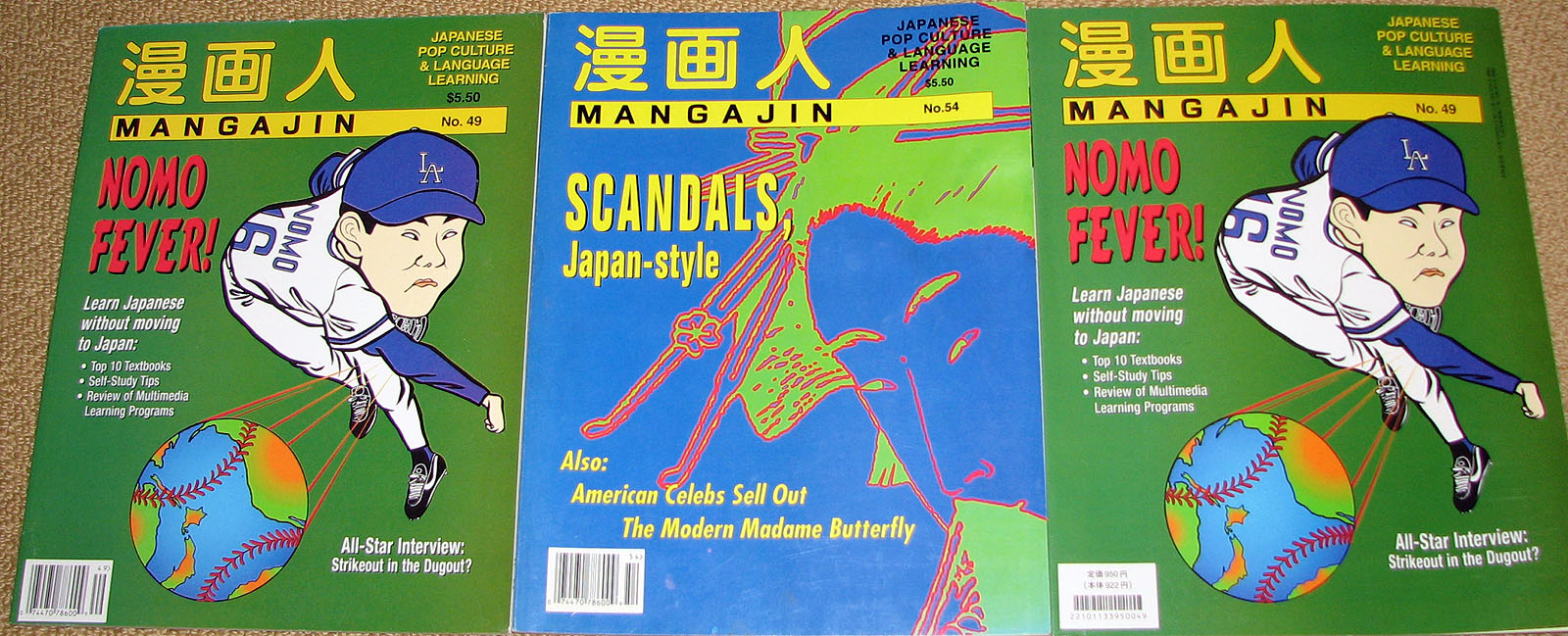
Issues No. 49 and 54 are now ready for your consumption. Email me if you are interested in these or any of the other Japanese items I’ve previously mentioned. I need to get rid of them all before we move to Japan.

You may wonder why I have shown two issues of No. 49 with Hideo Nomo on the cover. While the contents are the same, if you look closely you will see that the covers are slightly different. One is the version sold in Japan (with a 950円 cover price) and the other is the version sold in the U.S. (with a $5.50 cover price). Let me know which issue you prefer.

Finished “Otona no Kanji Renshuu” Level 7

After many attempts I finally passed the seventh level tests on Nazotte Oboeru Otona no Kanji Renshuu Kanzenhan (なぞっておぼえる大人の漢字練習完全版) for the Nintendo DS. If you can read the above Japanese and are wondering what アル is, that’s my name–Al.

The first six levels corresponded to how Japanese kids learn kanji in school–200 or less a year. The 7th level was a giant leap forward and hence was much more difficult to get through. Not only are the kanji much more difficult, on average, than those in the first 6 grades (kyōiku kanji 教育漢字), but there are also over 315 to learn and be tested on in Level 7. Ouch!

Level 8 appears to give users a minor break with “only” 286 kanji to learn. Would you believe me if I said I’m not that excited to jump into another 286 characters right away? 😉

The above screenshot shows that I can read kanji better than I can write them which is good for me since I rarely have to write them.

Here are a few more screen shots I haven’t previously shown. I’ll walk you through them in case you are thinking about purchasing this game. Explanations will be below the photos.

My normal routine is to do “Today’s practice” (the upper left big button). There you get 5 new kanji to learn and practice reading and writing. After doing 4 of these for a total of 20 characters I move on to “Promotion test” (the middle left big button). To pass the test you have to read all 20 of the kanji recently learned in “Today’s practice.” The characters are presented in random order and you never know if you will have to provide an on or a kun reading. The jukugo words may, or may not, be the same as those you were given in “Today’s practice.”

After passing the reading test, I take the writing test for the same 20 characters. Again, the questions are presented in random order. The recognition of my writing is very good by the program–much better than My Japanese Coach, but sometimes you are given a false positive if you are slightly off or haven’t drawn the last stroke.

After completing all of “Today’s practice” and “Promotion tests” for a level (except the final comprehensive exam for a level which is much more than 50% more difficult when it is over 300 characters instead of 200 characters or less) I go into “Weaknesses” (the middle big button on the right).

The above screen shows that I cleared out the final 4 kanji I previously made a mistake on by correctly writing them this time.

Once you have mastered all of your previously missed kanji under “Weaknesses” you earn the above certificate.

The above screen indicates that you have no previously missed kanji to review since the top button is grayed out. The lower button can never be cleared out. It provides short, 10-question quizzes (5 reading and 5 writing) for any kanji you have ever missed in the program. If you click on the lower button you see the following:

This means that at some point I incorrectly read 260 kanji and incorrectly wrote 541 of the 1,322 kanji studied so far. You can’t reduce these numbers by taking the 10 question quizzes and answering them correctly. This is good as you can always come back to review these kanji that you may now know fairly well without having to wade through the ones that you know really well and never miss.

The 60% indicates that when I have taken these 10 question quizzes of previously mistaken kanji I score an average of 6 out of 10 correct (usually 4 or 5 out of 5 for the reading and 1 or 2 out of 5 on the writing in my case).

I would like to see the creators (Nowpro) of this program put out a new edition of Nazotte Oboeru Otona no Kanji Renshuu Kanzenhan. While this is the best DS game for learning Japanese that I have tried so far, three enhancements would make it even better.

1) On the screen showing the on and kun readings, include a definition in Japanese and English.
2) On that same screen include three or four example jukugo.
3) When a user makes a mistake reading or writing a kanji (in any setting including the tests), take the user (or at least allow the user via a button option) to go to the on and kun reading page mentioned in 1 and 2.

If you have mastered this DS game then you are in luck. Nowpro is coming out with a variation early in 2009. Advanced students of the Japanese language will want to check out the latest offering in this series: Imi made Wakaru Otona no Jukugo Renshuu Kadokawa Ruigo Shinjiten Kara 5-Man Mon (意味までわかる大人の熟語練習 角川類語新辞典から5万問).