TravelJapanBlog.com - Japan (07, 09-10, 13), Denmark (08, 11, 16-19, 21, 24), Korea (13), Poland (21), Mexico (14, 15, 19, 26), Iceland (17, 19), Hawaii (14, 17, 22), Czech Republic (16, 17, 19, 21)
The above will search Traveljapanblog.com.
Concerts - Landscapes - Sports


Archive for Japan

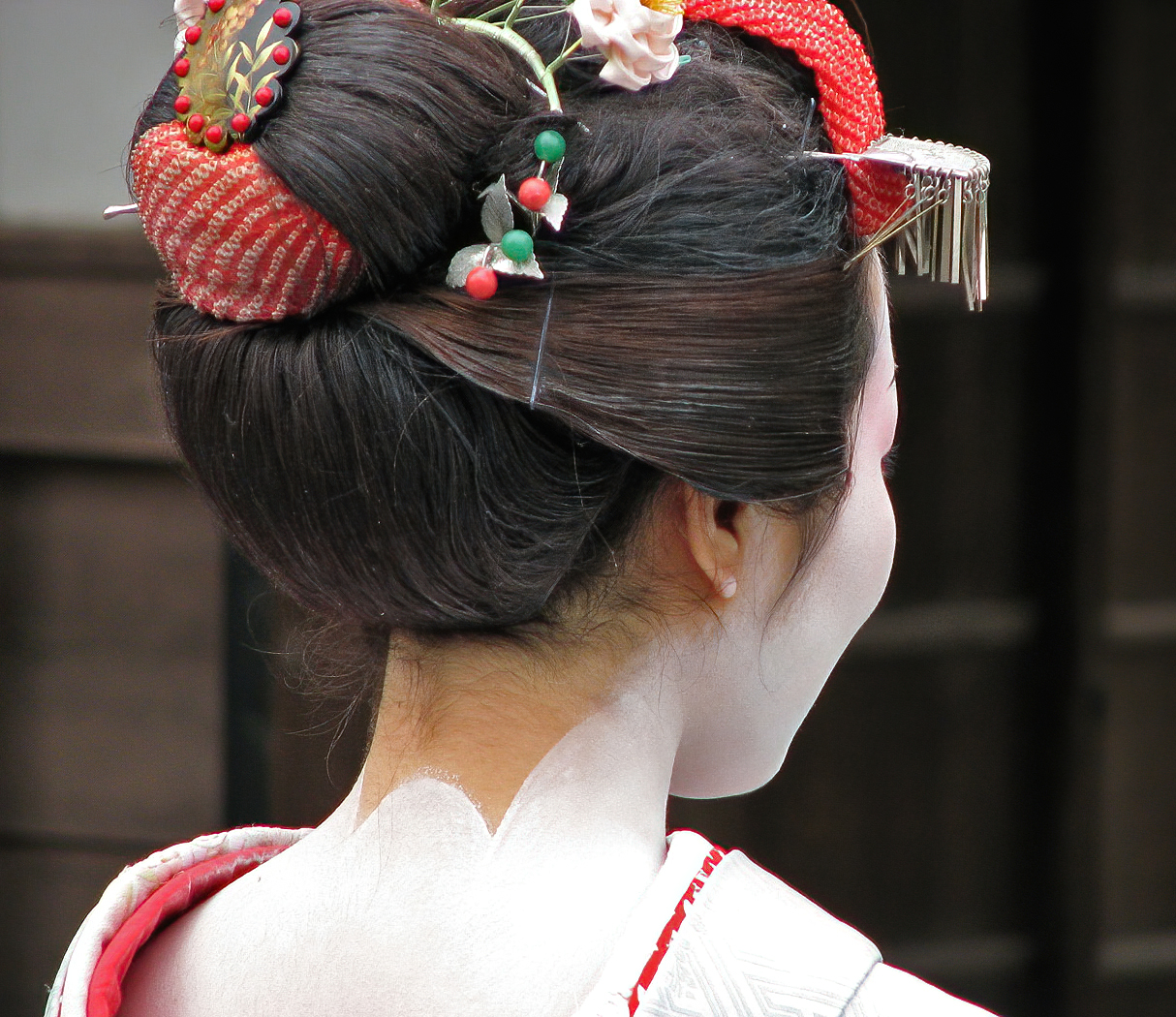
The Geisha Neck

Geisha Neck (Kyoto, Japan)

A geisha‘s neck is left with two “V” shaped lines unpainted. On some special occasions, like when a maiko (future geisha) debuts, three lines are left unpainted. This is supposed to make the neck even more erotic. What do you think? Does it work?

Technically, since I was in Kyoto when I took the above photograph, I should refer to her as a geiko (or maiko). For all I know, though, she was just a tourist who paid to have the makeup and outfit for the day.

3 cheers for the Seibu Lions

The Seibu Lions have advanced to the Japanese World Series. They are playing against the Tokyo Giants for the championship. Currently the series is even at a game a piece. If you can read a bit of Japanese then check out the latest here. Play resumes on Tuesday at Seibu Dome where the above picture was taken last year. Female cheerleaders come out and do their thing in the seventh or eighth inning in Japan. Then the fans fire off thousands of balloons. And this was for a regular old game, not the playoffs. I can’t imagine what happens when they turn things up a notch for the Japan Series.

The Temple of the Golden Pavilion 金閣寺

Having visited kinkakuji last year, I had heard the story of the monk who burned down the prior version of the temple but not in any detail. Reading Donald Keene’s memoir got me interested in Mishima. The two interests combined finally got me to pick up a copy of the English translation of The Temple of the Golden Pavilion and read.

And what a curious read it turned out to be! The book is said to be historical fiction. I’ve read reviews that claim that Mishima did research and actually interviewed the arsonist so maybe it’s more historical than fiction. In any event, I became thoroughly engrossed in this book.

I won’t go into any plot lines here as you can read them elsewhere on the internet, and I don’t want to provide any major spoilers for those who haven’t read it yet.

As I read the book, I felt like there were some of Mishima’s autobiographical elements coming out in the arsonist’s character. For instance, Mishima has the arsonist say that living to an old age is a curse. (p. 128) He takes special care to emphasize physical limitations (something Mishima, himself, seemed obsessed with). And the thought of suicide is rather glorious to Mishima’s mentally unstable arsonist. Mishima worked tirelessly to become a physical specimen (through body building), thought old age was not a good thing, and committed suicide at a relatively young age.

I thought the story line near the end sounded strangely like Mark David Chapman and his preparations to murder John Lennon. Mark Chapman identified with Holden Caulfield in The Catcher in the Rye. Holden Caulfield is not too unlike Mishima or the arsonist in The Temple of the Golden Pavilion. The Catcher in the Rye deals with adolescent aimlessness, a dissatisfaction with everything, being disgusted with the phoniness people, themes of anxiety over sex, the feeling that everything is soiled, and lost innocence–all items touched on in this work of Mishima’s.

Both the arsonist and Chapman went to prostitutes and spent the last of their money before committing their crimes. Both affiliated with a book. For Chapman it was The Catcher in the Rye. For the arsonist in The Temple of the Golden Pavilion it was Crime and Punishment. The similarities seemed so eerie that I wouldn’t be surprised to learn that Chapman had also read Mishima’s book.

I give this work two thumbs up and highly recommend it–especially if you have been to Kyoto.

Daimonji 大文字

“I ran. It was fantastic how far I ran without stopping to rest. I can’t even remember what places I passed. I must have… run up the mountain path that was bordered by bamboo grass and azalea and reached the top of Mount Hidari Daimonji. Yes, it was surely on top of Mount Hidari Daimonji that I lay down on my back in the bamboo field in the shadow of the red pines and tried to still the fierce beating of my heart. This was the mountain that protected the Golden Temple from the north.” (The Temple of the Golden Pavilion, p. 261)

Kinkakuji’s sosei (金閣寺の漱清)

“[Yoshimitsu] had added the tiny Sosei, which projected from the temple like an overhanging pavilion. It was as if he had put all his aesthetic powers into breaking the symmetry of the building. The role of the Sosei in the total architecture was one of metaphysical resistance. Although it certainly did not stretch very far over the pond, it looked as though it were running away indefinitely from the center of the Golden Temple. The Sosei was like a bird soaring away from the main structure of the building, like a bird that a few moments before had spread its wings and was escaping toward the surface of the pond, toward everything that was mundane. The significance of the Sosei was to provide a bridge that led between the order which controls the world and those things, like carnal desire, which are utterly disordered. Yes, that was it. The spirit of the Golden Temple began with this Sosei, which resembled a bridge that has been severed at its halfway point… ” (The Temple of the Golden Pavilion, p. 253-254)

Owakudani 大涌谷

Part of the Hakone Loop includes Owakudani which means the big, boiling valley. Why do they call it that you ask? Because it smells like sulfur from the boiling trenches you see along the walk. As a tourist attraction, they hard boil eggs in the volcanic waters. The eggs turn black. Of course no one would normally pay the prices listed at Owakudani for a black, hard-boiled egg given that those visiting the place are almost ill from the smell of rotten eggs the sulfur provides to begin with. So they created the tale that if you eat these eggs boiled here you will live an extra seven years.

As evidence of the long living, they have hard-boiled Hello Kitty. The fact that Hello Kitty never seems to die is proof positive that there is something to the Owakudani, black, hard-boiled eggs.

Owakudani is actually not a very pretty place. However, the views of Mt. Fuji from Owakudani can be spectacular, and the cable you get to ride in on is lots of fun.

The word 黒タマゴ on Hello Kitty means “black egg” as if you couldn’t tell that Hello Kitty was a black egg.