TravelJapanBlog.com - Japan (07, 09-10, 13), Denmark (08, 11, 16-19, 21, 24), Korea (13), Poland (21), Mexico (14, 15, 19, 26), Iceland (17, 19), Hawaii (14, 17, 22), Czech Republic (16, 17, 19, 21)
The above will search Traveljapanblog.com.
Concerts - Landscapes - Sports


Archive for Japan

Japan exhibit in Copenhagen’s Nationalmuseet

Denmark’s National Museum is located in Copenhagen. The ground floor consists of Danish and Human history. On the upper levels there are exhibits for each country. I don’t know if this is always the case, but the day we were there the upper levels were nearly completely void of visitors.

The collections were still impressive. Either no one knows of them or people get so tired from the ground level that they never make it up the stairs. One of the problems may be that while the collections are massive, there are no stories or detailed descriptions to go along with them (like there are for the ground floor exhibitions).

I headed upstairs to check out the Japanese collection. On my way I noted the impressive collection from Greenland. Surely the Nationalmuseet has the finest and largest assemblage of items from Greenland given Denmark’s history. I was amazed at the number of items they had, the condition, and the age.

Anyway, I eventually headed past Greenland and on to Japan.

The Nationalmuseet had several display cases with Ainu artifacts. Ainu are the original settlers of Japan and now nearly extinct. I was more than a bit surprised to find this much Ainu material in Denmark.

Samurai armor and helmets seem to be a centerpiece of these types of foreign exhibits on Japan.

Finally, we shall end on the mask exhibit. Having recently read The Street of a Thousand Blossoms and being a daily visitor to Ojisanjake’s blog, I found this portion of the Japan exhibit to be very interesting. I especially liked the bottom six masks which show the process from block of wood to finished mask.

Nazotte Oboeru Otona no Kanji Renshuu Kanzenhan

This will likely be my last Japanese-related post for a while. Tomorrow we leave for Denmark! So for those of you only interested in Japan stuff on this blog check back in mid-August. From then until the end of time the vast majority of my blog entries will be about Japan, learning Japanese, etc.

Yesterday I passed the fifth level on Nazotte Oboeru Otona no Kanji Renshuu Kanzenhan (なぞっておぼえる大人の漢字練習完全版) for the Nintendo DS. Hurrah! What does this mean you ask? It means I could probably pass any kanji test thrown at a 5th grade Japanese kid (11 year old). That may not seem too impressive, but it was fun getting there, and I learned a lot along the way. I haven’t had the DS game that long and hope to pass all of the levels before this time next year. Stay tuned.

The fifth level brings one up to almost 900 kanji. Tests aside, I can probably read about 1,300 kanji well at this point and write about 800 well. Before buying this game those figures were probably about 900 and 100, respectively, and not as well as now. I’ve forgotten much over the past 20 years, but it is coming back quickly with study.

 Let me show you a few screen shots.

kanji ds

On the above picture you can see that I passed Level 5 by the skin of my teeth. Passing is 80%. Reading I received 100% on, but I have more difficulty writing. Lucky for me, reading is far more important from a practical standpoint. In fact, I really only practice writing because it helps with reading. On the rare occassions when I have to write Japanese I’m usually on a computer. The computer pulls up the possible characters for you so you really only need to be able to read to write Japanese (on a computer) these days.

The tests on this “game” are not so easy, as they aren’t multiple choice or true/false questions. You either know how to read or write it or you don’t. I’m guessing that real Japanese 5th graders have it a bit easier with multiple choice tests.

learn japanese nintendo ds

One of the nice things about this “game” is you can learn from your mistakes and review what you did very easily. After clicking on my “Graduation Certificate for 5th Level” (表彰状LV5卒業) the above screen shows which kanji were correctly answered (with a circle mark) or incorrectly answered (with no mark). You can click on any of these (including the ones marked correct) to review the kanji, including on/kun readings, stroke order, etc. Watch what happens when I click on the kanji I missed.

learn kanji on the nintendo ds

First, I should note that the screen isn’t all grainy like you see on the last two screen shots above. The photos clear up if you click on the images.

You have your on (音) and kun (訓) readings on the top screen along with the number of strokes. On the bottom screen you get walked through the proper stroke order. For more practice you can click on お手本 and practice writing the character as many times as you’d like. Nazotte… will show you how correctly you are writing the kanji.

There are many other features (like daily practice drills, a dictionary that allows you to look up unknown characters, and mini games). I’ll go over some more details and show you some more screen shots once I’ve made it through another level or two.

If you already have intermediate or advanced Japanese skills you can check out the features in Japanese here. You really don’t need to know anything more than hiragana to get much out of this game though. Someone, for instance, studying for JLPT Level 4 could use Level 1 of Nazotte… to study. For JLPT Level 3 one could use Levels 1, 2, and 3 of this game. JLPT Level 2 is through about Level 5 of Nazotte… And if you master through Level 9 of Nazotte… you’ll easily pass JLPT Level 1.

Japanese learning materials for sale or trade

Yesterday I finished the previously mentioned Kochi Kame. I thoroughly enjoyed reading this manga. It turned out to be not so Scooby Doo like after all. Only the first few episodes had similar storylines. The rest showed a wide variety of plots and were unpredictable so that was good.

After finishing I tossed the book into a drawer filled with other Japanese things I’ve finished (since my bookshelves are already overflowing). I realized then that I have too much to read in the next year before returning to Japan so there is no way I will revisit these again. That being the case, I’m willing to part with them for cash or trade.

japanese learning materials for sale mangajin nihongo journal genki benkyo

Here is what I have:
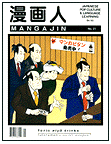
Mangajin cover
Japanese Business Glossary, 220 pages from 1983
Dictionary of Legal Terms, about 550 pages from 1993
– 5 issues of Mangajin, Nos. 9, 17, 18, 19, and 21 (Note that issues 9 and 19 are very rare and can no longer be purchased from the publisher for the normal $6.50 to $20 an issue plus postage. No. 21 is also rare and available for $20 + shipping from the publisher.)
Nihongo Journal, June 1993 (These are no longer available from the publisher and usually go for $20+ an issue when they show up on eBay.)
Kochi Kame, 190 pages, 158 kan from January of 2008.

All of these items include translations and/or furigana so you don’t have to have intermediate or advanced Japanese skills to benefit.

You can have them all for US$50 delivered in the U.S. If you don’t want everything, if you are outside of the U.S., or if you’d like to trade for these items, email me and we can arrange different terms.

Changing U.S. dollars into Japanese Yen

One of the more popular questions in Japanese travel forums on the internet relates to finding the best rates for changing U.S. dollars into Japanese Yen. That being the case, I did a comparison last year and posted my results here.

Subsequent to creating that web page, others have emailed me their experiences. In the future, people can compare stories by responding to this blog entry.

Here is one that I just received yesterday:

I found your study to be very thorough and just what I was looking for. Some new info as of June 2008:

Bank of America skims off 3%, so you get approx. 104 yen (exchange rate is 107) but no “additional” service fees if you change $1000+. Narita airport website now lists exchange rate. If you bring cash, it is 104 yen (I’m guessing there is a fee attached as well, but can’t confirm). If you bring Traveler’s Checks, the exchange is 106. So that seems to be the best option, if you can get your TC for free at your bank, then wait until you are in Japan to do the exchange.

(Lonely Planet (newest version) says you will pay fees at Japanese banks and airports to exchange, so I’m undecided at this point about what to do.)

There were no fees at Japanese post offices if you had international postal money orders in hand, and I don’t believe that has changed.

I’ve noticed in preparation for my trip to Europe next week that my credit card companies are charging more than they previously did. My MasterCard is taking 3% off the top for currencies other than U.S. dollars, and my American Express is taking 2%. Since my American Express gives 3% cash back on restaurants, and 2% back for travel-related purchases that won’t be bad. Hopefully people will take American Express, and I won’t be forced to use my MasterCard (which only gives 1% back).

Leave a reply if you have additional, first-hand experiences that can help people save money on currency exchanges.

3 new books on Japan

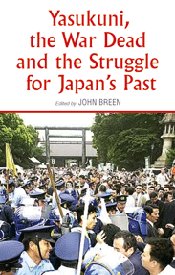
yasukuniThree books on Japan just arrived in my mailbox from Columbia University Press. They are: Yasukuni, the War Dead and the Struggle for Japan’s Past by John Breen, Troubled Apologies Among Japan, Korea, and the United States by Alexis Dudden, and Chronicles of My Life: An American in the Heart of Japan by Donald Keene.

Since we will be in the air on our way to Denmark a week from now these will have to wait until our return in August. I hope to have reviews posted here on each in August and/or September.

japan us koreaFor the trip I plan to take Philip K. Dick: Five Novels of the 1960s & 70s. Why? Because last summer I read Four Novels of the 1960s on my trip to Chicago, and I have fond memories of the readings coupled with my time in Chicago. Plus, Five Novels is much longer than the three titles on Japan so it should keep me busy longer. I don’t really want to carry around multiple books.

heart of japanDo you have any books that you have read that are forever linked in your brain with a trip or vacation?

I certainly do. For instance, I can’t think of Neil Young’s biography without thinking of my trip to Canada last fall or vice versa. Ditto with a trip to Hawaii and Origins Reconsidered: In Search of What Makes Us Human and probably a dozen or more other trips/books read on the trip.

The Street of a Thousand Blossoms

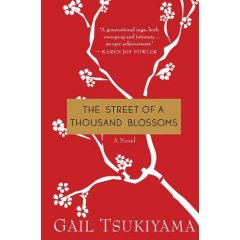
The Street of a Thousand BlossomsLess than a week after starting The Street of a Thousand Blossoms by Gail Tsukiyama I have finished reading it. The book isn’t short at over 400 pages, but I found it hard to put down. That, coupled with having to wait for breakfast in bed on father’s day for three hours 😉 , allowed me to finish The Street of a Thousand Blossoms in little time.

As mentioned in my prior blog entry on the subject, I really enjoyed the Yanaka setting. I felt like I could connect with more than just Yanaka though. For instance, I spent a day in the late 80s watching Sumo at Ryogoku Kokugikan. The highlight of the day was witnessing the great Chiyonofuji’s bout in person. So all of the Sumo dialogue in this book brought back pleasant memories. I’ve always been fascinated with Japanese masks (check out this blog daily for some outstanding photography and discussion) so Kenji’s story held my interest. And, of course, there is the trip to Hakone which I have also made. Basically everything felt familiar and resonated well.

The story is compelling, drawing on the themes of renewal and hope. I don’t want to give away too many details for those of you who haven’t yet read The Street of a Thousand Blossoms.

The occasional errors in Japanese are my main criticism. Although Tsukiyama has a Japanese name, she doesn’t understand Japanese. This won’t be noticed by readers who are in her same shoes, but those who can speak the language will cringe at times. One example is her use of hai. She uses it far more frequently and in situations in which Japanese would not. Another is her use of the unconjugated verb hairu (to enter) as a command. She should have said something like haitte kudasai or o hairi kudasai instead of just hairu. A final one (there are others) that I’ll offer as an example is the Hakone Lake which she calls Ashino. In English it should be called Lake Ashi. In Japanese it is called ashinoko (芦ノ湖). The “no” indicates it is the Lake (ko) called (no–shows possession like ‘s in English) Ashi. Put another way, one could translate Lake Tahoe as “tahoe no ko” in Japanese but you would never call it “tahoeno” in English or Japanese.

She gets Japanese culture and customs wrong on some counts as well. For example, she has the school year starting in September like it does in the U.S. In Japan, though, school years, company fiscal years, etc. start in April–not September.

These minor critiques aside, this book is very enjoyable even if you haven’t been to Yanaka, Sumo, Hakone, Nara, or even Japan.

Here are a couple more pictures I took last year from areas mentioned in The Street of a Thousand Blossoms.

ashinoko Lake Ashi hakone japan mt. fuji

This is Lake Ashi with Mt. Fuji, mostly shrouded in clouds, in the background. The place on the right may be where Tsukiyama envisions Hiroshi and Aki staying.

hakone jinja 箱根神社

This is another picture from the ferry on Lake Ashi. The kanji say 箱根神社 or Hakone Jinja. “Jinja” means Shinto Shrine or Temple.