TravelJapanBlog.com - Japan (07, 09-10, 13), Denmark (08, 11, 16-19, 21, 24), Korea (13), Poland (21), Mexico (14, 15, 19, 26), Iceland (17, 19), Hawaii (14, 17, 22), Czech Republic (16, 17, 19, 21)
The above will search Traveljapanblog.com.
Concerts - Landscapes - Sports


Archive for Korea

Ramen in Korea

honki honnki ramen gwangju south korea

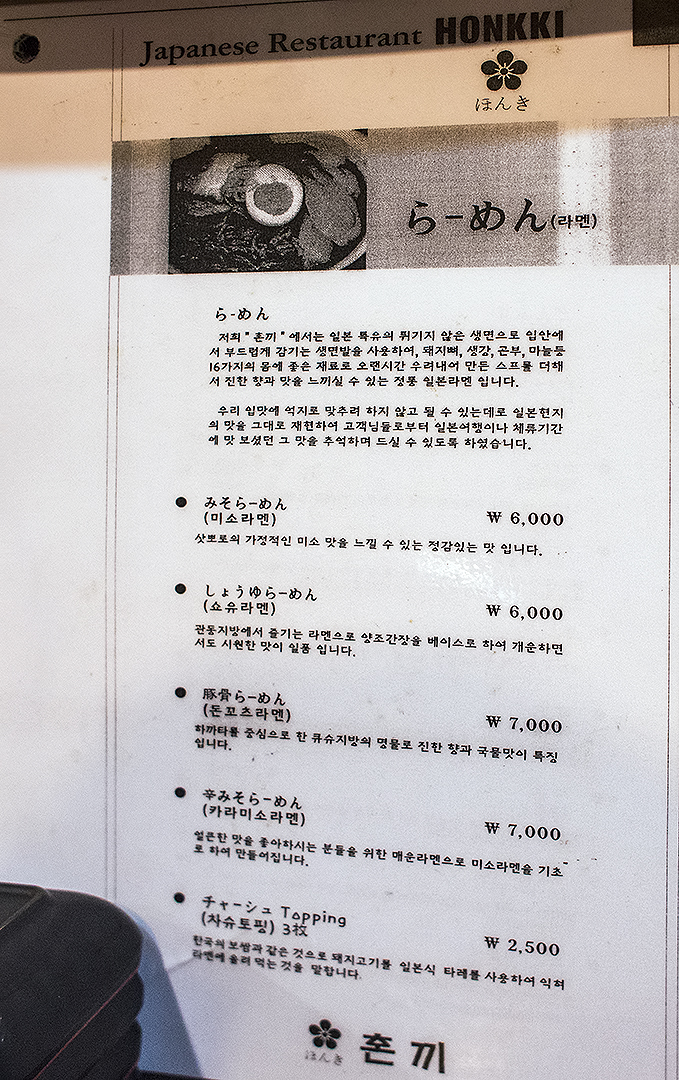
Honkki Japanese Restaurant menu (near back gate of Chonnam National University, Gwangju, South Korea)

Most Korean restaurants aren’t set up for single, foreign travelers. The menus are only in Korean, the portion sizes (and prices) are for two to four people ordering one thing, and the tables are set up for parties of four (or less frequently parties of two). Some places even turn you away if you come in by yourself. One workaround if you can read Japanese is to patronize Japanese restaurants in Korea. Although the employees won’t likely be able to speak English or Japanese, the two that I have been to have menus in both Korean and Japanese so at least I know what I’m ordering.

On this day I went with the Miso Ramen (みそら~めん).

honkki japanese food cnu honki honnki ramen gwangju south korea

It was good, one of the better bowls of ramen I’ve had outside Japan. The half a hard-boiled egg was a little different than how eggs are usually served in Japanese Ramen, but other than that it seemed pretty authentic.

Kaiten Sushi in Shinsegae Department Store basement

回転寿司 gwangju south korea

回転寿司 in Gwangju, South Korea

It’s not unusual to see conveyor belt sushi in Japan, but this was the first time I saw it in Korea. The location was particularly unusual as it was in a department store of all places. With double-rows of sushi (and some Korean food items) going around and around, and having eaten nothing but a piece of bread and a bag of chips all day long, I was ready to give it a try. However, there were no empty seats (the above photo shows only about a one third of the filled seats) so I had to opt for something else.

Gwangju stadium panorama

panorama photomerge gwangju baseball stadiums new and old along river

Gwangju’s new baseball stadium

Let me introduce you to my bike while in Gwangju. This is Squeaky. I call my bike Squeaky because it squeaks, a lot. Squeaky isn’t a comfortable bike to ride. Nor does it do well on even mild inclines. But I’m still glad to have Squeaky as it allows me the opportunity to see much more of Gwangju than I otherwise would.

The big stadium behind the river is still under construction. It is scheduled to open for the next baseball season in 2014. They haven’t named it yet. At the KIA Tigers game I went to fans were given stickers to place on the name of the stadium they preferred. Since I can’t read or understand Korean, I’m not sure what name I voted for, but I was thanked for voting.

Bulgogi hot pot

gwangju south korea lotte department store restaurants

Bulgogi or sukiyaki?

I was checking out Gwangju’s Lotte Department Store the other night, and when I got to the top floor there were a bunch of restaurants–not unlike how Japanese department stores are setup. Also, unlike the restaurants everywhere else in Korea, these had displays showing what the food would look like and English titles. I saw one that said bulgogi and looked no further. I went in and ordered. Unlike bulgogi in the states, this version came in a bowl of boiling soup. It looked and tasted more like sukiyaki than any bulgogi I have had. I love sukiyaki so I was happy. This hot pot bulgogi had sukiyaki ingredients like enoki mushrooms, Chinese cabbage, negi, and jelly noodles. It was a perfect melding of my favorite Korean and Japanese dishes. It came with kimchi (of course), a couple other pickled sides, and rice for about $6. I will be back.

The department stores in Korea are rather interesting. Instead of being organized by type of item, like in the states, they are organized by brand. So you go to one part of Lotte for Gap and another for Uniqlo and another for Zara, etc. There were probably 30+ mini stores from all over the world inside Lotte. Based on my experience with Lotte in Japan, I was expecting 7 floors of gum. 😉

Changing US$ dollars into Korean Won (and Japanese Yen)

change us dollars into korean won south best rate airport atm how to

10,000 Korean Won Bill

One of the most popular posts on this blog is the one dealing with getting the best rate when you change dollars into Japanese Yen. Here is a 2013 update based on my actual experience, and my exchange rate and fees for converting my dollars into Korean Won.

First, the yen…
My 2009 experience held true in 2013. I was planning to get money out of an ATM in the Narita airport while transferring planes to Fukuoka. However, once I went through customs and security in Narita, there were no ATMs so I couldn’t get yen out of an ATM there. You can obtain yen in the Narita airport if you are departing from there, and perhaps you can near customs, but I didn’t think to look until after I went through security for domestic transfers as I was more concerned with finding my gate than obtaining yen. In Fukuoka I didn’t look for an ATM in the airport (as I had brought enough yen with me to get to my ryokan). The next morning I walked into the first 7-Eleven I saw, inserted my (Wells Fargo issued) ATM card (which has Plus, Star, Instant Cash, and Interlink logos on the back), and without any troubles withdrew my maximum allowed on the US side (which I had raised via a phone call before leaving). The yen came out at the market rate and Wells Fargo charged me a $5 fee (which means my total exchange fee was 1/3 of 1%). Rates for changing cash in the US airport were more than 5% and in Japan the rates were about 2 or 3% so the ATM card is still the way to go (if you need to change more than a couple hundred dollars).

Next, the won…
The English instructions at the first ATM I went to in the Korean airport were pretty confusing, and I couldn’t get any won out using my ATM card. I asked someone for help, and they assisted me even though they couldn’t speak English. We went through three ATM machines before we found one that gave me won. Also, the ATM machine in Korea spit out only 10,000 won bills. In the USA I’m used to getting $20 bills out of ATM machines. In Japan you get (mostly) 10,000 yen bills (about $100). A 10,000 won bill is worth less than $9 so that means if you are pulling out the equivalent of, say, $1,500 in US$ you will receive about 160 bills! Try fitting that into your wallet! The rate charged was the market rate, and Wells Fargo charged me $5 so, again, the ATM was the way to go for getting the best rate (if you are pulling out large sums of money). The number of ATMs that work in Korea don’t seem to be as high as those in Japan (I’ve never had an ATM in Japan–whether that be an airport, convenience store, bank, or post office–not work), but don’t give up. Just try another machine until you find one that will give you Korean Won with your foreign bank card.

Carp attack!

Jejumok-Gwana 제주목관아 carp pond 잉어 koi korea south fish republic

Jejumok-Gwana (제주목관아) Carp

I saw Hiroshima Carp earlier on this trip, but these were the first carp I saw in Korea. As I lowered my camera down toward the water they got really frisky.