The Mori Tower and Louise Bourgeois’s Spider (Maman)

In front of the Mori Tower, in the Roppongi Hills complex, there is a giant spider called Maman. We saw a smaller version of it in Denmark a couple years ago.
|
The above will search Traveljapanblog.com. Concerts - Landscapes - Sports |
In front of the Mori Tower, in the Roppongi Hills complex, there is a giant spider called Maman. We saw a smaller version of it in Denmark a couple years ago.

While on our walk in Niiza, we were becoming a bit hungry when we saw the above building in the distance. “Great,” we thought, “a few sushi pieces and we’ll be good to go until lunch.”
When we got closer, we realized that this was no ordinary kaiten sushi place. Not only can you get sushi off of a conveyor belt here, you can also get it to go or get it through the drive through!

Drive-through restaurants aren’t nearly as common in Japan as they are in the U.S.A. Above is a photo of the menu.

This kind of Tokyo home is becoming harder and harder to find. I suppose Tokyo was loaded with these kinds of structures after the war. Most are now long gone, although some neighborhoods still have some clusters. The one pictured above was all by its lonesome, wedged between a gasoline service station/car wash and a bar. The location isn’t down some back alley in a shitamachi as you may expect. This home is right on Meiji Dori between Ebisu and Hiroo Stations.

My home for the past 10 months…

I have seen this curious building, above, several times (on Shinmejiro Dori, just west of Takadanobaba Station). On this day it finally looked ready for a picture with the blue sky and white fluffy clouds passing by.

This second photo is from the beginning of Walk #2. The Shakujii River was at my back and the Azaleas were in bloom.
I’m sometimes asked what has changed in Japan from when I lived here in the late 1980s. One of the biggest changes is the aesthetics of the apartment housing. I’m not sure exactly when this change came about, but once upon a time nearly all apartments in Japan (danchi or 団地) were made of white concrete. These still exist, as you can see in the above photo, but they are no longer made to look this way. Most, in Tokyo anyway, have been rebuilt with a more modern design (or at least the facade covering the buildings make them look more modern than the white cement which doesn’t age very well).
Not all go for the blue of today’s top photo, but they still look more pleasing than the endless, dirty-white housings of Japan’s past.
As mentioned last time Japan is not standing still. Guidebooks tend to credit Japan’s new buildings on fires and wars, but that really isn’t the truth as far as the modern landscape is concerned. Otherwise, most buildings in Tokyo would have been built around 1950. Actually, most have been rebuilt once and sometimes several times since 1950. I’m not talking about a remodel. Functioning buildings are torn down and constructed from scratch on a regular basis.
There aren’t many old buildings where I am from on the west coast of the U.S., but that isn’t because the structures have all been rebuilt. Other places I’ve visited (Denmark, Italy, France) have many buildings more than a few decades old and some are much older. Not so in Japan, even with its long history. Outside of Tokyo isn’t an exception as the places that claim a history of hundreds of years have usually been rebuilt, frequently many times.
Here are a few examples I have recently noticed.
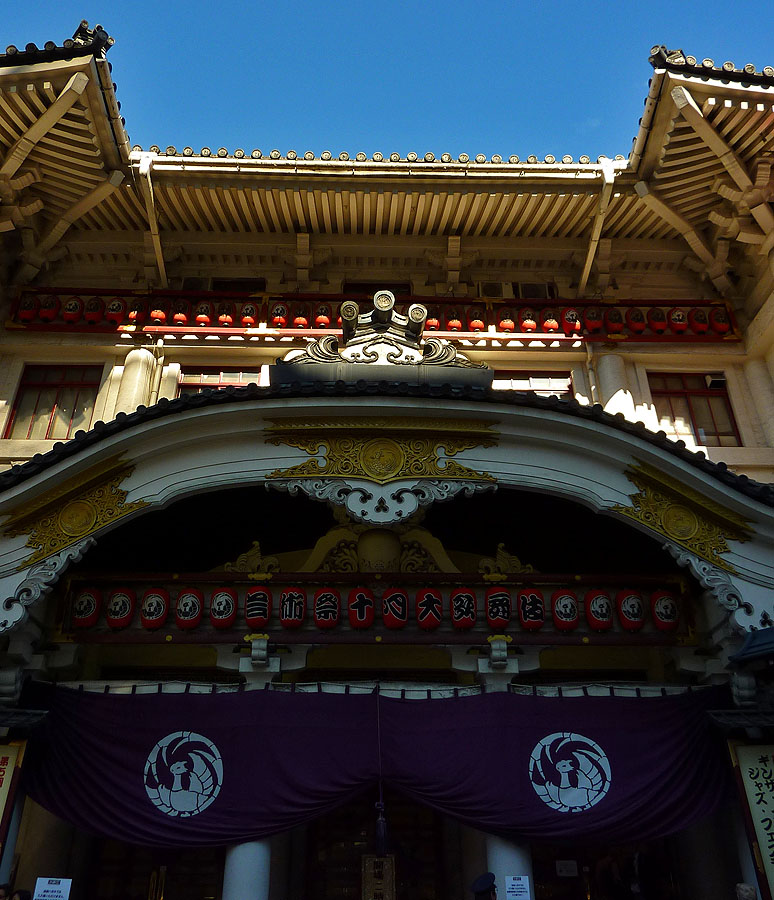
Ginza’s Kabuki Theater closed last week. It will be gutted and a new Kabuki Theater will be built in its place. The old Kabukiza was ancient by Tokyo standards at about 60 years. I’m sad it will no longer exist, but it was very dated. There was no leg room in the seats for anyone over about 5′ 8″. Handicap access was non-existent. Modern amenities were completely missing. The rebuilding of this place actually makes sense. Once the new Kabukiza is opened in 2013, the old one will be forgotten.
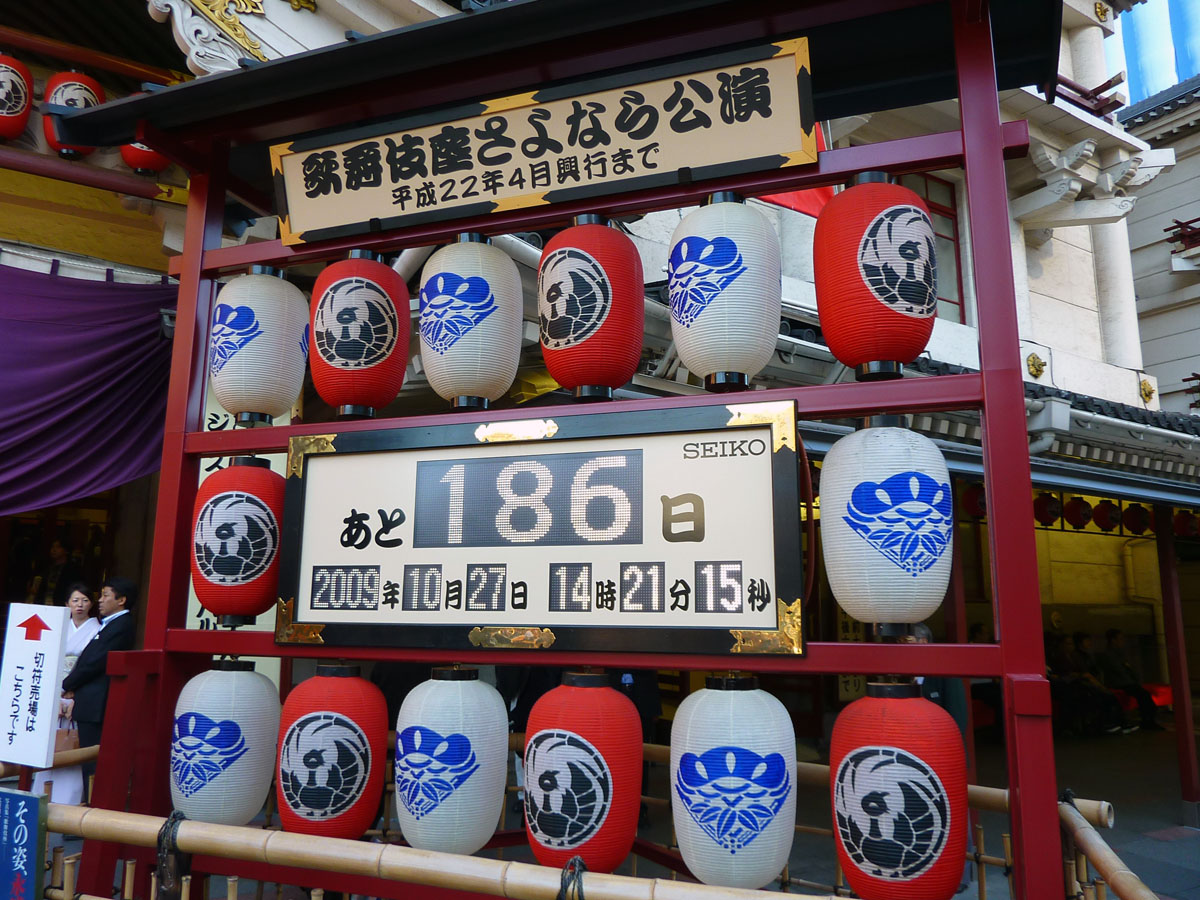
This was the sign in front of Kabukiza about 190 days ago.
Next up is the Grand Prince Hotel Akasaka. With less than 30 years of life under its belt, this hotel will be demolished in March of 2011. A 40-story, luxury hotel has less than a 30-year life these days? Is construction cheap or something? I don’t think so. I don’t understand why such buildings are “refreshed” in Tokyo on such a regular basis.
Finally, I was walking down Meiji Doori the other day and came upon a huge construction site on the corner of Omotesando where the GAP was a few weeks before. The building seemed pretty nice to me, but now it is gone. Another will soon fill its place. The building was only 10-years old! 10-year old buildings being razed for another to be built in its place seems more than a bit strange.
Such is life in Japan’s building merry-go-round.