TravelJapanBlog.com - Japan (07, 09-10, 13), Denmark (08, 11, 16-19, 21, 24), Korea (13), Poland (21), Mexico (14, 15, 19, 26), Iceland (17, 19), Hawaii (14, 17, 22), Czech Republic (16, 17, 19, 21)
The above will search Traveljapanblog.com.
Concerts - Landscapes - Sports


Posts tagged buildings

Tokyo tram


“Three old women were the only passengers on the Sunday morning tram [from the end of the line at Waseda]. They all looked at me and my flowers. One of them gave me a smile. I smiled back. I sat in the last seat and watched the ancient houses passing close to the window. The tram almost touched the overhanging eaves. The laundry deck of one house had ten potted tomato plants, next to which a big black cat lay stretched out in the sun. In the garden of another house, a little girl was blowing soap bubbles. I heard an Ayumi Ishida song coming from somewhere, and could even catch the smell of curry cooking. The tram snaked its way through this private back-alley world. A few more passengers got on at stops along the way, but the three old women went on talking intently about something, huddled together face-to-face.

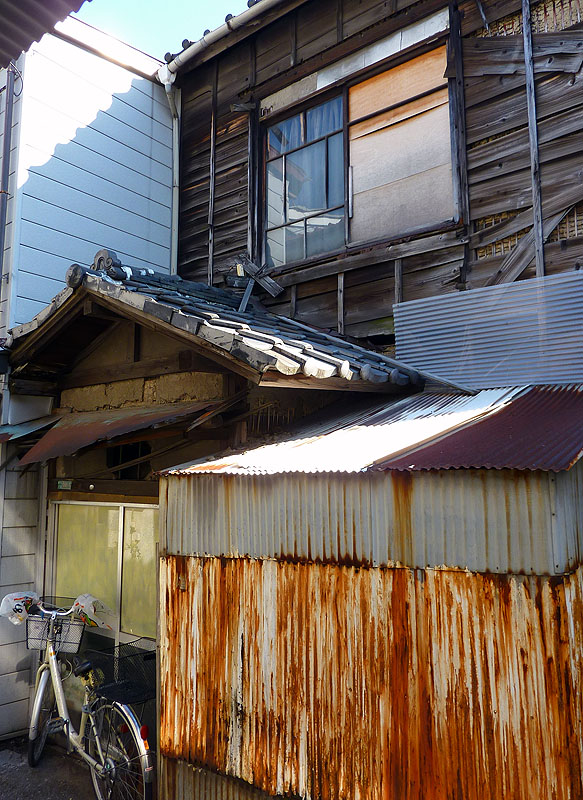
I got off near Otsuka Station… None of the shops along the way seemed to be doing very well, housed as they were in old buildings with gloomy-looking interiors and faded writing on some of the signs. Judging from the age and style of the buildings, this area had been spared the wartime air raids, leaving whole blocks intact. A few of the places had been entirely rebuilt, but just about all had been enlarged or repaired in places, and it was these additions that tended to look shabbier than the old buildings themselves.” Norwegian Wood p. 84

Spring in Shinjuku

shinjuku-ku kabuki-cho signs businesses bars

Today’s picture is of the same place as the top picture in this prior blog entry, Shinjuku’s Kabukicho. The differences are the vantage point and time of day.

Waseda University cafeteria view

“I went to the [Waseda University] cafeteria afterwards and ate a cold, tasteless lunch alone. Then I sat in the sun and observed the campus scene.” Norwegian Wood p. 103

China’s new real estate

China’s real estate market is stranger than Japan’s real estate at the height of its bubble or the U.S. real estate market before the credit melt down. Prices are going up even faster in China than those other places did, yet unlike those other places, few are actually living in the new developments.

The above photo is of a recent complex next to Lvyin Park. It looks nice from the outside. I’m guessing it isn’t as well made as it looks from a distance though. At night, when lights normally go on in occupied apartment buildings, only a small number of the units appear to be occupied. Why? Few Chinese can afford the price.

From my observations, and from hearing what some Chinese people told me, here is one view of how the current Chinese real estate bubble is working. The government owns all the land, which they now view as an investment to make money from. They sell (or lease) the land to a developer at a profit equal to the sales (or lease) price (since the land cost the government nothing, the sale is 100% profit). Since prices are going up at a rapid pace, the developer makes a fortune as well by building a cheaply made building that looks nice. Buyers line up to purchase the units with the hope that prices will continue to increase. The buyers have no intention of ever actually living in the place. A couple years later, assuming prices rise, they dump the apartment to another buyer who won’t live there, and the cycle repeats.

The problem is there are about a million “rich” people in China and about 1.3 billion people who can’t play the real estate game. The million who can play the real estate game aren’t doing much to benefit the other 1.3 billion people, many living in poverty. The million own millions of properties that sit vacant while the vast majority live in cramped and unsanitary conditions. The government and rich grow richer. The masses working for them earn next to nothing.

cbd zhengzhou henan

China’s government has built a new Central Business District (known as the CBD) east of the city center in Zhengzhou. 12 lanes of traffic, 6 in each direction, will someday move cars around the area. The streets (above) were completely empty on the day I visited the place. On the same day I was stuck in several traffic jams just a few kilometers to the west. Those streets were packed with people, bikes, cars, and buses. Why were these empty? They are paved nicely and have fine sidewalks (unlike the other, crowded streets).

At first I thought it was because the buildings must not be finished. True, some were still under construction, but many were completed. I was told that only a few investors have purchased the buildings from the government. No businesses are moving in to the area. Nor are any people. The few investors hope to sell everything (if and) when the prices rise more. But if no one can afford to move in now, how are they going to be able to afford an even higher price later? Someone is going to lose a lot of money when the bubble bursts. It won’t be the Chinese government. It probably won’t be the initial speculators (i.e., those with money and close ties to the government) either.

The sad part isn’t that someone’s investment will drop in value. The disappointing aspect is that the government is making money at the expense of the people rather than doing something to help the people’s standard of living (like invest in the infrastructure where the people actually live).

To stimulate the economy in 2008 and 2009 the Chinese government provided incentives for people to purchase cars. Auto sales jumped, while the roads, which are loaded with potholes and are crowded already, got more congested and the air became filthier still.

Zhengzhou University of Light Industry

Zhengzhou University of Light Industry (郑州轻工业学院) is where I spent a good chunk of my time while in China. There isn’t much about the place on the internet. I was told the buildings are mostly from the 1960s. To be perfectly honest, the place can use some major renovations. The classrooms aren’t heated (or cooled in the summer). The vegetation on the campus that was supposed to be green looked rather gray, matching many of the buildings and the polluted sky. If you ever find yourself here, be sure to check out the copy center and a restroom or two. Just make sure you don’t have to actually use the copy center or a restroom.

The above photo is from a classroom on the third story of one of the buildings from which I was teaching. Notice that the campus is completely devoid of students while classes are in session. This is different from any university I have ever experienced. Students are in class, on time, and none leave early.

Compare that situation to when the bell rings (yes a bell rings to signal the end of class–another thing I’ve never experienced at a university), and all students are moving away from class to go off campus to eat. The campus shuts down for two and half hours for lunch. Very different.

Some of my Chinese students wanted me to see their dorm. All students are required to live in the dorms. Students complain about college dorm life all over the world, but a visit to a Chinese dormitory will make anyone living in any other dorm feel very fortunate.

The above photo is of the shared balconies. Sixteen students share a single, small balcony to try to dry their laundry in the cold, smoggy air.

Eight students share each room, although there is little room outside of the four bunk beds. There is one study table in the middle of the beds shared by all (or more likely used to put things on so students can sit on their bed which is where they normally have to store their things).

In the back corner is a small room with a hole in the floor for a toilet. A shower and sink are also in the back corner room, but I was told the showers aren’t used because the water isn’t heated; in fact, it isn’t even warmed. Plus, all the water (mostly for doing laundry in the little sink) has to be carried up several flights of stairs. Electricity is on a strict quota so if students use up their quota power is cut to their room.

Despite such unfavorable living conditions, these eight (only five are pictured with me) seemed to get along great, and they were usually smiling.

Nihonbashi (日本橋)

“We took the subway to Nihonbashi. The place was practically empty, maybe because it had been raining all morning. The smell of rain filled the big, cavernous department store, and all the employees had that what-do-we-do-now? kind of look. Midori and I went to the basement restaurant and, after a close inspection of the plastic food in the window, both decided to have an old-fashioned cold lunch assortment with rice and pickles and grilled fish and tempura and teriyaki chicken.” Norwegian Wood p. 342