Year of the Tiger ema

Here is a closeup of the tiger (寅) ema discussed in yesterday’s entry.
The stamp on the lower right of the ema is the official one of Meiji Jingu. It says Meiji Jingu (from top to bottom and right to left 明治神宮) in funky script.
|
The above will search Traveljapanblog.com. Concerts - Landscapes - Sports |
Here is a closeup of the tiger (寅) ema discussed in yesterday’s entry.
The stamp on the lower right of the ema is the official one of Meiji Jingu. It says Meiji Jingu (from top to bottom and right to left 明治神宮) in funky script.

The south gate is the main approach to the Meiji Shrine. Normally you can walk right up to this point, but on New Year’s Day it may take an hour or more to reach this area from the Harajuku Station. If you want to avoid the crowd, there are other entrances (like from Yoyogi Station, past the archery area and through the west gate).
Notice the giant ema (wooden wish plaques or 絵馬) and arrows (hamaya or 破魔矢) on the gate. The shrine does a massive business in selling smaller versions of these items (and other good luck trinkets) for the first week of the year. Some of these amulets are to be brought back to the shrine the next year and burned. People pay to have this service performed as well. How is that for a business model? Sell your customer something and then charge them in a year to destroy the product. When they come back to have last year’s goods burned, you sell them the same product again for the next year and the cycle repeats. Nice.
For 2010 the giant ema featured a tiger since it was the year of the tiger. I’m guessing that for 2011 a similar ema with a rabbit was on the gate since 2011 is the year of the rabbit.

The above photograph is from Kiyomizudera (清水寺) in Kyoto. The boards to the right are ema. Below I have a picture of one close up.

Normally these wooden plaques are written on in Japanese and contain a wish or request. This one had some rare English and is used more as a memorial than the typical desire or prayer.

These are the ema (prayer plaques discussed here previously) at the Golden Pavilion in Kyoto. The god that grants these desires is 不動明王 who you can also gain favors from across town at Fushimi Inari Taisha.
In our last Fushimi Inari episode the topic of ema came up. In addition to ema you can also find mikuji, otherwise known as omikuji, 御神籤, or おみくじ, at most Shinto shrines in Japan.

These work differently than ema, although to a photographer or appreciator of Japan’s shrines they serve the same basic function of cool window dressing on the other beauties and wonders around every turn. Omikuji are purchased, like ema, but they are not written on. Instead, they already have writing on them. The writing is a fortune–sometimes good, sometimes bad. If you purchase one and it has a 吉 character then you have a good one. The character before the 吉 indicates how good your fortune or blessing is. If yours has a 凶 on it, then you have a curse. Ouch! The way to possibly avoid your curse is to tie it at the above location at the shrine. All those curses make for a work of art.
As you can also see from the above photo, the grounds are meticulously kept and cherry blossom season (sakura) makes things even prettier.

Fushimi Inari is the head Inari shrine. Other Inari shrines are all over Japan and feature Torii Gates, but Fushimi has the most. I don’t know the exact number, but it must be in the thousands. It’s a wonder to behold, especially if the paths beneath the gates are empty of tourists like they were when we were there. Again, get there before 10 a.m. for best results. Better yet, wear running clothes, get there by 8 or so and run through them all.
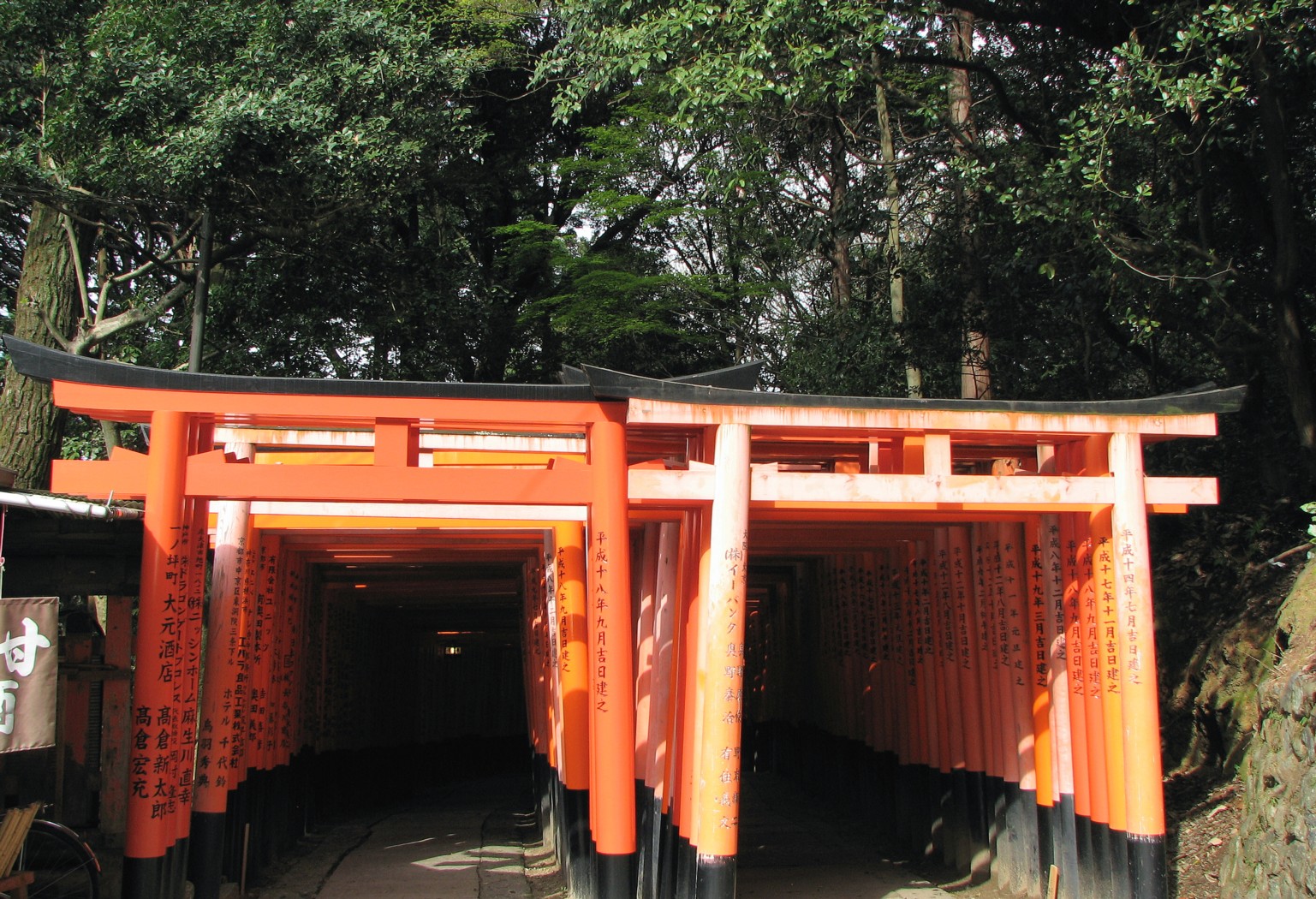
The writing on one side of the gates indicates what person, or more commonly, company, purchased the torii. On the same side, but other post, of the torii is the date it was purchased (or perhaps installed).
Prior to actually visiting Fushimi Inari, I was picturing one path of a few dozen gates. I was surprised when I got there to find seemingly countless paths of torii, some running parallel, or at least starting parallel, to each other. It’s a maze like no other.
If you are like me, you like blogs you are interested in to be updated daily or at least several times a week. Nothing is worse than those blogs of promise that only have new content once every few months. I get tired of waiting and stop visiting. To that end, I will blog “old” information at times–especially times like now when I’m not on the road.
So let’s flash back to our trip to Japan from last year. On our last morning in Kyoto we went to the famous Fushimi Inari Taisha which is one of my favorite places in the world. Like many temples and shrines in Japan, it is particularly nice in the early morning hours or at dusk. If you have seen the movie Memoirs of a Geisha then you have seen this place. It is famous for its Torii (鳥居) gates, of which it has a ton–seemingly as many as the rest of Japan combined. However, I’ll save the Torii pictures for another entry.
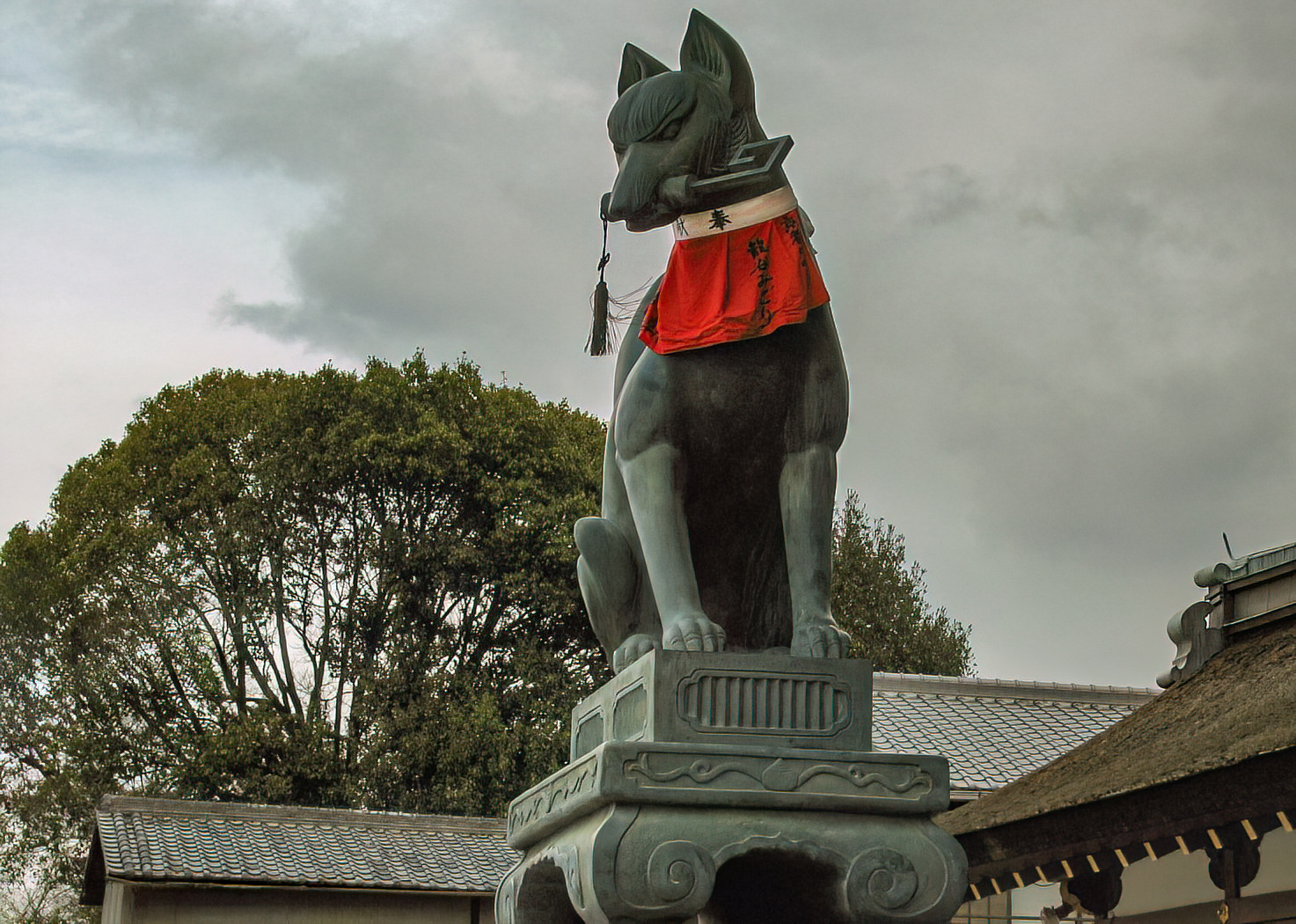
For this entry, let’s focus on a couple of other curiosities about the place. Inari (稲荷) is the Japanese god of foxes (kitsune, きつね, or 狐) among other things. Hence, you can find lots of foxes at this shrine. The one pictured here is near the entrance. (As always, maximize your window and click on any of this blog’s photos for a much better view.)
One of the beautiful things at Shinto shrines is the prayer card walls. The prayer or wish plaques are called ema (絵馬). I’m not sure if “plaque” is the proper term. I suppose they could just as easily be called cards, boards, or tablets. They are made out of wood. Ema means “picture horse” but these days they can have any or no pictures on them. I’ve seen some with popular manga pictures printed on the wood. They are frequently placed in such a way that you can get this kind of wonderful photo of them all lined up with a shrine in the background. This one not only had the wooden plaques lined up nicely but also had colorful origami cranes below.

Fushimi Inari Taisha actually contains multiple shrines. This next one has a specific purpose. The readable kanji in the lower right are 入学奉. I’m guessing that there is a fourth character that didn’t make it into the picture and that kanji is probably 納. 入学奉納 means “an offering to get into school.” Students come here (and you can see one in the above picture) to wish for acceptance into the high school or university that they are trying to enter. It’s easier and takes less time than studying. 😉

You can see the wish cards to the right and left of the center. A student would pull the white cord to ring the bell and summon the gods, clap their hands together twice, bow, make an offering of money, and then, perhaps, write their prayer on an ema to hang on the aforementioned wall.
Based on what I’ve read and conversations I’ve had, most Japanese don’t actually believe that the gods will get them into school. They do this more out of tradition and because it’s kind of fun. Although I’m no fan of superstition, I find these shrines and ema walls to be incredibly beautiful. The sights, sounds (of the bells, gongs, and hands doing quick claps), and smells (incense) really do make me feel something.