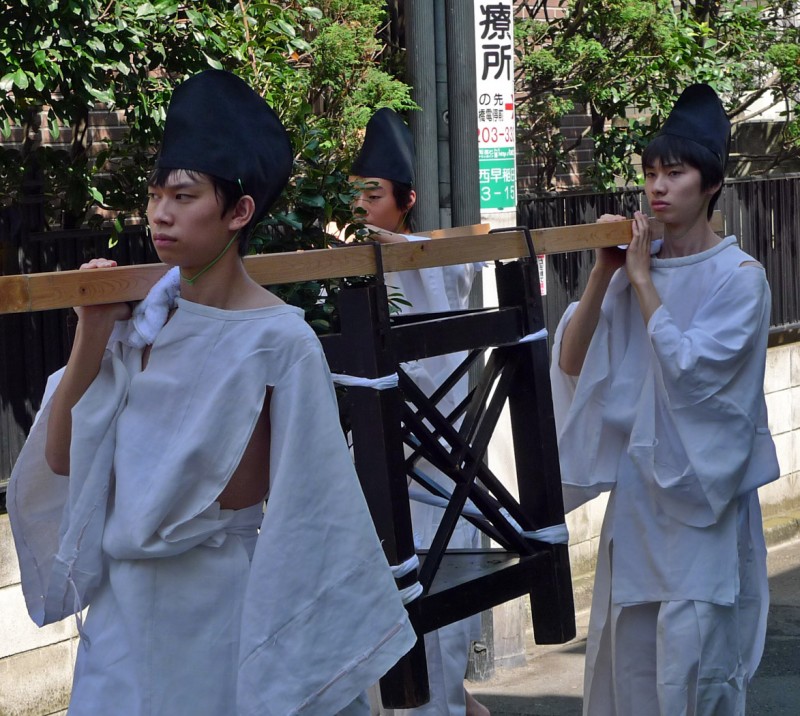
At a Shinto festival near our apartment in Tokyo, these Japanese boys carried what appears to be a palanquin or litter or kago (駕籠). Palanquin are used for carrying people, though, so I’m not sure if the Japanese actually call this a kago or if there is a different word for it. I believe this one is holding a plant, maybe a young tree. The item being carried in this manner in Shinto parades is referred to as a goshintai or “god body.” Similar to the omikoshi, the goshintai is carried around town on rare occasions (sometimes once a year, sometimes once every few years) before being returned to its place in the Shinto shrine.
On a different topic, notice the address sign on the telephone pole. It says 西早稲田 (NishiWaseda) 3-15 below an advertisement for the company “sponsoring” the pole (a doctor’s office or clinic of some kind down the street). I lived in the 3 Chome of NishiWaseda. It’s easy to get lost in Japanese neighborhoods since there are few street names, the addresses don’t run consecutively, and there is a complete lack of a grid pattern in most neighborhood layouts, but it’s much easier to find out where you are lost in Japan due to the high number of these address displays telling you exactly where you are. The problem is in figuring out how to get from your currently lost Point A to your target location Point B.
Posted on January 6th, 2011 under Japan. Tags: festivals, people, shinto. Comments Off on Carrying the body of god (御神体)


