TravelJapanBlog.com - Japan (07, 09-10, 13), Denmark (08, 11, 16-19, 21, 24), Korea (13), Poland (21), Mexico (14, 15, 19, 26), Iceland (17, 19), Hawaii (14, 17, 22), Czech Republic (16, 17, 19, 21)
The above will search Traveljapanblog.com.
Concerts - Landscapes - Sports


Posts tagged kofu

Takeda Jinja 武田神社

武田神社 ricoh

I walked up Takeda Dori to see Takeda Jinja for the first time in 22 years, but I was in for a surprise at the top of the street. I was expecting to see a typical, peaceful shrine, but, instead, Takeda Jinja was taking part in the Takeda Shingen Matsuri (信玄公祭り).

武田神社 kofu japan

Wave after wave of Shingen’s 24 regiments made their appearance at the shrine to receive their 戦勝祈願式, which I suppose would translate into something like “victory in war blessing ceremony.”

kofu japan 武田神社

Above is a picture of one of Takeda Shingen’s 24 generals (武田二十四将) for the day. I’m not sure which one, but his blessing worked well as he was alive at the end of the day, unlike most of Shingen’s real generals who died in the Battle of Nagashino in 1575.

琴 takeda jinja kofu yamanashi ken japan

If Shinto prayers and battle cries aren’t your thing, you could always move away from the main shrine and over to the stage where these Japanese ladies were playing traditional Japanese folk tunes on their kotos (琴).

More from Kofu

poster for shingenko festival matsuri

My heart was filled with excitement when I reached the Kofu Station. I’m not sure if it was the fantastic weather, anticipation of the Takeda Shingen Festival, or the fact that I hadn’t been to Kofu (甲府) in almost 22 years. Probably it was mostly the latter. I was thinking that maybe my thoughts of Kofu were overblown in my head simply because it was the first place I lived in Japan, and I hadn’t been back in so long. 懐かしすぎると思って But that didn’t turn out to be the case. I wasn’t let down upon arrival. I do in fact love the place and wasn’t disappointed.

The people were friendly, the weather was spectacular, and the cherry blossoms were just past their peak. I overheard the ladies I met on the train talking quietly amongst themselves about how they should invite me to hang out with them for the festival. While this would have been fun for about an hour or two, it was barely past noon and I had lots of old, familiar territory I wanted to see again. So I said goodbye before we exited the train station and before they had a chance to continue their niceness to me. I was hoping I’d see them again later in the day, but that didn’t happen.

武田信玄像

I had made no plan of what to do once I arrived in Kofu. My first instinct on exiting the train was to see Takeda Shingen’s statue (武田信玄像) in front, which I had gazed at daily for seven months back in 1988. He looked as good as ever, especially with the cherry blossoms.

kofu city

I kept going in that direction towards my old apartment in Asahi Cho (朝日1丁). Most of the stores and buildings were different, but something felt the same too. The only stores that hadn’t changed were a doll store and a glasses store on Asahi Dori. The building I lived in was still there. It was one of the newer buildings on the street in the 1980s, I think, but now it looks like one of the oldest. Nearly everything has been rebuilt.

Before my conscious mind could catch up with my unconscious one I was in the elevator, then facing my old apartment door, and then knocking on it. No one answered which, in hindsight, was probably best. I took the above photo from the front door of my old apartment. Maybe I have a similar one from 1988 in an old photo album somewhere that I can compare it to when I get back to the U.S.

武田通り 甲府市 山梨県 武田神社 桜

I kept walking up Asahi Dori to see what else had changed, and before I knew it I was making my way to Takeda Jinja (武田神社)–again completely unplanned, my feet just started carrying me there. This brought back memories of my first night in Kofu, a cold and rainy one in January 1988 in which I rode a bike up Takeda Dori and thought the street would never end its gradual uphill climb.

This time I walked up it. Takeda Dori (武田通り) is lined with sakura (桜), but they were several days past their peak. The University of Yamanashi (山梨大学) is on this street, although I don’t remember it being located here in 1988. Was it?

I passed kids while walking up the street, and they all said hello (harro actually) to me. I really miss this in Tokyo. Kids in my neighborhood in Tokyo only say things to me if I say something to them first. Most don’t even glance at me on their way school in Nishi-Waseda. It’s as if I’m Japanese to them. Not so in Kofu.

Getting to Kofu

高尾駅

Perhaps I should back up and present my day in Kofu chronologically. I took the Keio Line from Shinjuku to Takao Station for two reasons. The first is that it costs 190 yen less (each way) than JR, and the second is that the views are better. You can see Mt. Fuji on a clear day from Keio’s Kitano Station, but it wasn’t clear enough yet on this day. If you get on a semi-limited express train (like I did) the Keio Line is actually faster too.

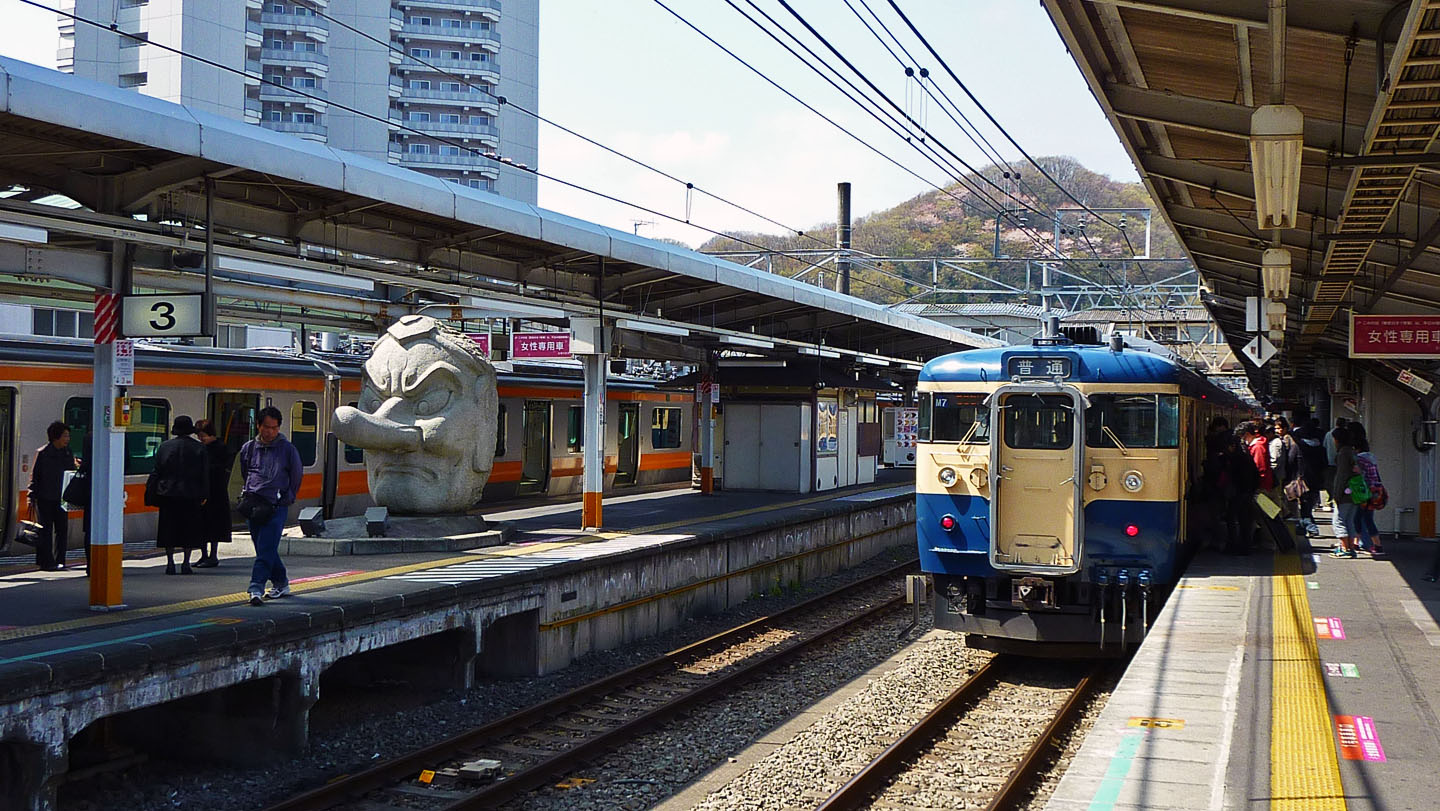
I transfered at Takao Station onto the JR Chuo Line. On the JR platform is a giant Tengu head statue. Tengu is the symbol of Mt. Takao, which you can get to from this station but not as easily as from the Takaosanguchi Station on the Keio Line.

The train I took, pictured above, from Takao to Kofu is the exact same one I took 22 years ago according to my memory. Japan is full of improvements in the past few decades but JR doesn’t seem to have changed a thing to the regular trains on this line.
ootsuki station fujiyoshida fuji five lakes map directions

The views from the train were really nice–rivers, lakes, fishermen, sakura, mountains, older Japanese homes–things that are not so commonly viewed from trains in Tokyo. The train stations are also much smaller. Everything is a bit more charming.

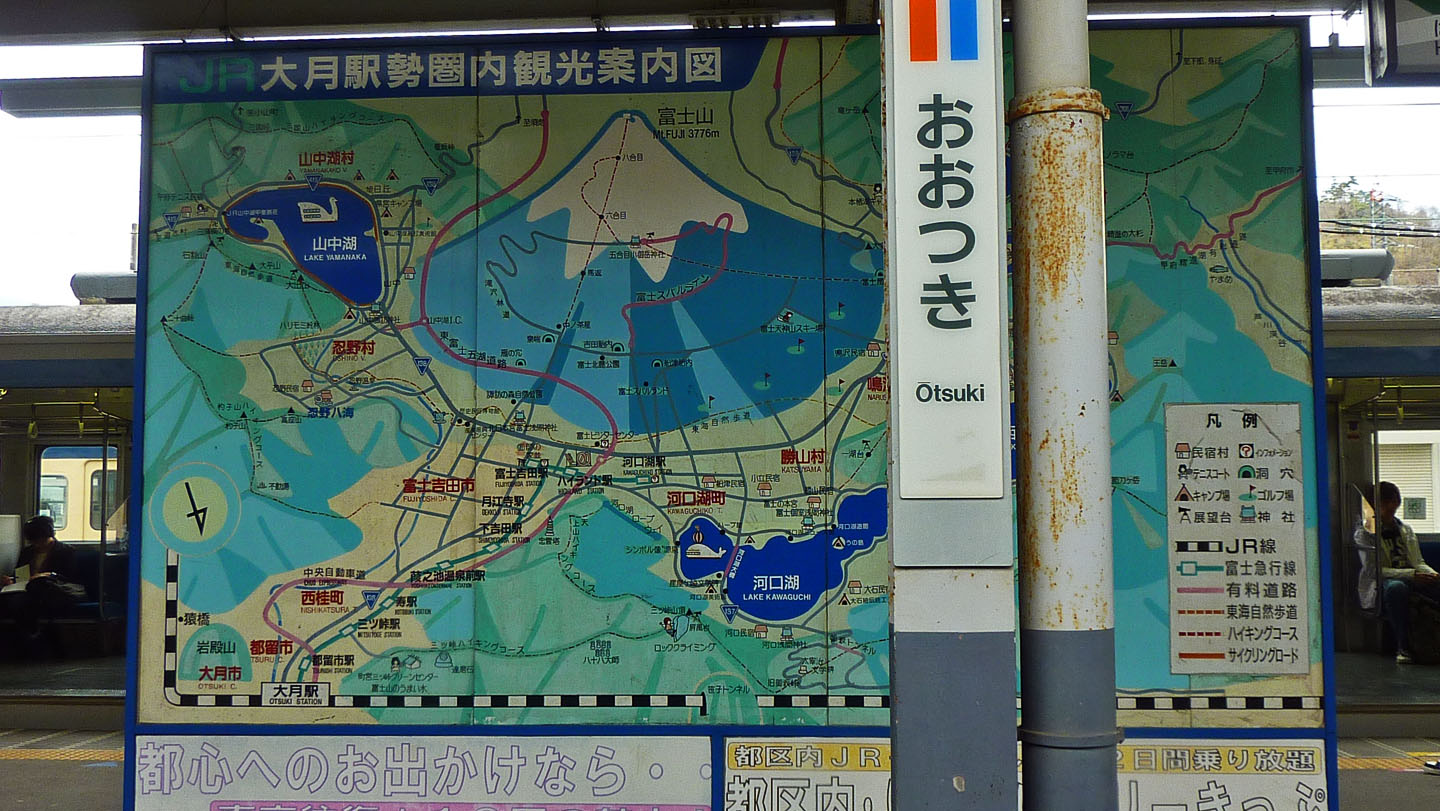
The first decent sized station after Takao is Ootsuki. From Ootsuki you can head south to Fujiyoshida or to the Fuji Five Lakes Area. I stayed on the train though. The above photo is of a map of the area that I took from inside the train while we were stopped at the station.

jidohanbaiki cherry blossoms blue sky kai-yamato station

The blossoms along this route were really fantastic at times. Sometimes it seemed to be snowing as blossoms fluttered around the train as we speed through a tunnel of blooming trees. The sun came out, for one of the first times during the cherry blossom season, which made things look even better.

enzan higashiyamanashi station view cherry blossoms yamanashi ken sakura mountain view

I’m not sure if the above photo is from Enzan Station or Higashiyamanashi Station, but the view was great.

The City of Yamanashi in Yamanashi Prefecture had orchard after orchard of blossoming trees. I’m not sure if they were cherry blossoms as they were pink instead of the normal white. Yellow, ground flowers (rapeseed perhaps) bloomed beneath them. With the mountains, partially blue sky, and white fluffy clouds, it made for an impressive scene (and one somewhat different than the one pictured above).

The people in Yamanashi Ken have always been very good to me. I got up to let four, older Japanese ladies sit together when they got on in Yamanashi. That was enough to turn me into an instant friend in their eyes. They shared their candy with me, and we had a good time talking about the area and Kofu, which is where they were also going to experience the same festival.

Takeda Shingen’s wife

武田信玄

The Takeda Shingen Festival featured more than twenty different companies or organizations dressed up as Takeda Shingen’s regiments. Some included females as well. Most females were dressed up as samurai, but the above group had a lady in a palanquin that I believe was supposed to be Takeda Shingen’s mother. Before her in the procession was this female who may have represented Lady Uesugi or Lady Sanjo, two of Takeda Shingen’s wives.

Notice the Takeda Shingen statue in the background. You can find it to the right as you exit the Kofu Station. It is one of the few things that hasn’t changed since I lived in Kofu in 1988. The Takeda Shingen statue hasn’t changed since it was erected in 1969. The Shingen statue is one of my first memories of Japan as I walked from the station to the right (west) to reach my apartment located in Asahi 1 Cho.

Takeda Shingen Festival 信玄公祭り

信玄公祭り

My first seven months in Japan, 22 years ago, were spent in Kofu. I went back, for the first time, for this year’s Takeda Shingen Festival. Things have changed; others have stayed the same, like my love for the place. とても懐かしかった。

Eventually I’ll post a few dozen pictures and video from the day’s events.