TravelJapanBlog.com - Japan (07, 09-10, 13), Denmark (08, 11, 16-19, 21, 24), Korea (13), Poland (21), Mexico (14, 15, 19, 26), Iceland (17, 19), Hawaii (14, 17, 22), Czech Republic (16, 17, 19, 21)
The above will search Traveljapanblog.com.
Concerts - Landscapes - Sports


Posts tagged nishi-waseda

Ever smoked a mango?

Don Quijote ドン キホーテ

Near Waseda University you can find a mini Don Quijote (ドン キホーテ) store (no relation to this Don Quixote) called Picasso (Pikaso or ピカソ西早稲田店). Though not as strange as its larger counterparts, you can find some rather bizarre items at Pikaso as well.

While waiting in the check-out line at Pikaso I snapped today’s photo. With these devices you can supposedly make your cigarette smoke smell like mango, grapefruit, or peppermint. Maybe I should buy some of these and leave them on my next door neighbor’s smoking deck…

Chanpon Taro Takadanobaba 元祖焼麺 ちゃんぽん太郎

元祖焼麺 ちゃんぽん太郎

After eating ramen at Ippudo (一風堂) I was presented with coupons for free gyoza at Chanpon Taro, a chanpon restaurant that recently opened in the neighborhood. Never having tasted the stuff before I wanted to give it a try. I immediately became a fan of chanpon (pictured above), sort of a variation on ramen. However, I must say that each time I eat chanpon it is a little less good. That first bowl was the best, and now I’ve run out of free gyoza coupons. 🙁

I like the fact that both Ippudo and Chanpon Taro are smoke free, but next time I think I’ll be back at Ippudo.

Lawson 100

This random picture showed up on my SD card. I’m guessing Ellie took it while Ryan was breaking down our cartons to recycle.

Truth be told, there isn’t a cheap grocery store within walking distance of our apartment, although there are nearly half a dozen of them. There probably isn’t one in all of Tokyo or even all of Japan for that matter. Sure, a few things are cheaper and a few more can be had for similar prices to those found in the USA, but most supermarket items are priced higher and many are much higher. One example are the beverages shown above. In a regular Japanese supermarket these cost between 180 and 300 yen ($2 – $3.50) each for 1000 ml (1 liter). In the states we are used to purchasing a gallon of milk for a similar price. Unfortunately a gallon is nearly 4 liters, meaning we would pay four times as much.

To make matters a bit better we shop for many of our groceries at a convenience store. I know; that sounds crazy. People don’t shop for groceries at convenience stores in the states. But we go to Lawson 100 here on a daily basis. Everything is 105 yen once you include tax.

New York Times article on ramen

The New York Times published an article on ramen in my neck of the woods today. Don’t miss the 14 pictures. Linda and Ellie actually met the blogger of Ramen Adventures that day on his way to Ganko Ramen (がんこラーメン), the ramen place highlighted for much of the piece. We call the place “The Bone” for obvious reasons. It’s less than a minute from our apartment. You may not spot it if you are looking to eat there. Head for Yamituki to find Ganko (頑固).

There are detailed descriptions of the place on other blogs that are better than that given in the article. Suffice it to say, when you duck under the tarp you are entering the twilight zone.

New Year’s festivities in Japan

Shimekazari japan new year door hanging

We are back from Thailand, just in time for Japan’s biggest holiday, New Year (正月). We plan on going to Zojoji (増上寺) Temple, near Tokyo Tower, to do the New Year Countdown. If you see on TV balloons being let go in front of Tokyo Tower then think of Ellie as being the one who let them go. 😉

Tokyo is very peaceful at the moment (especially compared to Thailand) as most businesses are closed and many people have split town for the next 5 days to a week. Most doors have some sort of New Year’s decoration on them. These are called shimekazari (注連飾り). The one above I couldn’t even see before my flash went off, but I was sure Mrs. Uchida would have one.

正月 shimekazari japanese new years decoration

Above is one more close up.

We didn’t want to be the only ones without something on their door so we put up a poster provided by our friendly, neighborhood Nishi Waseda Culture Association. 2010 is the year of the tiger.

case's front door on new year's eve tokyo japan

And now back to our Thailand trip…

Futomendo Ramen (太麺堂)

line for futomendo takadanobaba ramen

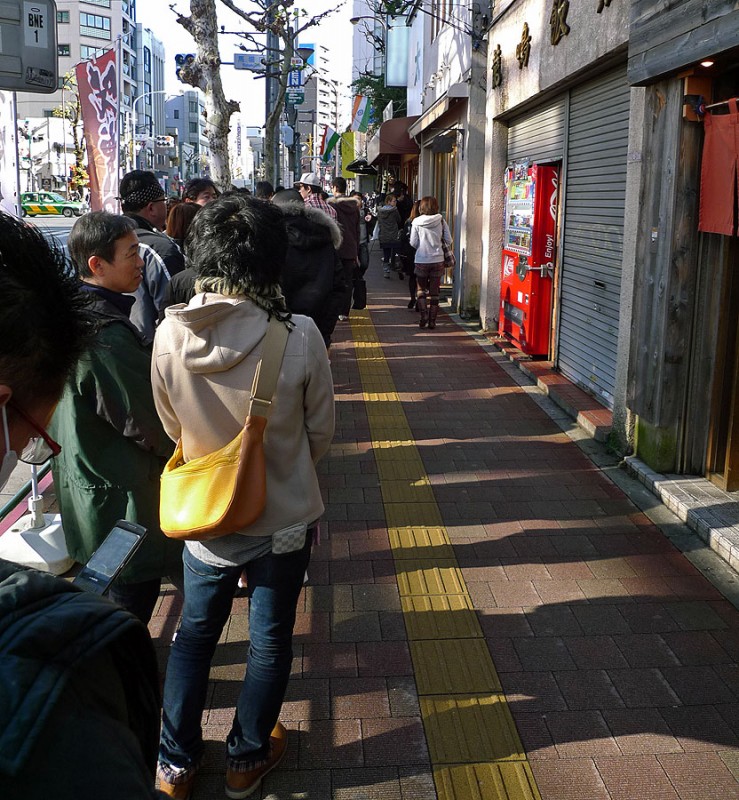
Near the corner of Waseda Street (早稲田通り) and Meiji Street (明治通り) a ramen shop opened last month. Since then a steady line of about 50 people (even in rain) have waited outside to enter. Sometimes the line grows to more than 100 people. Within eyesight of this establishment are at least 5 other places selling nearly the exact same thing. Within a 5 minute walk are more than 20 other places selling ramen. Yet none of them ever have a line to get in. Ever.

People latch on to popular things all over the world simply because they are popular. In Japan this is taken to a higher level. The popular product rarely seems to be better, less expensive, or unique either.

Two Saturdays ago the weather was great, and we had nothing in particular to do, so we got in the above line to see if Futomendo Ramen was somehow special.

futomendo fat noodle house takadanobaba ramen

Once we made it to the front of the line there was something like excitement inside me. I was hungrier, too, so that enhanced the experience. It sort of felt like we were about to get on a roller coaster at an amusement park after such a wait.

In the above photo you can see, in the lower-right corner, that they have even posted instructions on how to line up to get in. I’ve seen brand new restaurants post similar instructions in the hope that lines will form even though they never do.
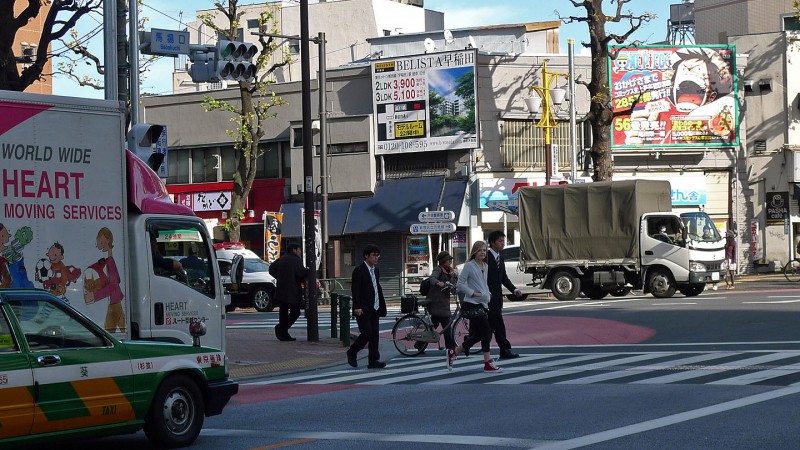
ellie case crossing waseda doori one piece manga billboard

We had so much time to wait in line that Ellie actually had time to walk home and back. She probably could have done so four or five times.

power lines blue sky tries on waseda doori

To pass the time we listened to comments made by those walking past us, learned some Japanese, and took pictures of our surroundings.

tokyo buildings near corner of waseda street and meiji doori

Once we got in I didn’t take any more pictures. Sorry.

The first character in the name of the place (太麺堂) means “fat.” The name is literally “fat noodle shop.” Customers were supposed to fill out little cards, writing a phrase or sentence using the fat character. For instance, you could write “My dad is fat.” or “These fat noodles are delicious.”

Ellie came up with a clever one all her own. She wrote, in English, “My favorite sumo wrestler is Dragon Fat.” Underneath, I wrote the person she was talking about in kanji–山本山 龍太. The waitress didn’t know anything about sumo, but we had a fun discussion when she picked the card up anyway.

So how was the ramen you ask? It was good. The ramen noodles were fatter than normal, though not as thick as udon. It didn’t warrant the wait, but we had a fun experience anyway. The taste was a bit different than the norm, but I wouldn’t consider it superior to many of the places, without a line, in the neighborhood.