TravelJapanBlog.com - Japan (07, 09-10, 13), Denmark (08, 11, 16-19, 21, 24), Korea (13), Poland (21), Mexico (14, 15, 19, 26), Iceland (17, 19), Hawaii (14, 17, 22), Czech Republic (16, 17, 19, 21)
The above will search Traveljapanblog.com.
Concerts - Landscapes - Sports


Posts tagged people

Shaolin Temple

On the first day when I didn’t have a class to teach I headed to Shaolin Temple (少林寺), the birthplace of Kung Fu. The monastery has more than a 1,500-year history. However, most of the current buildings were built since the 1980s. Thanks to the pollution, it seemed much older.

Lots of Kung Fu movies have been filmed here, or at least the studios were made to look like they were shot at Shaolin Temple. This has contributed to the place becoming too touristy now.

There was a story about these lotus stones in the temple. I think the founder of the temple was able to walk across a river on lotus flowers or something. People walk on the lotus stones now for good luck.

Nearby there are several Kung Fu schools with hundreds of students in colorful, Kung Fu uniforms. The students were outside practicing all day.

I apologize for the poor quality of the above photo. Our driver never stopped at these places (which seemed less touristy and more interesting in some regards than the temple) so I took this photo from a speeding van.

The students are in these schools full time so they aren’t receiving a regular education. In addition, these schools are more expensive than regular schools in China. Our guide said the goal of the boys (or rather their parents who paid for them to be in these “boarding schools”) is to someday appear in Kung Fu movies.

There is one Kung Fu academy on the temple grounds. I caught these Kung Fu kids on their lunch break.
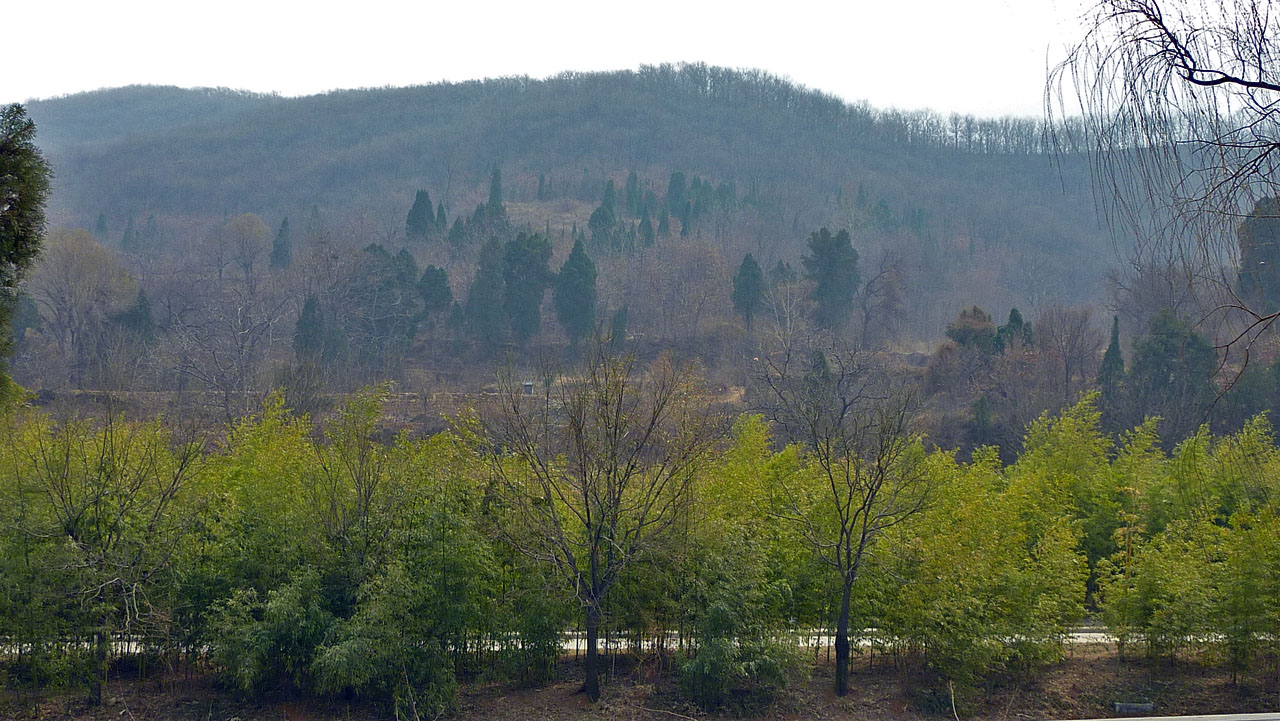
There is a dry river bed that runs along the walk on the side of the temple grounds. On the other side is a rather decent view. From photos like this, the haze gives the appearance of that special, mysterious Kung Fu feel. In person, the smell tells you that the mysterious fog is actually smog.

Tokyo Sakura

On March 26 we visited Shinjuku Gyoen (新宿御苑) for the first time. It was still a week or so too early for the peak of the cherry blossoms (sakura), but a half dozen of the trees were in full bloom. Hanami was in full swing regardless. The best cherry blossom viewing time varies a bit each year, but this year, like most years, it looks like the first week of April will be the best time to view sakura in Tokyo.

Some didn’t care about the flowers. They were there to play on the grass.

Others came only for pictures of the flowers with some serious equipment.

ぼけ ボケ

There were other flowers in full bloom, like these Chaenomeles.

A stroll through Lvyin Park

chinese kids with foreigner in zhengzhou china park

Between my hotel and the university was Lvyin Park (绿茵公园). Normally I would take a taxi between Fengleyuan Hotel and Zhengzhou University of Light Industry since cabs are so cheap in China, but on the days when the weather was decent I would walk the 30-40 minutes and cut through the park.

Chinese kids were the only people willing to talk to me. They could tell me their English name, age, favorite food, and where they were from with ease and good pronunciation. After that they just wanted a picture with the extremely rare foreigner. Chinese kids take English courses, but they rarely, if ever, have a native-speaking teacher. I didn’t teach English in Japan, but I asked my students if they had ever had a non-Chinese teacher. The answer was “no.”

One kid, who called himself Sam, claimed to be from Australia, but I think he was a bit confused. Maybe he was the exception, and his teacher was from Australia.

绿茵公园

“Ground calligraphy” or “water calligraphy” (地书) is very popular at this park. Every time I walked through there were at least three or four working on their characters. Do they write poems? I’m not sure. One guy (not the one pictured above) seemed to be writing the name of businesses.

Music could be heard all over the park. Perhaps six or seven different “groups” were playing, some with a singer.

While taking the above photo a lady approached me and started speaking to me in Chinese. Of course I couldn’t understand a word. I showed her my pictures, and her expression seemed to indicate that she had never seen a camera before. She indicated that she wanted me to take her picture along with her two friends so I did.

Notice in the above photo the tank ride in the background. I zoomed in for a close up.

This was the result. Having children ride in tanks seemed a bit strange, but it wasn’t the last time I saw the military/weapons influence in China.

Chinese people

Zhengzhou is an ancient city, currently under going some major changes. City conditions can be extremely different just by walking a few blocks. The area around my hotel was more old school, with loads of poverty, and many signs of, and buildings from, China’s 1950s and 1960s. Today’s blog entry features some photos I took on my first couple days in China.

The man in the top picture was parked outside an elementary school with two baskets of baby chicks to sell. I wonder if parents are happy when their child comes home from school with an armful of chicks.

For some reason most kids showed up to school a half hour or more before they could actually enter the gate. Therefore, there were lots of people with food carts selling the children something to eat. In addition, there are several tiny toy stores near the school entrances.

This little guy was eating french fries while riding on Pikachu.

Nobody thought this scene was the least bit unusual, except perhaps me. I realized why in the subsequent days as these kinds of loads were common; some were even larger.

It was a cold day to be sitting outside selling fruit. Rummaging through the remains of one of Zhengzhou’s many dilapidated buildings for some bricks didn’t look like fun either.

This was my favorite bunch of students at Zhengzhou University of Light Industry (郑州轻工业学院). They were cold, too, even though we were inside. The building had no heat (or AC in summer) so the room seldom exceeded 5 degrees C (41 degrees F). I taught in thermals, four shirts, a coat, and sometimes a scarf and gloves. On my first day of teaching (when I wasn’t prepared with all those layers) I shivered through my lecture.

Tokyo Marathon 2010 photos – Part 3

東京マラソン

For all of the Tokyo Marathon 2010 pics click here.

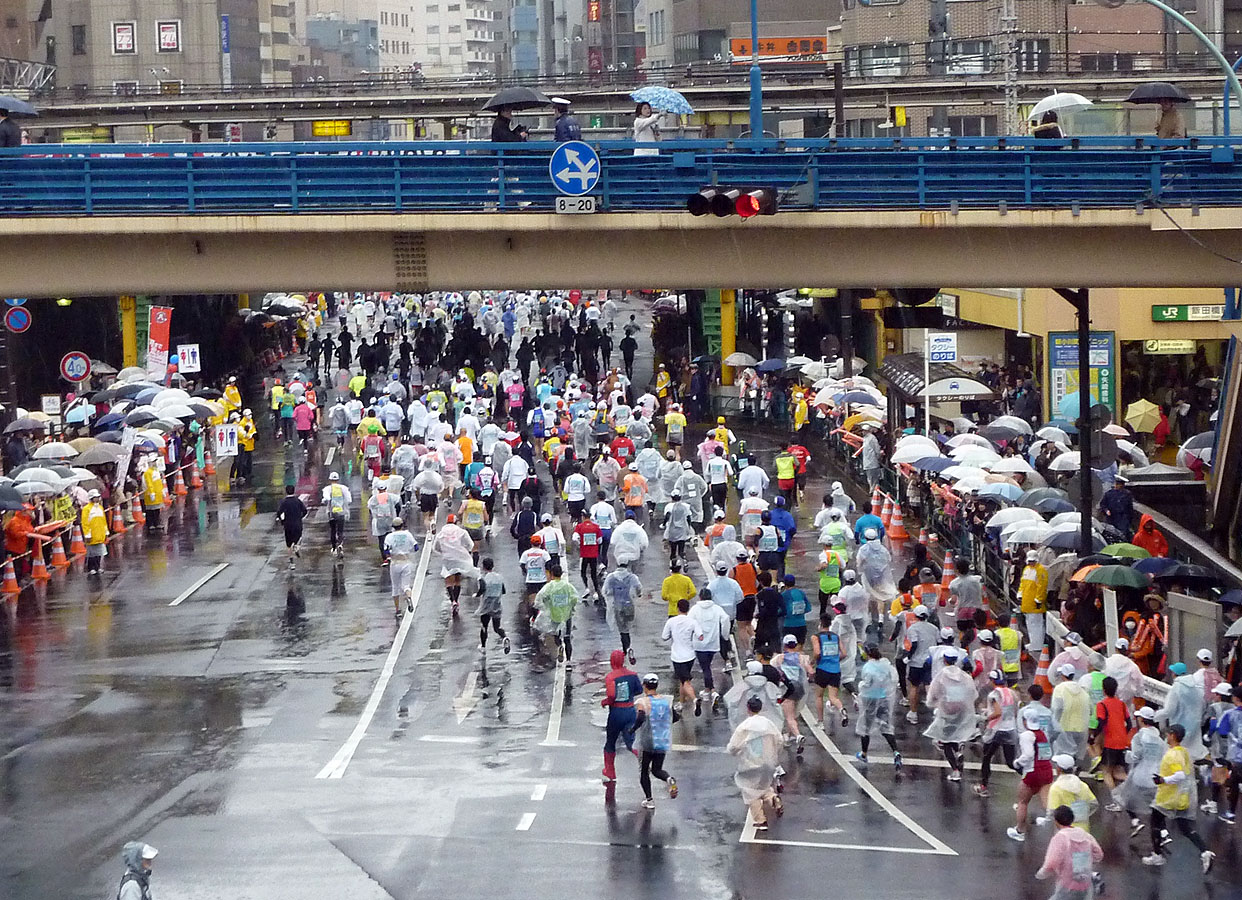
The above picture is my last of the day, just before heading into the Iidabashi Metro Station. I was very cold and very wet at this point. Watching the rest of the race in front of the TV provided a nice contrast. How often do you get to witness the same sporting event in person and on TV in your home and have them both be live?

I took this one from the steps leading up to the pedestrian crossing overhead.

The view from the crossing was great but police kept people moving.

Runners were in shower caps, wet suits, garbage bags, and anything else they could think of to try and keep dry.

More to come…

Kamakura Daibutsu (Giant Buddha) hike

Last week I made my fourth excursion to Kamakura. I have taken a completely different route each time and still feel like I have much to explore and discover in this ancient capital of Japan.

We followed Yamaonna’s Kamakura Daibutsu Hiking Course 大仏ハイキングコース during the morning. I won’t repeat everything she said. Click the link for details.

We skipped Engakuji as I was just there at the end of November. Tokeiji (東慶寺), our first stop, was incredible. I’ll have more pictures from Tokeiji in future entries. The top picture in today’s entry is from there.

The trail itself was very cool and nearly empty. The second picture is of an “ordinary” house, and its fence, on the first part of the trail.

There are a few things I would add or change to Yamaonna’s write up of the Giant Buddha Hiking Course.

One is Jochiji’s admission fee, which has increase by 50 yen in the past few months to 200 yen. Strangely, the 200 yen sign looked very old. Maybe they change the price based on the season?

One item about the Daibutsu Hiking Course I would add is that there are views on this hike when you are near the top. The views to the right are of Mt. Fuji and those to the left are of the bay and the Pacific Ocean. Unfortunately, the morning was overcast and a bit hazy so we couldn’t see Mt. Fuji and could barely see the ocean when we sat down on the above, empty bench next to these four Japanese ladies.

If you aren’t tired after your walk and after visiting the Daibutsu, make sure to visit Hasedera if you haven’t before or if you aren’t planning on doing so on a future trip. From there you can jump on the train and go to Enoshima or you can walk the beach back most of the way to the Kamakura station, saving 250 yen and seeing much more than you can see from the train.

Also, a cheaper way to get to Kamakura is from Shibuya through Yokohama. Instead of the 780 or 890 yen quoted on Yamaonna’s blog, it is only 550 yen (although it takes a bit longer).

One final note, this hike can be very muddy if it has rained recently. It hadn’t rained in almost 48 hours but it was still muddy for us in places. I wouldn’t recommend this hike if it has rained in the past 24 hours.