TravelJapanBlog.com - Japan (07, 09-10, 13), Denmark (08, 11, 16-19, 21, 24), Korea (13), Poland (21), Mexico (14, 15, 19, 26), Iceland (17, 19), Hawaii (14, 17, 22), Czech Republic (16, 17, 19, 21)
The above will search Traveljapanblog.com.
Concerts - Landscapes - Sports


Posts tagged shinto

Oji Inari Jinja

At first glance, I wasn’t sure when I took this photo. The Japanese maples have green leaves, yet there are leaves on the ground and on the shrine roof. In well-populated parts of Japan the leaves are swept up so quickly that autumn doesn’t seem like autumn for long once the leaves fall. However, this isn’t autumn at all or the maple leaves wouldn’t be green. Someone just got a little “lazy” with the leaf sweep the prior fall. I took this photo of the most rear structure in the 王子稲荷神社 complex in early May of last year. The angle is a bit unusual. Normally you don’t find yourself above a shrine and above the torii.

Don’t confuse Oji Inari Jinja with Oji Jinja. This one is better even though Oji Jinja is one of the “Tokyo Jissha” (東京十社 or ten shrines of Tokyo).

Prayers and wishes at the shrine in the snow

Today’s photo is a close up of the ema at Mizu Inari Shrine. A wider view of the same scene can be seen here. Normally I like to browse what people have written. On this cold evening, I took a picture instead to read on my computer screen back in my warm apato.

Some of the prayers/wishes here are for good health, to be fast at math, and to be a good studier. One person wants money. Another wants a home free of sickness, devils (maybe bad luck), and disasters.

Is it impolite to read the wishes of others? I’m not sure.

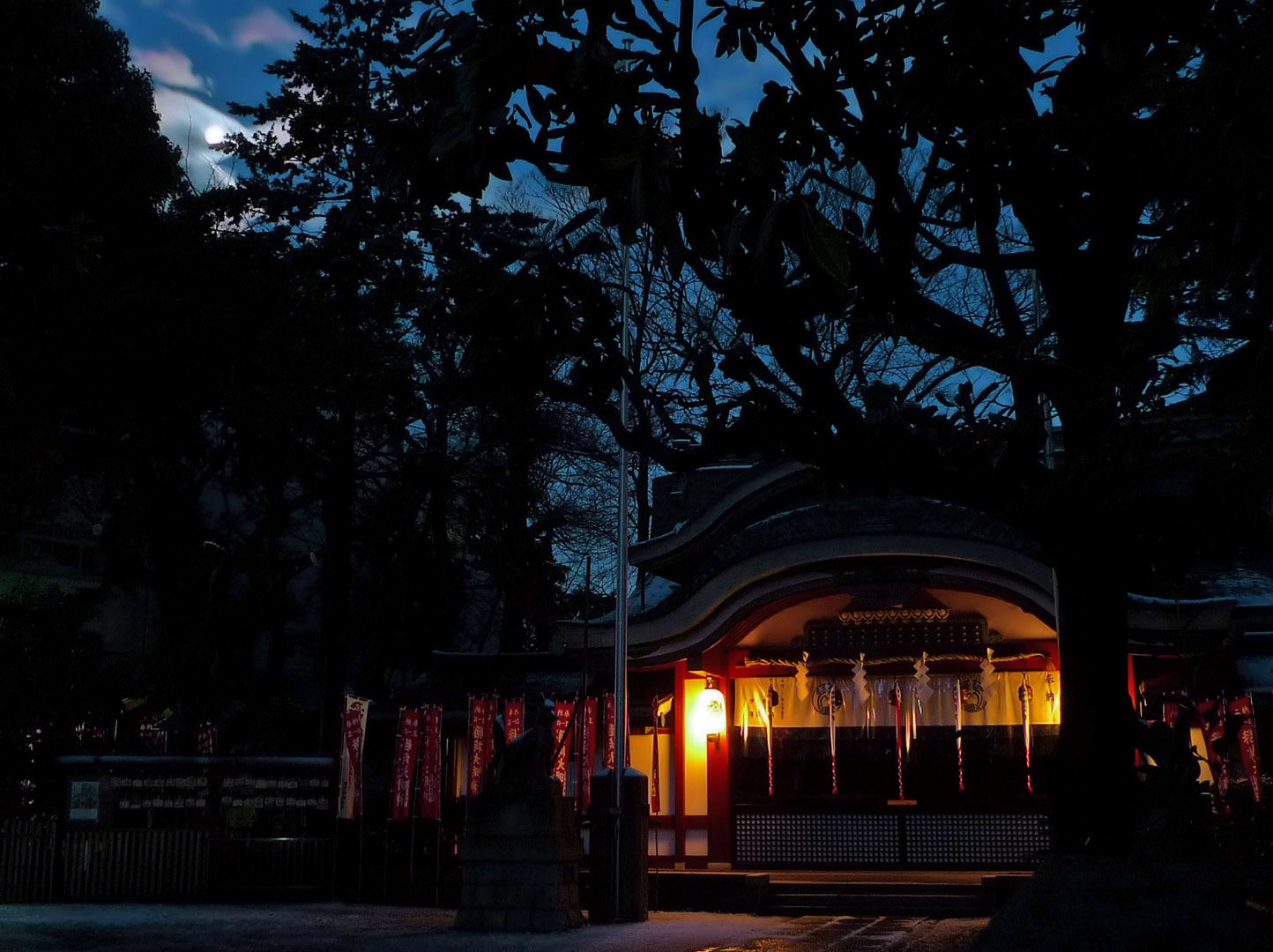
Mizu Inari Jinja with moon in the sky and snow on the ground

It doesn’t snow often in Tokyo. When it does, I like to go for a walk. This walk took me to Mizu Inari Jinja, between our apartment and Waseda University. A full moon in the sky just added to the stellar atmosphere.

Four Seasons Hotel Tokyo (grounds at night)

I have shown you this place before. Chinzanso looks just as good, if not better, at night.

Ema from all over Japan

I’m not sure if Yasukuni Shrine in Tokyo does this every year or if they just did it for the 2010 New Year, but shrines from all over Japan sent their ema to be on display. Today’s photo is just a small part of the hundreds of ema on display. Many, if not most, featured a tiger since 2010 was the year of the tiger.

Carrying the body of god (御神体)

At a Shinto festival near our apartment in Tokyo, these Japanese boys carried what appears to be a palanquin or litter or kago (駕籠). Palanquin are used for carrying people, though, so I’m not sure if the Japanese actually call this a kago or if there is a different word for it. I believe this one is holding a plant, maybe a young tree. The item being carried in this manner in Shinto parades is referred to as a goshintai or “god body.” Similar to the omikoshi, the goshintai is carried around town on rare occasions (sometimes once a year, sometimes once every few years) before being returned to its place in the Shinto shrine.

On a different topic, notice the address sign on the telephone pole. It says 西早稲田 (NishiWaseda) 3-15 below an advertisement for the company “sponsoring” the pole (a doctor’s office or clinic of some kind down the street). I lived in the 3 Chome of NishiWaseda. It’s easy to get lost in Japanese neighborhoods since there are few street names, the addresses don’t run consecutively, and there is a complete lack of a grid pattern in most neighborhood layouts, but it’s much easier to find out where you are lost in Japan due to the high number of these address displays telling you exactly where you are. The problem is in figuring out how to get from your currently lost Point A to your target location Point B.