TravelJapanBlog.com - Japan (07, 09-10, 13), Denmark (08, 11, 16-19, 21, 24), Korea (13), Poland (21), Mexico (14, 15, 19, 26), Iceland (17, 19), Hawaii (14, 17, 22), Czech Republic (16, 17, 19, 21)
The above will search Traveljapanblog.com.
Concerts - Landscapes - Sports


Posts tagged shinto

Bon Odori – Day 2

bon odori written in kanji and hiragana japanese

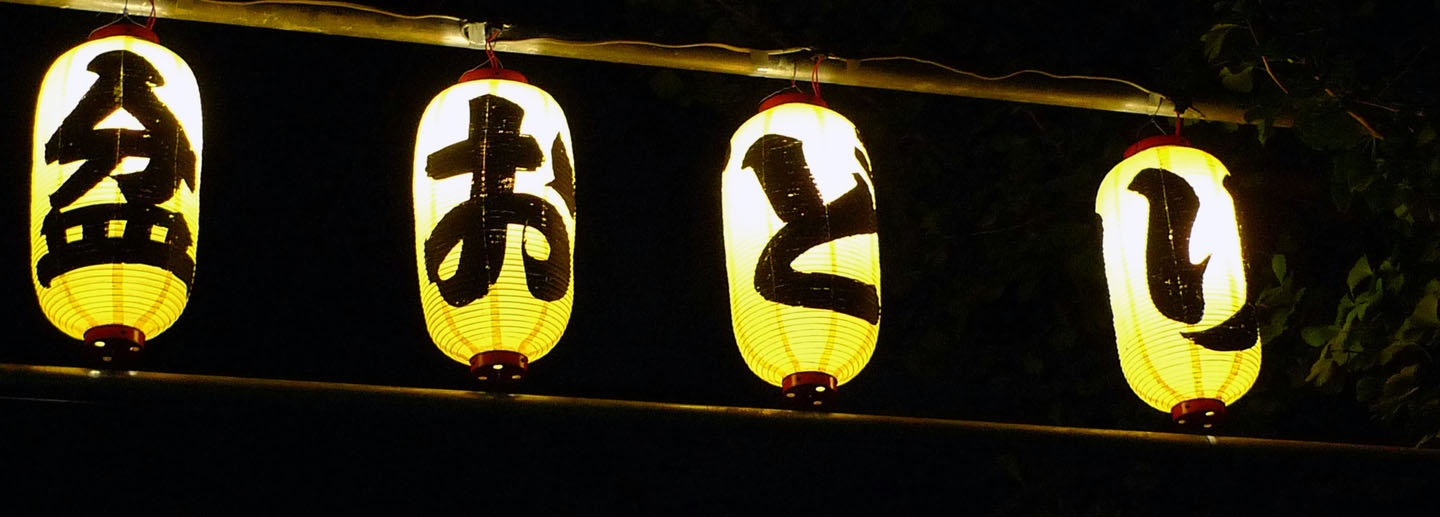
First a little Japanese lesson for you. Bon Odori can be written in three ways in Japanese–ぼんおどり (all hiragana), 盆おどり (kanji and hiragana like the lanterns on my street pictured above), or 盆踊り (mostly kanji).

Bon (or o-bon) means the annual summer festival which celebrates or brings to mind the deceased. O-bon happens in both July and August, usually around the 15th of each month. In some parts of Japan it is only celebrated once, rather than in both months.

Odori simply means “dance.” Odoru is a verb meaning “to dance.” Put Bon and Odori together to get something that loosely means “dance of the dead.” Viewing a Bon Odori doesn’t conjure up visions of a dance of the dead however.

bon odori tokyo japan august 2009

After the magic that was the first night’s dance I made sure my family came with on the second night, even though my daughter had already fallen asleep again. I brought her in a nearly comatose state so perhaps it was a dance of the dead after all. 😉

I think they really enjoyed it too, especially watching the little girls, all dressed up, trying to learn the dances from their mothers and grandmothers. The taiko drumming that accompanies the dance is fun to experience as well.

black and white bon odori picture japanese lanterns

After each song an announcer thanks everyone for their participation and then introduces the following number. They probably did a dozen different songs, or more, each night. Each song has a different dance with which it is associated. Some of the participants were amazing in their ability to remember the steps and movements in each of the folk dances. I don’t think they ever do the bon dances outside of the night or two each year.

shinjuku-ku nishi-waseda jinja bon festival matsuri

My wife and daughter were invited to join the dance, but they politely declined.

The songs remained in my dreams both nights, going through my head over and over again. Maybe we’ll still be around next year (in July anyway) to catch another Bon Odori or two.

盆踊り Bon Odori – Day of the Dead Dance – 1st Night

It has been 21 years since I saw my last Bon Odori. The dancers came right down the street I was living on at the time in Kofu, Yamanashi Ken. Fast forward to the present and the morning after we arrived in Japan. I saw an announcement that the local shrine in Nishi-Waseda was having a Bon Odori on that very night and the following evening as well. I was so excited!

bon odori torii

My family didn’t have the energy to attend, and my daughter feel asleep before the dance began, so I headed to the shrine on my own. It is only a two minute walk. The music began just as I arrived. There were only a dozen or so dancers. The dancers’ husbands were all sitting together, in matching yukata, fanning themselves.

bon odori dancer husbands

As the music reached the ears of our neighbors, they all seemed to creep out of their homes and make it to the shrine. By the time I left, an hour later, over a hundred people were in attendance, and the number of dancers had increased by several fold.

bon dance nishiwaseda tokyo japan august 15 2009

I was, of course, the only non-Japanese person there. The whole evening was enchanting. I felt as though I had traveled through time and space. The tall, modern, Tokyo buildings couldn’t be seen in the darkness. The light from the paper lanterns was dim, and the shrine in the background provided the perfect setting. My lack of a yukata and foreign looks seemed to ruin the authenticity so I stayed back in the shadows.

dance of the dead folk japan bon obon odori taiko drumming

Japanese lanterns

If today’s picture looks a little familiar it is because a portion of it sometimes appears as the banner across the top of this blog.

To the foreign eye this photograph probably looks like a cool piece of Japan–lantern after lantern loaded with strange and unique Japanese characters. I wonder what it looks like to a Japanese person. What is written on these lanterns you ask? Business names. That’s right; this is just a wall of advertising. I find it to be more beautiful than American billboards, but maybe the Japanese look at it as an eyesore.

The location of these lanterns is near the entrance of a shopping street in Kyoto. Immediately behind the lanterns is a shrine. I’m guessing it is for the prosperity of the businesses that sponsor it. You can see some shimenawa and gohei if you look closely.

Inari foxes

“At present, however, it is no longer possible to establish distinctions of genera in this ghostly zoology, where each species grows into every other. It is not even possible to disengage the ki or Soul of the Fox and the August-Spirit-of-Food from the confusion in which both have become hopelessly blended, under the name Inari by the vague conception of their peasant-worshippers. The old Shinto mythology is indeed quite explicit about the August-Spirit-of-Food, and quite silent upon the subject of foxes. But the peasantry in Izumo, like the peasantry of Catholic Europe, make mythology for themselves…

But these strange beliefs are swiftly passing away. Year by year more shrines of Inari crumble down, never to be rebuilt. Year by year the statuaries make fewer images of foxes. Year by year fewer victims of fox-possession are taken to the hospitals to be treated according to the best scientific methods by Japanese physicians who speak German. The cause is not to be found in the decadence of the old faiths: a superstition outlives a religion. Much less is it to be sought for in the efforts of proselytising missionaries from the West–most of whom profess an earnest belief in devils. It is purely educational. The omnipotent enemy of superstition is the public school, where the teaching of modern science is unclogged by sectarianism or prejudice; where the children of the poorest may learn the wisdom of the Occident; where there is not a boy or a girl of fourteen ignorant of the great names of Tyndall, of Darwin, of Huxley, of Herbert Spencer. The little hands that break the Fox-god’s nose in mischievous play can also write essays upon the evolution of plants and about the geology of Izumo. There is no place for ghostly foxes in the beautiful nature-world revealed by new studies to the new generation The omnipotent exorciser and reformer is the Kodomo [child].” (Lafcadio Hearn, 1894, Glimpses of Unfamiliar Japan, pp. 321, 341)

Luckily, in the 110+ years since Hearn wrote the above, the foxes (kitsune) haven’t all been destroyed or forgotten at Inari shrines in Japan. I took the above photo just last year at Fushimi Inari Taisha. The fox statue isn’t easy to see unless you increase the image size by clicking on it. The fox is centered in the torii gate.

Japanese Gardens

I’m back from my winter vacation, although it seems strange calling it a vacation when I went from a cold, snowy place to a colder, snowier place. Hopefully you enjoyed the Italian offerings of the past couple weeks. We’ll turn back to Japan now.

On my trip I finished both volumes of Glimpses of Unfamiliar Japan. I’ll share a few quotes and thoughts on the book here in the next week or so. To go along with the following quote I present the above photo which I took at ginkakuji in Kyoto last year.

“Now, a Japanese garden is not a flower garden; neither is it made for the purpose of cultivating plants. In nine cases out of ten there is nothing in it resembling a flower bed. Some gardens may contain scarcely a sprig of green; some have nothing green at all, and consist entirely of rocks and pebbles and sand, although these are exceptional. As a rule, a Japanese garden is a landscape garden, yet its existence does not depend upon any fixed allowance of space. It may cover one acre or many acres. It may also be only ten feet square…  Therein are created minuscule hills with minuscule houses upon them, and microscopic ponds and rivulets spanned by tiny humped bridges; and queer wee plants do duty for trees, and curiously formed pebbles stand for rocks, and there are tiny toro, perhaps a tiny torii as well, – in short, a charming and living model of a Japanese landscape.

Another fact of prime importance to remember is that, in order to comprehend the beauty of a Japanese garden, it is necessary to understand – or at least to learn to understand – the beauty of stones… Until you can feel, and keenly feel, that stones have character, that stones have tones and values, the whole artistic meaning of a Japanese garden cannot be revealed to you. In the foreigner, however aesthetic he may be, this feeling needs to be cultivated by study. It is inborn in the Japanese; the soul of the race comprehends Nature infinitely better than we do, at least in her visible forms. But although, being an Occidental, the true sense of the beauty of stones can be reached by you only through long familiarity with the Japanese use and choice of them, the characters of the lesson to be acquired exist everywhere about you, if your life be in the interior… At the approaches to temples, by the side of roads, before holy groves, and in all parks and pleasure-grounds, as well as in all cemeteries, you will notice large, irregular, flat slabs of natural rock, mostly from the river beds and water-worn, sculptured with ideographs, but unhewn. These have been set up as votive tablets, as commemorative monuments, as tombstones, and are much more costly than the ordinary cut-stone columns and haka chiseled with the figures of divinities in relief. Again, you will see before most of the shrines, nay, even in the grounds of nearly all large homesteads, great irregular blocks of granite or other hard rock, worn by the action of torrents, and converted into water-basins (chodzubachi) by cutting a circular hollow in the top. Such are but common examples of the utilization of stones even in the poorest villages; and if you have any natural artistic sentiment, you cannot fail to discover, sooner or later, how much more beautiful are these natural forms than any shapes from the hand of the stone-cutter. It is probable, too, that you will become so habituated at last to the sight of inscriptions cut upon rock surface, especially if you travel much through the country, that you will often find yourself involuntarily looking for texts or other chiselings where there are none, and could not possibly be, as if ideographs belonged by natural law to rock formation. And stones will begin, perhaps, to assume for you a certain individual or physiognomical aspect, – to suggest moods and sensations, as they do to the Japanese. Indeed, Japan is particularly a land of suggestive shapes in stone, as high volcanic lands are apt to be; and such shapes doubtless addressed themselves to the imagination of the race at a time long prior to the date of that archaic text which tells of demons in Izumo “who made rocks, and the roots of trees, and leaves, and the foam of the green waters to speak.” (Lafcadio Hearn, 1894, Glimpses of Unfamiliar Japan, p. 345)

The Street of a Thousand Blossoms

The Street of a Thousand BlossomsLess than a week after starting The Street of a Thousand Blossoms by Gail Tsukiyama I have finished reading it. The book isn’t short at over 400 pages, but I found it hard to put down. That, coupled with having to wait for breakfast in bed on father’s day for three hours 😉 , allowed me to finish The Street of a Thousand Blossoms in little time.

As mentioned in my prior blog entry on the subject, I really enjoyed the Yanaka setting. I felt like I could connect with more than just Yanaka though. For instance, I spent a day in the late 80s watching Sumo at Ryogoku Kokugikan. The highlight of the day was witnessing the great Chiyonofuji’s bout in person. So all of the Sumo dialogue in this book brought back pleasant memories. I’ve always been fascinated with Japanese masks (check out this blog daily for some outstanding photography and discussion) so Kenji’s story held my interest. And, of course, there is the trip to Hakone which I have also made. Basically everything felt familiar and resonated well.

The story is compelling, drawing on the themes of renewal and hope. I don’t want to give away too many details for those of you who haven’t yet read The Street of a Thousand Blossoms.

The occasional errors in Japanese are my main criticism. Although Tsukiyama has a Japanese name, she doesn’t understand Japanese. This won’t be noticed by readers who are in her same shoes, but those who can speak the language will cringe at times. One example is her use of hai. She uses it far more frequently and in situations in which Japanese would not. Another is her use of the unconjugated verb hairu (to enter) as a command. She should have said something like haitte kudasai or o hairi kudasai instead of just hairu. A final one (there are others) that I’ll offer as an example is the Hakone Lake which she calls Ashino. In English it should be called Lake Ashi. In Japanese it is called ashinoko (芦ノ湖). The “no” indicates it is the Lake (ko) called (no–shows possession like ‘s in English) Ashi. Put another way, one could translate Lake Tahoe as “tahoe no ko” in Japanese but you would never call it “tahoeno” in English or Japanese.

She gets Japanese culture and customs wrong on some counts as well. For example, she has the school year starting in September like it does in the U.S. In Japan, though, school years, company fiscal years, etc. start in April–not September.

These minor critiques aside, this book is very enjoyable even if you haven’t been to Yanaka, Sumo, Hakone, Nara, or even Japan.

Here are a couple more pictures I took last year from areas mentioned in The Street of a Thousand Blossoms.

ashinoko Lake Ashi hakone japan mt. fuji

This is Lake Ashi with Mt. Fuji, mostly shrouded in clouds, in the background. The place on the right may be where Tsukiyama envisions Hiroshi and Aki staying.

hakone jinja 箱根神社

This is another picture from the ferry on Lake Ashi. The kanji say 箱根神社 or Hakone Jinja. “Jinja” means Shinto Shrine or Temple.