TravelJapanBlog.com - Japan (07, 09-10, 13), Denmark (08, 11, 16-19, 21, 24), Korea (13), Poland (21), Mexico (14, 15, 19, 26), Iceland (17, 19), Hawaii (14, 17, 22), Czech Republic (16, 17, 19, 21)
The above will search Traveljapanblog.com.
Concerts - Landscapes - Sports


Posts tagged temples

Temple gate (法明寺の門)

japanese buddhist temple gate homeiji maple leaf in spring ikebukuro tokyo japan

I have two Japanese maple trees in my backyard in the USA, but I don’t remember them being extra beautiful, extra green in spring. In Japan the maples seem to have an extra spark this time of year. Maybe it’s just because they haven’t been green for so many months so they merely appear extra special now. Or maybe the green gets a little tired later in the summer. In any event, they looked great around the gate of the Homeiji Temple in Ikebukuro a week ago.

azalea flowers in ikebukuro at homeiji

From the inside of the gate the azaleas (ツツジ) looked good too.

Kishimojin in Ikebukuro 池袋の鬼子母神

hyomoji buddhist temple

On Kenpo Kinenbi (憲法記念日 or Constitution Day) I went on a bike ride to Oji (王子) via Otsuka (大塚), Ikebukuro (池袋), and a few other places. Along the way I stopped at Kishimojin in Ikebukuro. The name of this place is interesting I think.

鬼子母神

The characters (read right to left) mean devil/demon, child, mother, god.

鬼子母神 ikebukuro japan

There is an inari shrine on the same grounds which can’t be adequately captured in a photo. The highlight between the torii gates is an enormous tree which is loaded with fresh, green leaves in May even though the tree itself is anything but fresh.

shinto inari jinja torii

According to the sign, this tree has been around for more than 600 years.

Kofu Castle (aka Maizuru Castle Park or 甲府城)

manzoin kofu

After all of the festivities at Takeda Jinja I planned to catch a bus down to the station to walk Kofu’s shopping district streets for the first time in ages. However, the bus was so loaded with people thinking the same thing that I opted to walk back down Takeda Dori. The other people at the bus stop went the sardine route.

I purchased a bento on Takeda Dori and ate it at a deserted shrine closer to the bottom of the hill. A bit farther along was an empty temple (pictured above) called Manzoin (満蔵院). Manzoin doesn’t appear to be well cared for at the moment.

The streets of Kofu seem to have changed in the past couple decades as I don’t remember the bridge that goes over the tracks being there. The top photo in yesterday’s blog entry is from the new bridge.

Maizuru Castle Park or 甲府城 japanese

Instead of heading for the shopping area, I was drawn to Maizuru Castle Park (舞鶴城公園), just over the bridge, which is extremely different than it was in the 1980s. I remember the place as a fairly small park with some cherry trees. Now it is a partially reconstructed castle, sometimes called the Kofu Castle.

kofu yamanashi ken japan

Most of the buildings and fortress walls are new, or at least I think they are new. I don’t remember them.

信玄公祭り castle remains kofu japan

Great views of Kofu and Mt. Fuji can be had from the top. These banners are advertising the Shingenko Matsuri (信玄公祭り or Takeda Shingen Festival). The irony is that Kofu’s original castle was built after Takeda Shingen was dead. Shingen died in 1573. The castle was built in 1583 by Tokugawa Ieyasu after he defeated Shingen’s son in battle. Needless to say, Takeda Shingen never flew banners from the top of it. But they looked pretty cool on this evening anyway.

White Horse Temple 白馬寺

White Horse Temple 白馬寺

For my last free day in Zhengzhou, I booked a tour (with the help of a student who could speak some English) to visit Luoyang, including the White Horse Temple and the Longmen Caves (also referred to as the Longmen Grottoes).

I was picked up at my hotel at 7 a.m. Two hours, lots of traffic, and about eight hotel pickups later we were on our way. Or so I thought…

The tour guides didn’t say a word to me all day as they couldn’t speak English. The tour guide kept mentioning Shaolin Temple as she spoke in Chinese to the rest of the group. That was the only word I could catch. I assumed she was trying to sell them a tour of Shaolin Temple on another day. When we made the turnoff for Shaolin Temple I resigned myself to the fact that I was put with the wrong tour group, and I was going to get another tour of Shaolin Temple. Ugh. As everyone got out of the van for Shaolin Temple the guide held up the stop sign hand to me. It turns out the tour splits at Shaolin Temple, and I was going to the correct place after all. Yeah!

white horse temple henan china

The White Horse Temple is China’s oldest Buddhist temple dating back nearly 2,000 years. I’m not sure how old the various parts of the temple actually are now as most has probably been reconstructed. Some things looked extremely old, but they could have been built last week for all I know.

luoyang buddhism china

I would have liked to have spent an hour or two at the White Horse Temple, taking pictures and soaking in the feel of the place. Unfortunately, I was stuck with my tour group (despite the fact I couldn’t understand a word being said), and was therefore only afforded a quick walk through the place. One member of the group was from Singapore. He could say things to me in English but couldn’t really understand my responses. He told me that the guide was taking us across the way to see flowers and we would have to pay to enter. This turned into the theme for the rest of the day. The guide would take us places to get us to pay more, and she would get a kickback. Meanwhile, I spent no more than two hours total at the two places I wanted to see on what turned out to be a 12-hour tour. If I had it to do over again I would have taken a bus. Had I done so I could have spent twice as long at the White Horse Temple and Longmen Grottoes in half the time. I also would have probably gotten lost and still be stuck in some “Grapes of Wrath” corner of China.

ancient brick stone building china

The tourist from Singapore said the guide said the above wall was ancient. 2,000 years old? Maybe parts of it.

oldest buddhist temple in china

I’ll have more photos from Luoyang, China here soon…

Shaolin Temple

On the first day when I didn’t have a class to teach I headed to Shaolin Temple (少林寺), the birthplace of Kung Fu. The monastery has more than a 1,500-year history. However, most of the current buildings were built since the 1980s. Thanks to the pollution, it seemed much older.
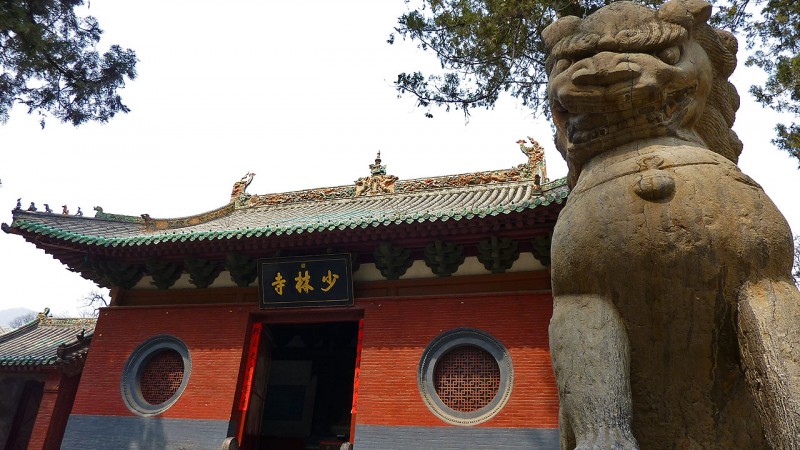
Lots of Kung Fu movies have been filmed here, or at least the studios were made to look like they were shot at Shaolin Temple. This has contributed to the place becoming too touristy now.

There was a story about these lotus stones in the temple. I think the founder of the temple was able to walk across a river on lotus flowers or something. People walk on the lotus stones now for good luck.

Nearby there are several Kung Fu schools with hundreds of students in colorful, Kung Fu uniforms. The students were outside practicing all day.

I apologize for the poor quality of the above photo. Our driver never stopped at these places (which seemed less touristy and more interesting in some regards than the temple) so I took this photo from a speeding van.

The students are in these schools full time so they aren’t receiving a regular education. In addition, these schools are more expensive than regular schools in China. Our guide said the goal of the boys (or rather their parents who paid for them to be in these “boarding schools”) is to someday appear in Kung Fu movies.

There is one Kung Fu academy on the temple grounds. I caught these Kung Fu kids on their lunch break.
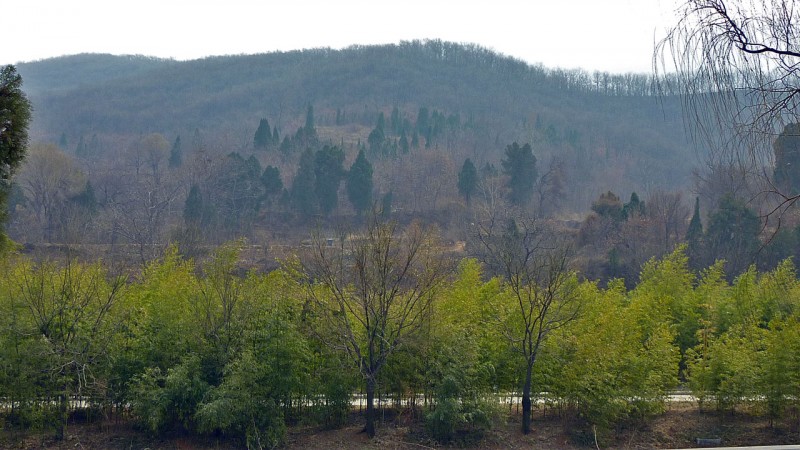
There is a dry river bed that runs along the walk on the side of the temple grounds. On the other side is a rather decent view. From photos like this, the haze gives the appearance of that special, mysterious Kung Fu feel. In person, the smell tells you that the mysterious fog is actually smog.

Mount Takao 高尾山

A mere 370 yen train ride from Shinjuku lands you at the bottom of Mt. Takao. There are lots of ways to get up the mountain. We took the Inariyama Trail as our guidebook says it is the least crowded and includes nice views of Mt. Fuji. Neither was true on this day.

Our best views of Mt. Fuji were from the train on the way there and from the train on the way back. While we were hiking and when we ate lunch on the top of Mt. Takao, Mt. Fuji was mostly obscured by clouds. If you want a picture of Mt. Fuji and can see Mt. Fuji from the train (after Kitano Station) you may want to hop off at the Keio-Katakura Station (京王片倉駅) as there is a good view from the station platform (near the rear of the train). You can then get on the next train and your train fare won’t be any different, assuming you don’t exit the station.

I was amazed at the crowds. I figured few would be climbing Mount Takao in winter, on the last Wednesday of January no less. Not so. The trail was swarming with people and hundreds of people were on top of the mountain. I can’t imagine how crazy crowded it must be on a weekend or holiday during spring, summer, or fall.

Takaosan Yakuoin Yukiji Temple (高尾山薬王院有喜寺) was one of the nicer temples I’ve experienced. Don’t miss it if you are hiking Mt. Takao. We almost did.

The colorful flag/banner/hanging seemed to be on all of the Buddhist temples during January. They are gone now that February has arrived.