TravelJapanBlog.com - Japan (07, 09-10, 13), Denmark (08, 11, 16-19, 21, 24), Korea (13), Poland (21), Mexico (14, 15, 19, 26), Iceland (17, 19), Hawaii (14, 17, 22), Czech Republic (16, 17, 19, 21)
The above will search Traveljapanblog.com.
Concerts - Landscapes - Sports


Posts tagged temples

Wat Po (or Pho) – The Reclining Buddha

ryan with a statue near the entrance to wat pho po Phra Chetuphon

After our meal, mentioned last time, we headed toward the complex that houses the Emerald Buddha (Wat Phra Kaew) and Grand Palace. Unfortunately, there are no signs telling you where the entrance is and we approached from the west and turned south. The entrance, we eventually found out, is on the north side, but the walls around it go on forever.

Numerous scammers tried to convince us that the place was closed for one reason or another in order to get us into a Tuk Tuk that an accomplice was operating. Eventually we made it to the south of the Grand Palace walls. While there we decided to check out Wat Po.
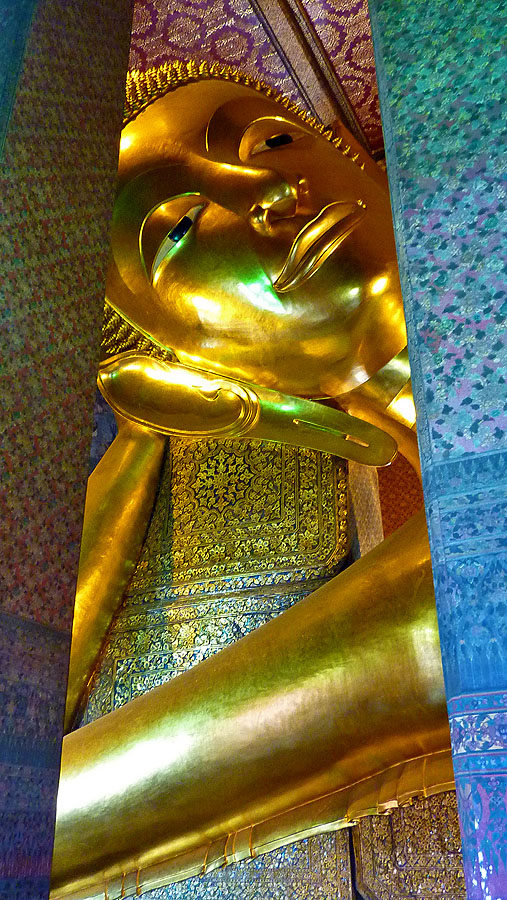
Phra Chetuphon reclining buddah bangkok thailand giant gold buddha

The highlight of Wat Po is the giant, gold Buddha inside one of the many buildings. Photos don’t do this Buddha justice. I tried numerous angles to try and capture its essence, but I just don’t get the same impression from the photos as I did in its presence. The statue is over 150 feet in length (imagine half a football field if that helps).

giant gold buddha feet bangkok thailand

You could fit a dozen people in the Buddha’s gold feet alone.

bottom of buddha's gold feet reclining bangkok wat thailand

The bottom of the Buddha’s feet and the eyes are the only parts not covered in gold.

buddha rests on hand and two giant gold blocks bangkok thailand

The building around the gold Buddha adds to the atmosphere. In addition to the pillars, which make a full view impossible (except from the end), the walls and ceiling are covered in frieze and paintings, and the sound inside is of metallic rain.

mural inside wat pho 108 bronze bowls for coins bangkok thailand

Once you round the Buddha, you will see where the sound is coming from. People drop coins into 108 bronze bowls along the wall on the Buddha’s back side. Offerings at such places always seem tacky to me, but the sound created by the coins hitting the bronze bowls actually added to the atmosphere.

Friends in the neighborhood

亮朝院 日蓮宗

From my apartment window I can see the top of a Buddhist temple not far away. It took me almost a week to actually pay the place a visit. The Nichiren sect temple is called Ryochoin (亮朝院). The structure and grounds are set a bit above the rest of the neighborhood. At this link you can see an old Edo Period drawing of the place.

Kongorikishi

These two guys are the Nio guardians of the Buddha. Usually they are in the sides of the gate leading to the temple and made of wood, but at this temple they are out in the open, past the gate, at the top of the stone stairs, and made of stone. I posted some more typical pictures of them previously.

nio

I imagine I’ll be taking many morning walks through these temple and burial grounds in the coming year. It’s nice to have so much protection nearby. 😉

This last protector is on the roof of the bell tower at 亮朝院.

bell tower roof ornament

The pure water (清水) at Kiyomizudera (清水寺)

pure water waterfall drink kiyomizudera kyoto japan

When I visited Kiyomizu Dera for the first time, I hadn’t read anything about the place in a guide book. Therefore, I had sort of a “Duh” moment when after following around the packs of tourists we actually arrived at the kiyomizu that makes up its name. I hadn’t really thought about why it was named as it was or what the significance of the name was until this point. Duh!

Anyway, I bet you can’t tell which of these kiyomizu samplers is my daughter. 😉

Sakura at Sounji

Ginkakuji (銀閣寺)

The Golden Pavilion (金閣寺) is gold. Hence the 金 character. So you would think the Silver Pavilion would be silver since it has the 銀 character. Nope; it’s all made out of wood. I think the plan was to cover it in silver once upon a time, but that never happened. They should call it Mokukakuji (木閣寺) or the Wooden Pavilion.

If you ever go visit Ginkakuji, it isn’t the pavilion that will likely impress you. The Zen sand gardens, ponds, and green gardens are what most tourists are there for. And there are lots of tourists at Ginkakuji. If you must go, make it early in the day. Or, even better, check out the nearby temples on the Philosopher’s Path instead. They don’t charge you an arm and a leg to fight the crowds like Ginkakuji does, and, better yet, they are practically empty.

More Fushimi Inari Taisha (伏見稲荷大社)

In our last Fushimi Inari episode the topic of ema came up. In addition to ema you can also find mikuji, otherwise known as omikuji, 御神籤, or おみくじ, at most Shinto shrines in Japan.

Fushimi Inari Taisha 伏見稲荷大社 mikuji sakura

These work differently than ema, although to a photographer or appreciator of Japan’s shrines they serve the same basic function of cool window dressing on the other beauties and wonders around every turn. Omikuji are purchased, like ema, but they are not written on. Instead, they already have writing on them. The writing is a fortune–sometimes good, sometimes bad. If you purchase one and it has a 吉 character then you have a good one. The character before the 吉 indicates how good your fortune or blessing is. If yours has a 凶 on it, then you have a curse. Ouch! The way to possibly avoid your curse is to tie it at the above location at the shrine. All those curses make for a work of art.

As you can also see from the above photo, the grounds are meticulously kept and cherry blossom season (sakura) makes things even prettier.

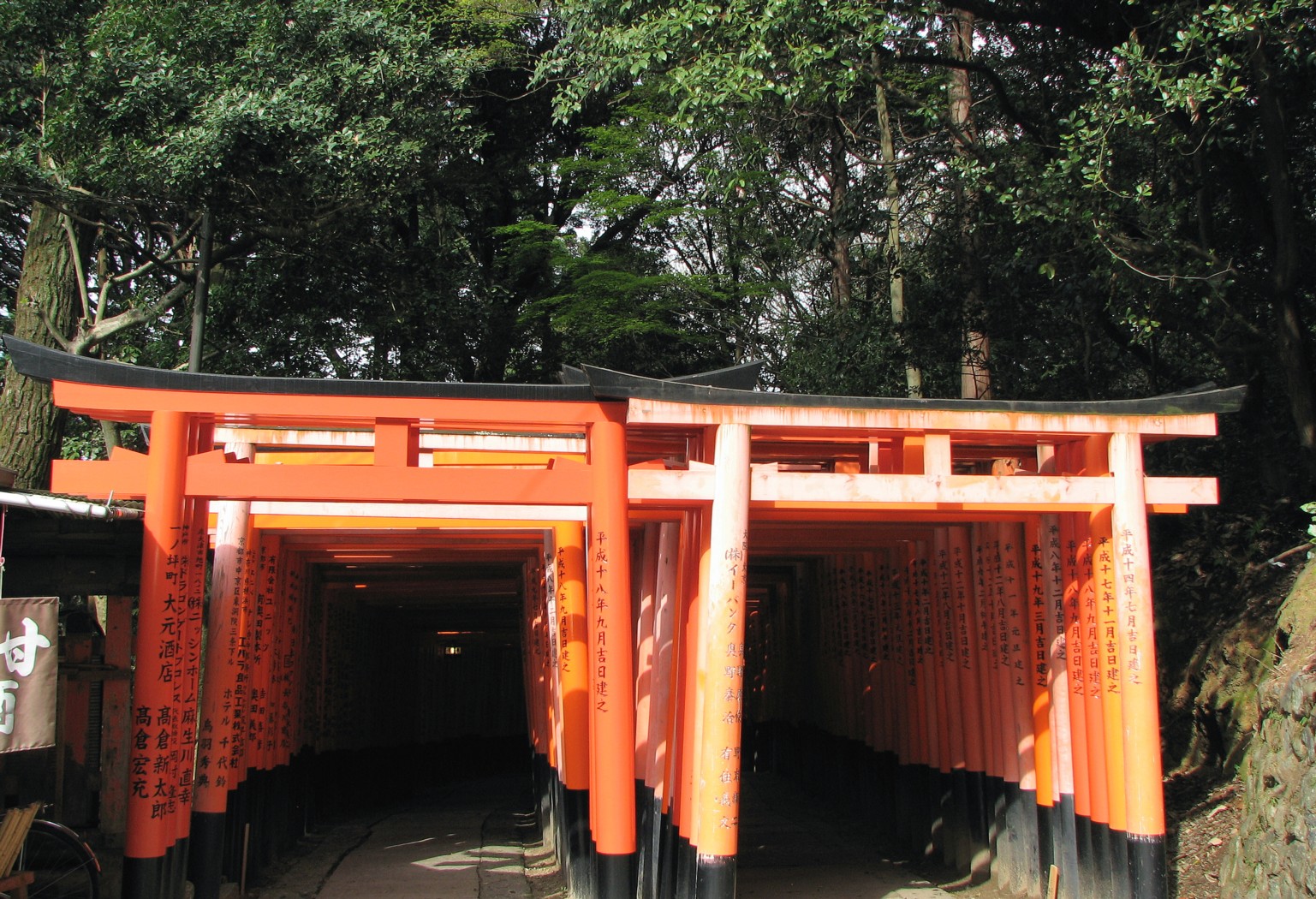
Fushimi Inari Taisha 伏見稲荷大社 torii gates

Fushimi Inari is the head Inari shrine. Other Inari shrines are all over Japan and feature Torii Gates, but Fushimi has the most. I don’t know the exact number, but it must be in the thousands. It’s a wonder to behold, especially if the paths beneath the gates are empty of tourists like they were when we were there. Again, get there before 10 a.m. for best results. Better yet, wear running clothes, get there by 8 or so and run through them all.

Fushimi Inari Taisha 伏見稲荷大社 torii paths kyoto

The writing on one side of the gates indicates what person, or more commonly, company, purchased the torii. On the same side, but other post, of the torii is the date it was purchased (or perhaps installed).

Prior to actually visiting Fushimi Inari, I was picturing one path of a few dozen gates. I was surprised when I got there to find seemingly countless paths of torii, some running parallel, or at least starting parallel, to each other. It’s a maze like no other.