TravelJapanBlog.com - Japan (07, 09-10, 13), Denmark (08, 11, 16-19, 21, 24), Korea (13), Poland (21), Mexico (14, 15, 19, 26), Iceland (17, 19), Hawaii (14, 17, 22), Czech Republic (16, 17, 19, 21)
The above will search Traveljapanblog.com.
Concerts - Landscapes - Sports


Archive for Japan

National Foundation Day (建国記念の日)

Back on February 11 Japan celebrated National Foundation Day. Japan was supposedly founded on this day and had its first emperor obtain his position as emperor almost 2,700 years ago. This was previously a big holiday in Japan, but since WW2 it has become rather tame. We went for a walk on February 11, 2010 from Ebisu Station to Azabu Juban and then to Roppongi before getting on a train for home. Between Ebisu and Azabu Juban there were hundreds of police in riot gear, dozens of prison buses ready to haul people away, and many vans preparing for some sort of demonstration or protest. I would have taken more pictures, but it was absolutely freezing. With the wind blowing, the temperature felt well below freezing. And later in the day it snowed. Anyway, my hands had no desire to leave their gloves to take photos.

We didn’t see an actual demonstration or protest. It was so cold if such an event did take place few were witness to the proceedings. I saw nothing about it on the TV or internet either.

The truck on the left says “Restore Emperor Military” (皇軍復活). The one on the right says “Japan National Party” (日本国政党). There isn’t a political party called the Japan National Party by the way. Apparently ultra-conservative Japanese still exist, but you have to be at the right place, at the right time, to find them.

Tokyo Skyline from Odaiba

I took today’s photo from the outside perch of the restaurant on the top floor of Joypolis. This is the Tokyo Bay with the Rainbow Bridge connecting my location at the time (Odaiba お台場) with the main part of Tokyo. Tokyo Tower is to the right.

This is one of those scenes that my LX3 does a much better job with than my TZ7. I tried this shot with both cameras and varying exposure lengths. The TZ7 couldn’t capture it as well with an exposure of 1 second or less. I needed that LX3’s 5-second exposure and better sensor.

This picture would probably look a whole lot better if my blog had a black background. Click on the image for a bigger and better view.

Entrance Examinations (入学試験)

japanese entrance exams

Fall semester ended at Waseda University early in February. The entire campus was immediately transformed into a giant testing center. For most of February there are daily entrance exams for high school students (and some college students looking to upgrade schools) trying to get into Waseda. Most of the normal entrances to campus have been closed. The one or two that are open feature tight security.

For the few of us walking around campus it is rather bizarre. Just a few weeks ago there were tens of thousands of students. Now you can do several laps around the buildings and see few, if any, people. Regular students cannot enter campus.

The other morning, a Sunday no less, I happened to arrive just as some test takers were. We were greeted with shouts of ohayo gozaimasu (good morning) and ganbare (good luck/hang in there/do your best) from a cheering section of people. Not only did I have to show my ID to several people in order to get to my office, I had to show my ID to leave campus as well. I’m guessing they had a problem with someone pretending to be someone else to get that someone else into school at least once in their history. Why else would they have this ridiculous amount of security?

The sign above says test takers are not allowed to leave campus until the last test has been completed.

Personally, I prefer the normal campus to the February “prison” campus.

“The Edo Inheritance” by Tokugawa Tsunenari

A few days before our trip to Nikko I picked up The Edo Inheritance with the hopes of gaining a greater appreciation for, and understanding of, the Edo Period (since the Tokugawa Shogunate and Nikko go hand in hand). The author is Tokugawa Tsunenari (徳川恆孝), who would be the current Shogun had the Edo Period never ended. Needless to say, he is a bit biased.

The Edo Inheritance is not a scholarly work or work of history in the academic sense. I suppose you could call it a personal reflection or interpretation with some history thrown in. The author doesn’t even try to sound objective or well researched. That’s not to say that he is always wrong; instead, I’m just saying The Edo Inheritance could have been much better with a good editor.

Tokugawa frequently tosses single anecdotes out there and draws wide-sweeping conclusions from them. The stories do make for entertaining reading, but don’t expect this work to be extensively relied upon in academic circles.

In a nutshell, Tokugawa believes the Edo Period has taken too many knocks from historians and the Japanese themselves. Perhaps he is correct.

If you are looking for a well-researched, introductory history of Japan look elsewhere. If the Edo Period fascinates you (like it does me) and you are already familiar with the basics then this may be a worthwhile, quick read. The book features more than 30 full pages of pictures of Edo drawn during the Edo Period.

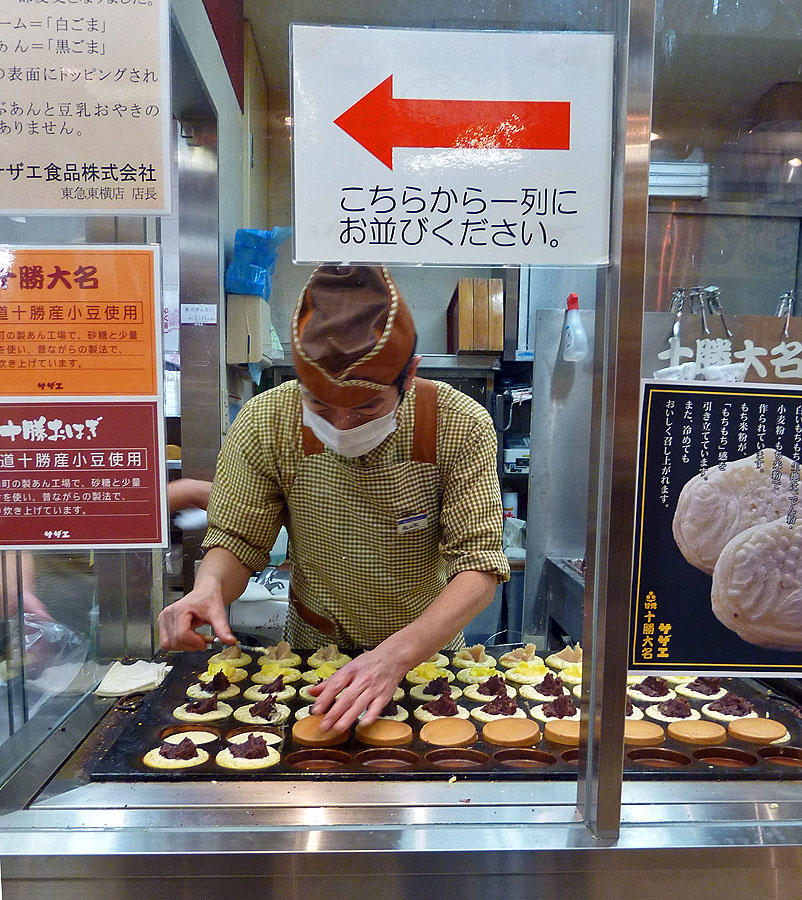
Imagawayaki (今川焼き)

Today’s photo is from the basement of a department store in Shibuya. This man is making imagawayaki which is basically a thick pancake filled with bean paste or custard. The picture on the right is of taiyaki, a variation which makes imagawayaki look like a fish.

Imagawayaki have been sold in Japan for over 230 years. I had my first one from a street vendor in Kofu over 22 years ago and can still remember the happiness biting into a hot one filled with custard brought on a cold winter day.

Harajuku Wedding

Two weeks ago we set off for Togo Shrine (東郷神社) in Harajuku to check out the flea market. This Tokyo flea market was supposed to take place on the first and fourth Sundays of every month. As we approached we knew something was wrong as the place was nearly empty. A small sign (in Japanese) said the flea market had been discontinued as of the beginning of 2010.

As we were leaving, though, we spotted this wedding party.

Mom, or perhaps mother-in-law, had some last pieces of advice for the bride.

They made their way up the stairs and into Togo Jinja…

…where their wedding took place moments later.