TravelJapanBlog.com - Japan (07, 09-10, 13), Denmark (08, 11, 16-19, 21, 24), Korea (13), Poland (21), Mexico (14, 15, 19, 26), Iceland (17, 19), Hawaii (14, 17, 22), Czech Republic (16, 17, 19, 21)
The above will search Traveljapanblog.com.
Concerts - Landscapes - Sports


Posts tagged torii

Bon Odori – Day 2

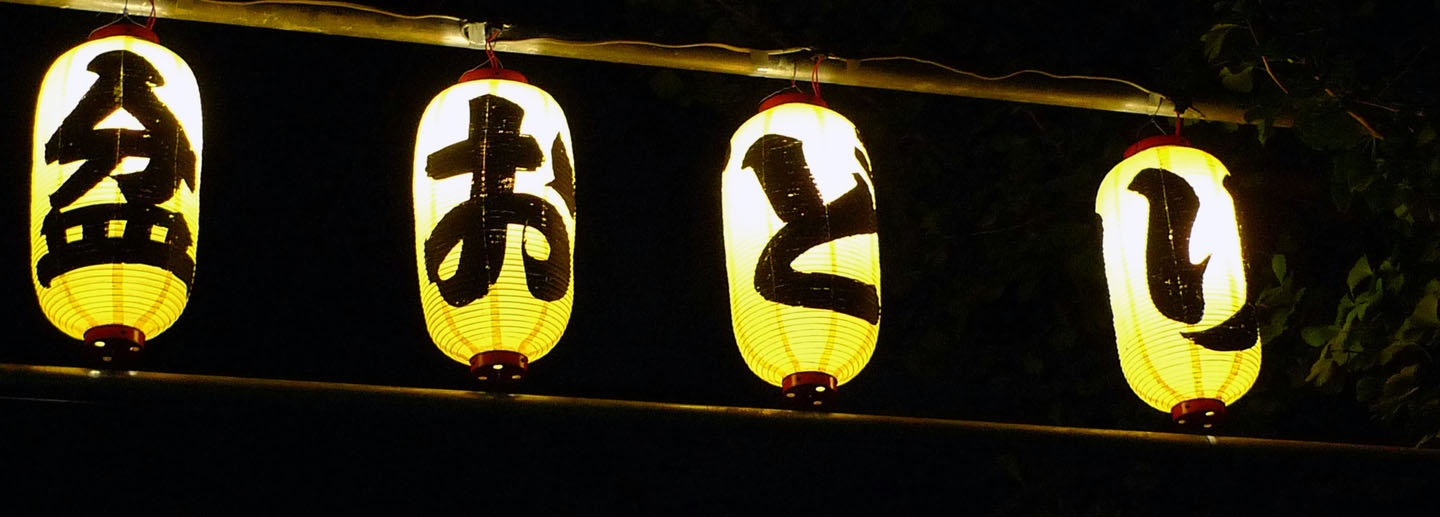
bon odori written in kanji and hiragana japanese

First a little Japanese lesson for you. Bon Odori can be written in three ways in Japanese–ぼんおどり (all hiragana), 盆おどり (kanji and hiragana like the lanterns on my street pictured above), or 盆踊り (mostly kanji).

Bon (or o-bon) means the annual summer festival which celebrates or brings to mind the deceased. O-bon happens in both July and August, usually around the 15th of each month. In some parts of Japan it is only celebrated once, rather than in both months.

Odori simply means “dance.” Odoru is a verb meaning “to dance.” Put Bon and Odori together to get something that loosely means “dance of the dead.” Viewing a Bon Odori doesn’t conjure up visions of a dance of the dead however.

bon odori tokyo japan august 2009

After the magic that was the first night’s dance I made sure my family came with on the second night, even though my daughter had already fallen asleep again. I brought her in a nearly comatose state so perhaps it was a dance of the dead after all. 😉

I think they really enjoyed it too, especially watching the little girls, all dressed up, trying to learn the dances from their mothers and grandmothers. The taiko drumming that accompanies the dance is fun to experience as well.

black and white bon odori picture japanese lanterns

After each song an announcer thanks everyone for their participation and then introduces the following number. They probably did a dozen different songs, or more, each night. Each song has a different dance with which it is associated. Some of the participants were amazing in their ability to remember the steps and movements in each of the folk dances. I don’t think they ever do the bon dances outside of the night or two each year.

shinjuku-ku nishi-waseda jinja bon festival matsuri

My wife and daughter were invited to join the dance, but they politely declined.

The songs remained in my dreams both nights, going through my head over and over again. Maybe we’ll still be around next year (in July anyway) to catch another Bon Odori or two.

Giant torii in Kyoto

This giant torii gate is located south of the Heian Shrine and Kyoto University. It may look a bit familiar to you if you are a frequent visitor to this site, even if you haven’t been to Kyoto, as I’ve used a piece of this picture as the TravelJapanBlog.com banner.

Inari foxes

“At present, however, it is no longer possible to establish distinctions of genera in this ghostly zoology, where each species grows into every other. It is not even possible to disengage the ki or Soul of the Fox and the August-Spirit-of-Food from the confusion in which both have become hopelessly blended, under the name Inari by the vague conception of their peasant-worshippers. The old Shinto mythology is indeed quite explicit about the August-Spirit-of-Food, and quite silent upon the subject of foxes. But the peasantry in Izumo, like the peasantry of Catholic Europe, make mythology for themselves…

But these strange beliefs are swiftly passing away. Year by year more shrines of Inari crumble down, never to be rebuilt. Year by year the statuaries make fewer images of foxes. Year by year fewer victims of fox-possession are taken to the hospitals to be treated according to the best scientific methods by Japanese physicians who speak German. The cause is not to be found in the decadence of the old faiths: a superstition outlives a religion. Much less is it to be sought for in the efforts of proselytising missionaries from the West–most of whom profess an earnest belief in devils. It is purely educational. The omnipotent enemy of superstition is the public school, where the teaching of modern science is unclogged by sectarianism or prejudice; where the children of the poorest may learn the wisdom of the Occident; where there is not a boy or a girl of fourteen ignorant of the great names of Tyndall, of Darwin, of Huxley, of Herbert Spencer. The little hands that break the Fox-god’s nose in mischievous play can also write essays upon the evolution of plants and about the geology of Izumo. There is no place for ghostly foxes in the beautiful nature-world revealed by new studies to the new generation The omnipotent exorciser and reformer is the Kodomo [child].” (Lafcadio Hearn, 1894, Glimpses of Unfamiliar Japan, pp. 321, 341)

Luckily, in the 110+ years since Hearn wrote the above, the foxes (kitsune) haven’t all been destroyed or forgotten at Inari shrines in Japan. I took the above photo just last year at Fushimi Inari Taisha. The fox statue isn’t easy to see unless you increase the image size by clicking on it. The fox is centered in the torii gate.

The Street of a Thousand Blossoms

The Street of a Thousand BlossomsLess than a week after starting The Street of a Thousand Blossoms by Gail Tsukiyama I have finished reading it. The book isn’t short at over 400 pages, but I found it hard to put down. That, coupled with having to wait for breakfast in bed on father’s day for three hours 😉 , allowed me to finish The Street of a Thousand Blossoms in little time.

As mentioned in my prior blog entry on the subject, I really enjoyed the Yanaka setting. I felt like I could connect with more than just Yanaka though. For instance, I spent a day in the late 80s watching Sumo at Ryogoku Kokugikan. The highlight of the day was witnessing the great Chiyonofuji’s bout in person. So all of the Sumo dialogue in this book brought back pleasant memories. I’ve always been fascinated with Japanese masks (check out this blog daily for some outstanding photography and discussion) so Kenji’s story held my interest. And, of course, there is the trip to Hakone which I have also made. Basically everything felt familiar and resonated well.

The story is compelling, drawing on the themes of renewal and hope. I don’t want to give away too many details for those of you who haven’t yet read The Street of a Thousand Blossoms.

The occasional errors in Japanese are my main criticism. Although Tsukiyama has a Japanese name, she doesn’t understand Japanese. This won’t be noticed by readers who are in her same shoes, but those who can speak the language will cringe at times. One example is her use of hai. She uses it far more frequently and in situations in which Japanese would not. Another is her use of the unconjugated verb hairu (to enter) as a command. She should have said something like haitte kudasai or o hairi kudasai instead of just hairu. A final one (there are others) that I’ll offer as an example is the Hakone Lake which she calls Ashino. In English it should be called Lake Ashi. In Japanese it is called ashinoko (芦ノ湖). The “no” indicates it is the Lake (ko) called (no–shows possession like ‘s in English) Ashi. Put another way, one could translate Lake Tahoe as “tahoe no ko” in Japanese but you would never call it “tahoeno” in English or Japanese.

She gets Japanese culture and customs wrong on some counts as well. For example, she has the school year starting in September like it does in the U.S. In Japan, though, school years, company fiscal years, etc. start in April–not September.

These minor critiques aside, this book is very enjoyable even if you haven’t been to Yanaka, Sumo, Hakone, Nara, or even Japan.

Here are a couple more pictures I took last year from areas mentioned in The Street of a Thousand Blossoms.

ashinoko Lake Ashi hakone japan mt. fuji

This is Lake Ashi with Mt. Fuji, mostly shrouded in clouds, in the background. The place on the right may be where Tsukiyama envisions Hiroshi and Aki staying.

hakone jinja 箱根神社

This is another picture from the ferry on Lake Ashi. The kanji say 箱根神社 or Hakone Jinja. “Jinja” means Shinto Shrine or Temple.

Fushimi Inari Taisha (伏見稲荷大社), The End

After five posts on the topic I will lay Fushimi Inari to rest and move on to something else tomorrow.

bamboo Fushimi Inari Taisha 伏見稲荷大社

In the above photo you get a glimpse of the bamboo groves. I don’t think they have shown up in any of my pictures so far, but there is lots of bamboo at Fushimi Inari. Although not quite as impressive as the bamboo around Arashiyama and Sagano (which I will show you at some future time), there is something magical about being surrounded by bamboo. I once lived in an apartment in Japan surrounded by bamboo groves, but that’s a story for another day too.

fudoThe banners say 腰神不動明王. 不動 (fudo) is the unmovable Buddhist god and 明王 (meio) means great king. 不動明王 means that this deity is the head of the great kings. He is pretty fearsome looking and usually is well armed. Needless to say, he is a good god to have on your side for protection. Don’t piss him off though.

The 神 character on the banner means god (kami) so there isn’t much mystery there. 腰 is a bit of a puzzle however. 腰 means waist or hips. Given that some of the other characters on the banner mean protection of the lower body, I’m guessing that this is some sort of offering place for those with bad hips and legs?

As you can see, you can get help for just about anything at Fushimi Inari. It’s your one-stop offering center for just about any wishes you need to have fulfilled.

fox statue kitsune Fushimi Inari Taisha 伏見稲荷大社

Along with tons of torii, there are tons of kitsune here. I’ve shown you only a few. The foxes usually have a red bib on. The red bibs are to ward off evil. Why bibs? You’ll see them on all kinds of statues in Japan, not just foxes. The bibs are related to children, particularly in keeping evil, disease, etc. from infants and small kids.

In the background you can also see some frog statues with the red bibs on. This place really covers all the bases.

The foxes usually have something in their mouths. As the symbol of the harvest (grains, rice, cereals, etc.), that something is frequently a key to the grain storehouse.

shinto prayer Fushimi Inari Taisha 伏見稲荷大社

In the above picture my daughter is getting into the Shinto way of things. I asked her what she wished for, and she said, “to come back to Japan.” It looks like that is going to happen so this Shinto stuff seems to work!

You can see some more shimenawa in this shot.

tanuki Fushimi Inari Taisha 伏見稲荷大社

My son immediately became a fan of tanuki (Japanese racoon dog) and now has one sitting on his shelf back home in Oregon. You can find a wide variety of lucky charms at Fushimi Inari. In this picture alone you can see tanuki, maneki neko (beckoning cat with raised paw), kaeru (frog), fukuro (owl), and daruma (達磨, dharma doll).

Fushimi Inari Taisha is about the only major shrine in the Kyoto area that is completely free. Directions are very simple as it is right next to the train station with the same name. Here is a map.

Fushimi Inari Taisha (伏見稲荷大社), Part III

I have more noteworthy photos from Fushimi Inari than I originally thought. I don’t think this will be my last blog entry on the subject either. I hope you are enjoying the pictures. This shrine is my favorite so I got a little picture happy.

Fushimi Inari Taisha 伏見稲荷大社 torii 鳥居

This first one shows a torii with a plaque. The plaque says 稲荷大社 (Inari Taisha). Notice the rope around the sacred object under and behind the gate. This rope is called shimenawa (注連縄). You’ll find it around Shinto gods (kami) like rocks and trees. I’m pretty sure you can spot some in Hayao Miyazaki’s famous anime movies like My Neighbor Totoro (となりのトトロ). Sometimes you’ll see it on torii (like in the picture two down). When in the manner below it is to ward off evil spirits or indicate that you are entering sacred space.

Fushimi Inari Taisha 伏見稲荷大社 鳥居 torii sakura

Did I mention that you’ll see a lot of torii here? 😉 Not all of the torii are for walking through. Similar to ema, people purchase these mini torii and then leave them as offerings to bring good fortune at the Shrine. I noticed that people put the date on the left side and their names on the right side of these torii. This is the opposite of what you see on the large torii you walk through. I don’t know the meaning or significance of this. It may just be a matter of the first person getting things backwards and then everyone else playing “follow the leader.”

The contrast of the bright torii, dull gray rocks and stones, white cherry blossoms, and vivid greens made every view breathtaking. I believe there was a large pond just beyond this scene. The intermingling of nature with this Shinto shrine is spectacular. As you can see from these last two pictures, the manmade artifacts are set beautifully in the groves.

Fushimi Inari Taisha 伏見稲荷大社 鳥居 Shimenawa gohei

As I suspected in my prior entry, the missing character was probably a 納. 奉納 (read right to left in Japanese on the torii) means “offering.”

Here we see more shimenawa. We also see some gohei (御幣, also called shide), the white paper hanging on the shimenawa.