Four Seasons Hotel in Fall (actually early December)

When I last showed you the grounds of the Four Seasons Hotel (Chinzan-So), it was summer. Now, the fall foliage is making a statement.

|
The above will search Traveljapanblog.com. Concerts - Landscapes - Sports |
When I last showed you the grounds of the Four Seasons Hotel (Chinzan-So), it was summer. Now, the fall foliage is making a statement.


While riding a bus for the first time one day in an unknown area I passed the 護国寺 bus stop. The place looked huge and my bus stop wasn’t very far beyond the 護国寺 stop. So after I finished my business I walked back to this Buddhist temple. A funeral was underway. The person must have been very important as there was an unbelievable number of people in attendance. A line of more than a hundred people were waiting to get in while the inside already looked full of hundreds of people to me. Rather than have one or two places for people to check in, there looked to be more than a dozen.
Of course I didn’t take any pictures of the funeral or the people lining up, but the size of the event meant that many of the typical photos of this place wouldn’t work either as the grounds were covered in automobiles. The cemetery went on forever so I took quite a few pictures while strolling through it as the sun went down. It was one of those magical moments that can only happen when you are by yourself (which isn’t often in public in Tokyo). Other than myself there were only crows–lots of big black ones.
Not having done my homework beforehand, I had no idea how famous this place is, that it is Japan’s Imperial Mausoleum, that Emperor Meiji’s remains are here (I figured they were at Meiji Jingu), and that Gokokuji is the head temple for the Japanese tea ceremony.
I didn’t realize until I did research after taking these photos, but the third and last picture in this entry (with the crow on the torii) is of Okuma Shigenobu’s grave. Okuma Shigenobu was the founder of Waseda University and was a former, two-time Prime Minister of Japan. I actually gave a speech in the Okuma Auditorium, named in his honor, last week. Others who have given speeches in that exact same spot include Bill Gates, Albert Einstein, Bill Clinton, and Nelson Mandela. Maybe someday they will be as famous as I. 😉
Gokokuji is about a 30 minute walk from the Ikebukuro Station, or you can catch a bus in the Nishi Waseda area that will take you right there. There is also a Gokokuji Station on the Tokyo Metro.


When you think of wildlife in a big city not much comes to mind outside of the zoo. Well, maybe you think of rats and cockroaches, but we haven’t seen either of those in Tokyo. (I saw lots of cockroaches when I lived in Tokyo 20 years ago, but my dwellings at the time were pretty grim too.)
At the nearby park, 甘泉園公園, there are tons of spiders. This park is immaculate. Everything is in perfect order except the spiders and their webs. I’m guessing the grounds keeper has either given up on the spiders or just likes them. It does add a certain charm to the place.

We’ve seen lots of other little (and not so little) critters running about, like this beetle.

This lizard had no problem posing for a photograph, but what made him really cool was where he was…

…perched on a stone torii gate in the middle of a Shinto shrine (Mizu Inari Jinja to be exact).

I’ve heard a lot more from this last bug than I have had the chance to see. I’ve only seen a few, but it seems like I’ve heard millions by now. These are the ubiquitous semi (cicada) that fill the summer air with their cries.

A couple days a week I teach a class south of Tokyo at Atsugi Naval Air Facility. The first couple times I was there were really strange as once you enter the gate everything changes–the language, the customs, the layout, the people, the currency, everything. It’s really no different than entering a very foreign country except that you are just walking a few feet rather than getting on a plane for 10+ hours.
The torii gate, in the above picture and just inside the base, is one of the few remaining signs that you are still in a foreign country.
The answer to the quiz from a couple of days ago can be seen below. Just outside the gate for the military base are these four vending machines. The one second from the left takes U.S. Dollars and serves up U.S. goods while the other three take Japanese Yen and serve up Japanese goods.

Surprising, to me, is that once you leave the base (other than this one vending machine) there doesn’t seem to be any businesses trying to cater to Americans. There are no bars, brothels, souvenir shops, or other establishments in the base area that I can see that are trying to entice the military personnel to frequent them. There are no signs in English, and the area looks like any other neighborhood in Japan.

This was my first time back to 明治神宮 since New Year’s Day of 1989. It was much warmer and much less crowded on this day. One of these days I’ll head down there early in the morning when there are few people around to really enjoy the atmosphere.
Lest the above photo doesn’t impress (since you can’t tell how large this torii and these trees are without some sort of frame of reference) I’ll also present another angle, taken from six feet off of the ground looking upwards.
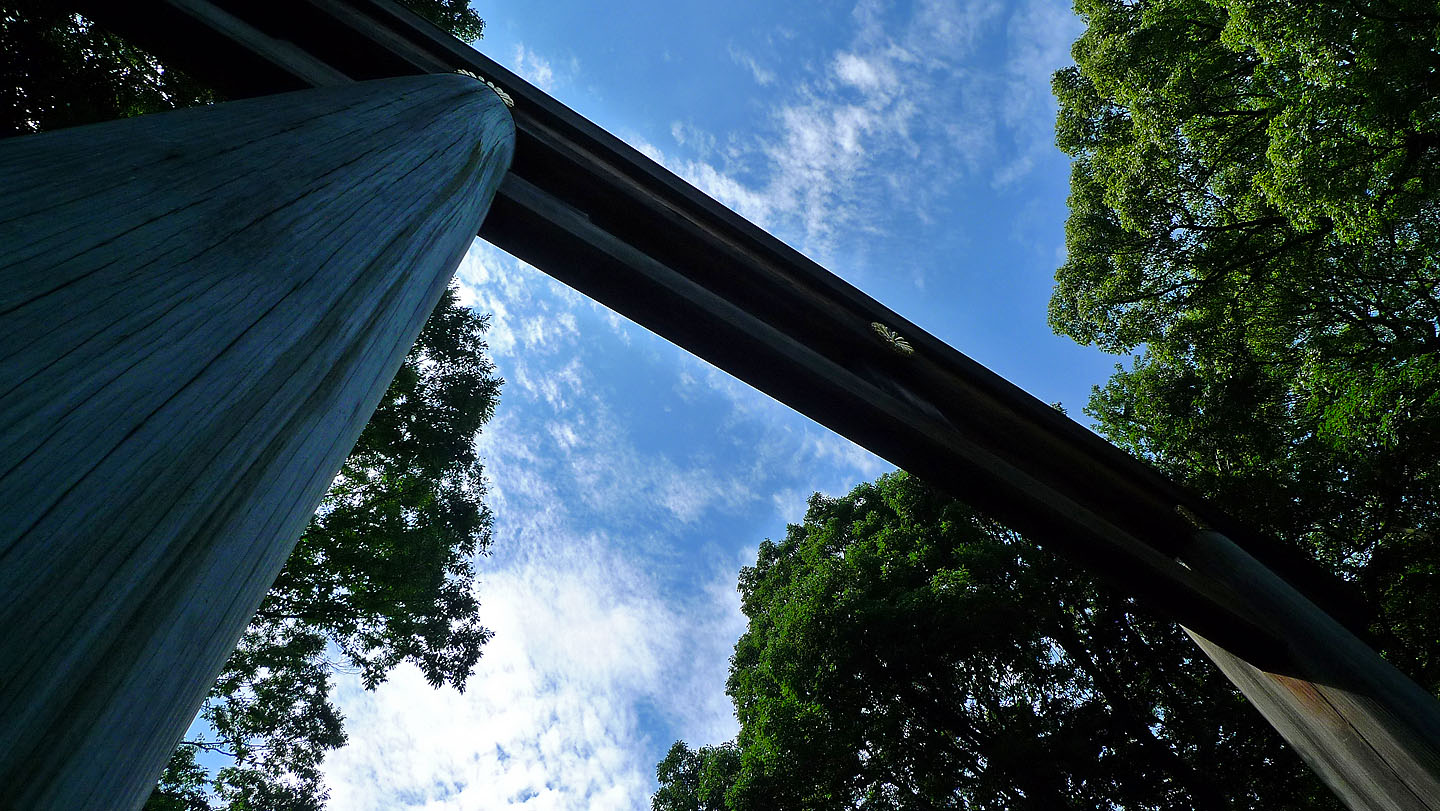
The sky was a photographer’s dream on this day. So far the sky in Japan this time of year has been mostly white. Completely blue can get a bit boring too. But this contrast of white and blue with the green of the trees and brown of the structures was heaven sent.

The photo above is of the gate to the inner sanctuary where the Meiji Emperor is enshrined. The picture below is of the inner sanctuary (内拝殿) itself. I didn’t see the sign saying you can’t take pictures of the inner sanctuary until after I snapped this one. Oops. If you look closely (perhaps after clicking on the image to make it larger) you can see the Shinto priest in white.


