TravelJapanBlog.com - Japan (07, 09-10, 13), Denmark (08, 11, 16-19, 21, 24), Korea (13), Poland (21), Mexico (14, 15, 19, 26), Iceland (17, 19), Hawaii (14, 17, 22), Czech Republic (16, 17, 19, 21)
The above will search Traveljapanblog.com.
Concerts - Landscapes - Sports


Archive for Japan

Mt. Mitake Hike – Part 3 (nearing Mt. Otsuka 大塚山)

hiking mt. otsuka near kori station tokyo japan

For most of the uphill climb after departing Highway 45 near Kori Station (古里駅) the above is all you can see. Few people were on this trail (in the 奥多摩町 area). In fact, we would have thought we were on some of our favorite hikes near home in Ashland, Oregon were it not for the roots lining the trail, the trees not being quite the same (sugi maybe? 杉), and the occasional hiker saying konnichiwa to us.

fall in japan

Upon reaching the ridge after a couple of hours, the views changed rather dramatically. They were also very different depending on which way you looked. Trees on one side of the ridge were non-existent on the opposing side and vice versa. Some trees had lost most of their leaves.

fall maple leaves japanese mt. otsuka mitake hike

Other trees, like these Japanese Maples, were peaking.

susuki tokyo mountains

I wasn’t expecting to see susuki up here, but there it was. From this last spot, if one could jump 50 feet straight up, they would be treated with a vast overview of Tokyo.

36 views of the Tokyo Tower

tokyo tower and a giant rose roppongi hills

Hokusai did the famous series “36 Views of Mt. Fuji,” a couple of which you can see here. I think I have taken more than that many pictures of Tokyo Tower from around Tokyo. I don’t think I will share 36 photos of Tokyo Tower with you today, but from time to time I’ll post a few and maybe we’ll eventually get to 36.

The top photo was taken from Roppongi Hills.

tokyo tower from waseda university

You can’t see Tokyo Tower from most spots on the Waseda University campus, as Tokyo Tower is on the opposite side of Tokyo. However, from a few of the higher buildings you can see it as demonstrated in the above photo, taken at a somewhat zoomed 50mm.

tokyo tower from shinagawa prince hotel

Today’s final shot is from the top of the Shinagawa Prince Hotel. The Shinagawa Station, in the lower right, is one of the busiest stations in Japan.

Mt. Mitake Hike – Part 2 (Kori Station to Mt. Otsuka)

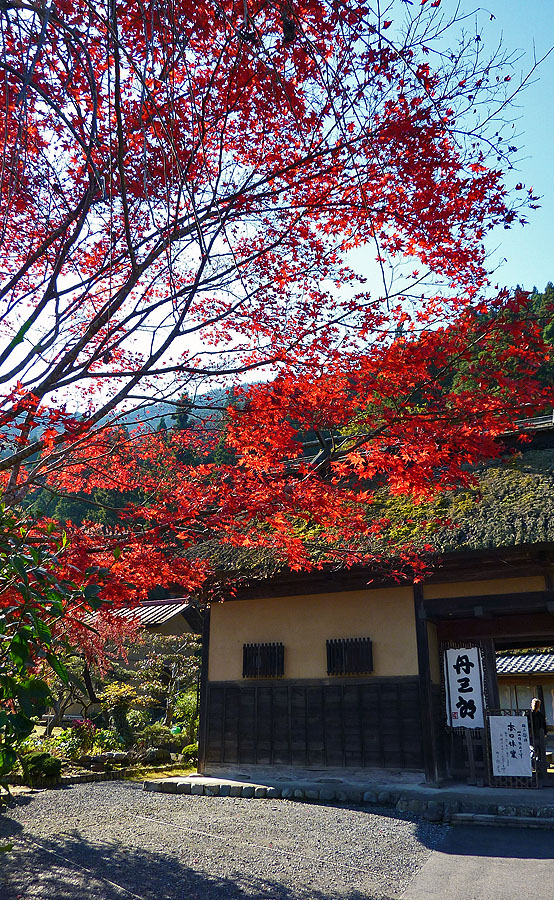
thatched roof building near kori station 古里駅

Before actually getting on the trail, the road from Kori Station (古里駅) to the dirt path is very scenic.

fall colors in japan near tokyo

There are thatched-roof houses, small farms, and colors galore.

japanese mountains farms kori tokyo japan okutama nishitama

After turning to the right, you will begin to climb. The views don’t last long as after a few hundred steps you will be in the trees for at least a couple of hours.

ellie at crossroads kori station 古里駅 mt. mitake road sign

If you can’t read kanji, and are doing this hike without a Japanese person with you, you’ll want a list of what a few dozen kanji mean. The trails are well marked for the most part, but you can easily get lost if you take a wrong turn. The signs don’t have any romaji on them. There are many junctions, some going off in more than a half dozen different directions.

Mt. Mitake (御岳山) – Part 1, getting there

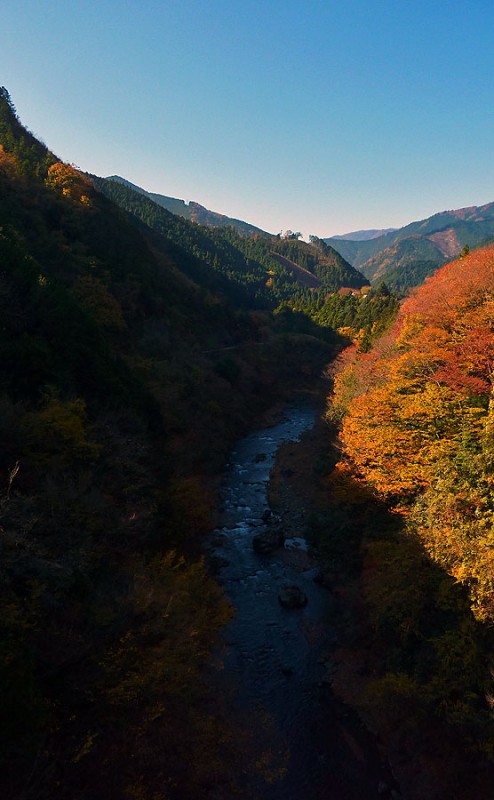
tama river kori station bridge

Last Saturday (November 21), upon recommendation from a friend who had been there the prior weekend and upon seeing it is a featured fall “walk” in a guidebook we own, we headed west of Tokyo to Chichibu-Tama-Kai National Park.

The above photo is of the Tama River (多摩川), from a bridge just a minute or two away from Kori Station (古里駅). This is were we began our walk. The fall colors were still nice, but they probably hit their peak at this location a week or two before.

bridge near 御岳山 mt. mitake station

This next picture is from inside the train near the Mitake Station. The train was actually packed on a Saturday morning, and most people got off at this station. We followed Day Walks Near Tokyo‘s advice and kept going to Kori Station. Some of the information in our book was dated and/or inaccurate. For instance, there no longer is a jiyukippu. Nor is it cheapest or fastest to go from Shinjuku and pay the 1992 price of 890 yen each way. Instead we went from Takadanobaba and paid 770 yen on the way there and just 600 yen on the way back (from Hinatawada), using a Seibu line instead of JR for much of the journey.

mt. fuji 富士山 from haijima station 拝島駅

When we transferred trains at Haijima Station, we had a good view of Mt. Fuji. The above pic didn’t come out so great through the lined glass and with the power lines grabbing the focus, but you get the idea.

Be careful when relying on the information in Day Walks Near Tokyo. “Walking time” in the book seems to mean “running time,” and even though we gave ourselves 7 hours of daylight to do the 4 hour and 45 minute walk with breaks, we ended up in darkness for the last hour. For instance, the first part of the walk says it takes a total of 1 hour and 30 minutes. However, even before we finished it 2 and a half hours later, we saw a sign on the trail pointing in the downward direction saying it was 1 hour and 30 minutes to the start of the walk.

The book really doesn’t prepare you for the amount of climbing. Only once does it mention the trail being steep, even though you will encounter steep trails both up and down all day long. The last 2 hours and 10 minutes (from Mt. Hinode to Hinatawada Station) is described as “quite easy going.” While it is mostly downhill, you will be descending hundreds of steep steps at times and generally navigating a trail loaded with tree roots, ditches, and other obstacles. As we were nearly out of daylight, we almost jogged this part of the trail, without any rests, and it still took longer than the 2 hours and 10 minutes the book estimated. If you plan to follow this trail after the days grow shorter in fall, be sure to bring a headlamp and get to Kori Station by 9 a.m. Another complaint about Day Walks Near Tokyo by Gary Walters is that after the fact I found out, by looking on other websites, that the highlights of a trip to Mt. Mitake are the Rock Garden and water falls (two sets). The book didn’t mention water falls or the Rock Garden so we didn’t know to see either.

We did see and experience some really cool stuff, though, and the fall colors were beautiful. I’ll show you some more pictures in future entries.

Asakusa (浅草) – Part 1

sensoji temple asakusa japan

On a recent Friday, Linda, Ryan, and I visited Asakusa. I thought it wouldn’t be so crowded, being as how it wasn’t a weekend. However, it was swarming with people, just like how I remembered it from my first visit here in the late 1980s.

nakamisedori asakusa tokyo japan

Nakamisedori (仲見世通り) is a long street, featuring almost 100 shops as you approach the temple. The exterior of the temple is currently being remodeled. The original temple is the oldest in Tokyo.

We followed the tour/map in Tokyo: Exploring the City of the Shogun (which I recommend) for the most part, but the pictures you see here are out of order.

asakusa kaminarimon  gate lantern tokyo japan

Here we are in front of the famous Kaminarimon (雷門). Ryan is growing fast. He passed up his mom a few weeks back and may catch me here soon too.

dancing god in asakusa odorigami

I have no idea what this last image is supposed to be. 踊神 means “dancing god,” but this is the ugliest looking dancing god (that can’t even dance) I have ever seen. This shot was taken on Rokku Broadway (六区ブロードウェイ), near the Asakusa Entertainment Hall and Toyokan.

Sumo (相撲) – Part 4

sumo 相撲 face ring

I understand that some of my relatives, following the blog, wanted to see more pictures of overweight males wearing little. So today’s entry is for them. 😉

sumo rikishi falling out of ring wrestler

It is at moments like those shown in the above photograph that you are glad you don’t have a first row seat. There isn’t much space outside the ring before the Sumo wrestlers fall into the spectators below. With hundreds of bouts in a day, several people end up with hundreds of pounds of flesh falling into their laps. I’d be surprised if there haven’t been some injuries.

ryogoku sumo hall arena tokyo japan

Today’s pictures are from the September tournament. The November tournament is now underway in Fukuoka. The above photo is of the Ryogoku Kokugikan (両国国技館) in Tokyo.

相撲 hakuho 白鵬 yokozuna

As mentioned in a prior entry, the above yokozuna, Hakuho (白鵬), was defeated on this night. Hakuho has been the best sumo wrestler of late, winning 10 of the prior 15 tournaments. This photo captures his last happy moment of day 6 in the tournament. Hakuho went on to win the rest of his bouts, including one over the other yokozuna, Asashoryu. Unfortunately for him, Hakuho’s loss on day 6 of the tournament meant that he would have to beat Asashoryu twice to win the tournament. Asashoryu doesn’t lose twice in a row often and he didn’t on day 15 of the tournament either. Asashoryu won the September tournament with a record of 15-1, including the playoff victory, for only his fourth tournament victory in the past 16 tournaments.

I can hardly wait for January to come around as the tournament will return to Tokyo. I have tickets to the final day. Stay tuned.