TravelJapanBlog.com - Japan (07, 09-10, 13), Denmark (08, 11, 16-19, 21, 24), Korea (13), Poland (21), Mexico (14, 15, 19, 26), Iceland (17, 19), Hawaii (14, 17, 22), Czech Republic (16, 17, 19, 21)
The above will search Traveljapanblog.com.
Concerts - Landscapes - Sports


Archive for Japan

More Fushimi Inari Taisha (伏見稲荷大社)

In our last Fushimi Inari episode the topic of ema came up. In addition to ema you can also find mikuji, otherwise known as omikuji, 御神籤, or おみくじ, at most Shinto shrines in Japan.

Fushimi Inari Taisha 伏見稲荷大社 mikuji sakura

These work differently than ema, although to a photographer or appreciator of Japan’s shrines they serve the same basic function of cool window dressing on the other beauties and wonders around every turn. Omikuji are purchased, like ema, but they are not written on. Instead, they already have writing on them. The writing is a fortune–sometimes good, sometimes bad. If you purchase one and it has a 吉 character then you have a good one. The character before the 吉 indicates how good your fortune or blessing is. If yours has a 凶 on it, then you have a curse. Ouch! The way to possibly avoid your curse is to tie it at the above location at the shrine. All those curses make for a work of art.

As you can also see from the above photo, the grounds are meticulously kept and cherry blossom season (sakura) makes things even prettier.

Fushimi Inari Taisha 伏見稲荷大社 torii gates

Fushimi Inari is the head Inari shrine. Other Inari shrines are all over Japan and feature Torii Gates, but Fushimi has the most. I don’t know the exact number, but it must be in the thousands. It’s a wonder to behold, especially if the paths beneath the gates are empty of tourists like they were when we were there. Again, get there before 10 a.m. for best results. Better yet, wear running clothes, get there by 8 or so and run through them all.
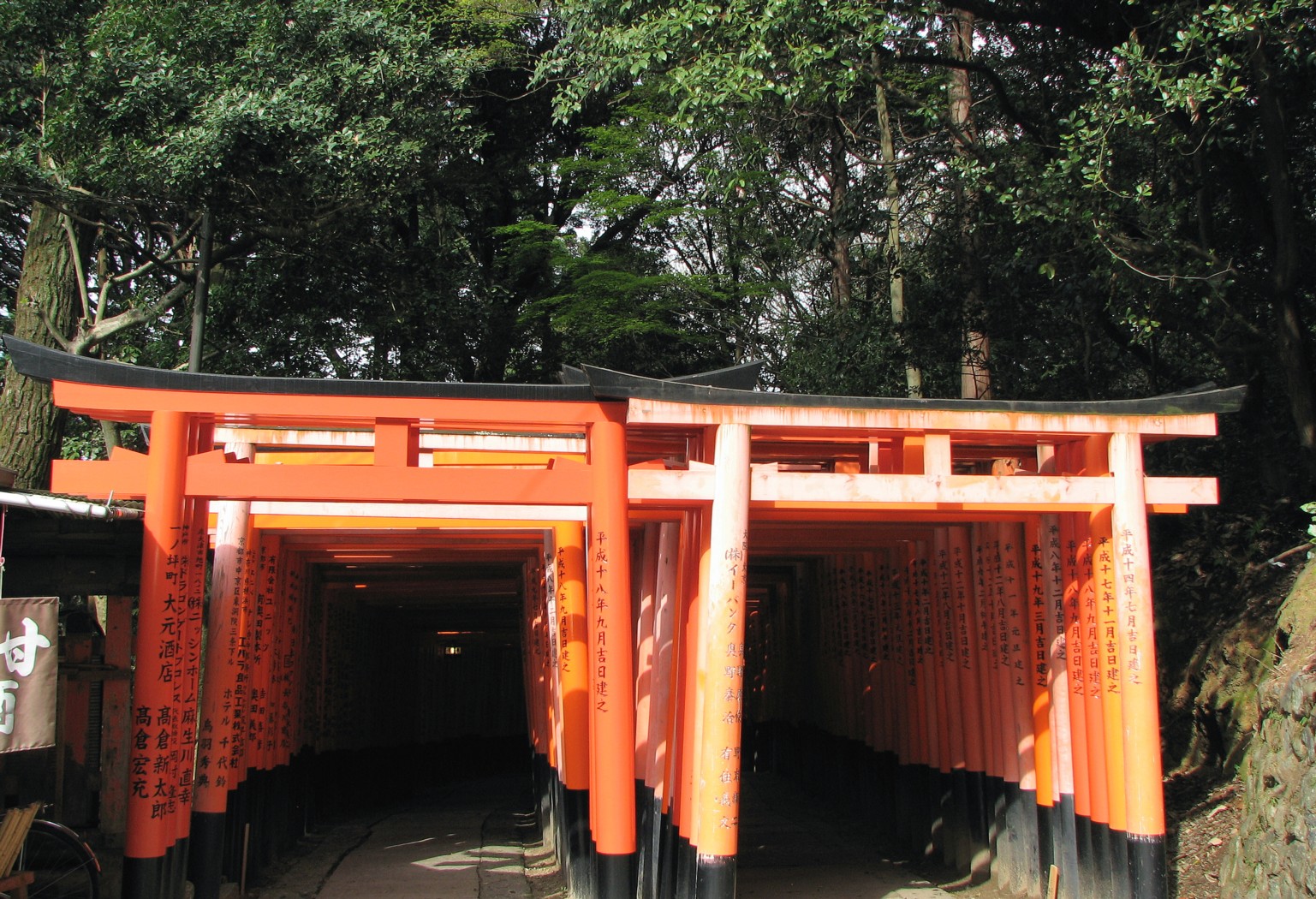
Fushimi Inari Taisha 伏見稲荷大社 torii paths kyoto

The writing on one side of the gates indicates what person, or more commonly, company, purchased the torii. On the same side, but other post, of the torii is the date it was purchased (or perhaps installed).

Prior to actually visiting Fushimi Inari, I was picturing one path of a few dozen gates. I was surprised when I got there to find seemingly countless paths of torii, some running parallel, or at least starting parallel, to each other. It’s a maze like no other.

Japanese enigma

As I’ve mentioned elsewhere, for the past year or so I’ve become a bit obsessed with Japan and relearning and improving my Japanese. I haven’t really stopped to wonder why, but last night, as I was reading, the answer came to me. I suppose part of the answer is simply that if you are going to be living somewhere for a significant period of time you become more interested in it. But there is more to it than that.

mangajinI was reading Mangajin, No. 19. The feature story was interviews with translators. Gerry Harcourt was asked (page 19), “What do you like most about the Japanese language?” Her response was a bit of a nirvana moment for me. She said, “It’s so different from English. It jolts my way of thinking. I enjoy the surprises.”

And just like that I realized why the thought of moving back to Japan has caused my mind to think of little else. I’ve been jolted. And I enjoy the daily joltings and surprises that Japan and its language provides. After all, I can already speak, read, and understand Japanese good enough to have a great time in Japan. So I’m not really studying it to get by. I’m doing so because it is such a rewarding and interesting challenge.

Without the challenge and joltings I’m quite sure I wouldn’t be expending the time and effort.

Fushimi Inari Taisha (伏見稲荷大社)

If you are like me, you like blogs you are interested in to be updated daily or at least several times a week. Nothing is worse than those blogs of promise that only have new content once every few months. I get tired of waiting and stop visiting. To that end, I will blog “old” information at times–especially times like now when I’m not on the road.

So let’s flash back to our trip to Japan from last year. On our last morning in Kyoto we went to the famous Fushimi Inari Taisha which is one of my favorite places in the world. Like many temples and shrines in Japan, it is particularly nice in the early morning hours or at dusk. If you have seen the movie Memoirs of a Geisha then you have seen this place. It is famous for its Torii (鳥居) gates, of which it has a ton–seemingly as many as the rest of Japan combined. However, I’ll save the Torii pictures for another entry.

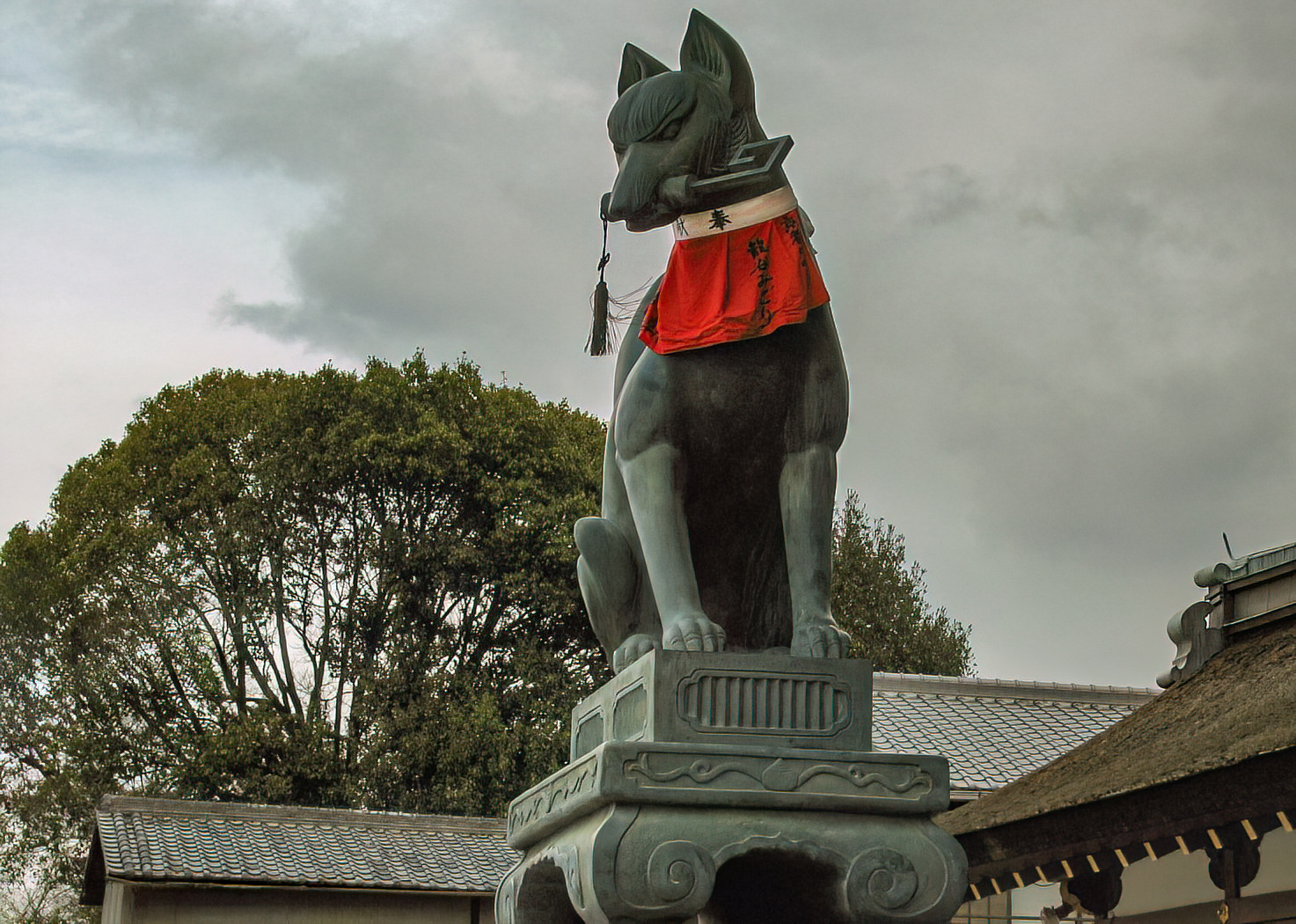
For this entry, let’s focus on a couple of other curiosities about the place. Inari (稲荷) is the Japanese god of foxes (kitsune, きつね, or 狐) among other things. Hence, you can find lots of foxes at this shrine. The one pictured here is near the entrance. (As always, maximize your window and click on any of this blog’s photos for a much better view.)

fushimi inari kitsune

One of the beautiful things at Shinto shrines is the prayer card walls. The prayer or wish plaques are called ema (絵馬). I’m not sure if “plaque” is the proper term. I suppose they could just as easily be called cards, boards, or tablets. They are made out of wood. Ema means “picture horse” but these days they can have any or no pictures on them. I’ve seen some with popular manga pictures printed on the wood. They are frequently placed in such a way that you can get this kind of wonderful photo of them all lined up with a shrine in the background. This one not only had the wooden plaques lined up nicely but also had colorful origami cranes below.

Fushimi Inari Taisha actually contains multiple shrines. This next one has a specific purpose. The readable kanji in the lower right are 入学奉. I’m guessing that there is a fourth character that didn’t make it into the picture and that kanji is probably 納. 入学奉納 means “an offering to get into school.” Students come here (and you can see one in the above picture) to wish for acceptance into the high school or university that they are trying to enter. It’s easier and takes less time than studying. 😉

You can see the wish cards to the right and left of the center. A student would pull the white cord to ring the bell and summon the gods, clap their hands together twice, bow, make an offering of money, and then, perhaps, write their prayer on an ema to hang on the aforementioned wall.

Based on what I’ve read and conversations I’ve had, most Japanese don’t actually believe that the gods will get them into school. They do this more out of tradition and because it’s kind of fun. Although I’m no fan of superstition, I find these shrines and ema walls to be incredibly beautiful. The sights, sounds (of the bells, gongs, and hands doing quick claps), and smells (incense) really do make me feel something.

What does Japanese Baseball have to do with the place we are staying in Paris and the creation of this blog?

Travel Essentials~Ashland Oregon~no sales taxIn yesterday’s blog entry I may have made it sound like we found the place we will be staying in Paris completely on our own. While we may have found it on our own, the truth is that it was also recommended to us by our good friends the Bestors who own a travel store in town. So it’s not just the internet photos and descriptions we based our reservation on, and we are pretty confident we will enjoy the place. 

But the question that is probably really on your mind is what does the title of this post mean? The answer is that the very same Bestors asked me to write about an experience we had on our trip to Japan last year for their travel newsletter. I subsequently posted that article to the internet here, and wanting to do more of the same ultimately led to the creation of this blog.

Travel Essentials~Ashland Oregon~no sales taxI was in Travel Essentials last week to pick up a few items for our trip to Denmark and Paris, including the books and maps mentioned in a prior blog entry. One item I purchased really stands out so I thought I’d share. I’ve tried book lights in the past with poor results. Bob recommended the Petzl Tikka Plus LED Headlamp & Book Light for its quality and flexibility (as you can use it not just on planes and for reading in bed but also while camping, etc.). I picked one up and have been exceedingly happy with it.

Kochi-Kame (こち亀 or こちかめ)

kanji game for the nintendo dsAbout a month ago, I decided to upgrade my previously mentioned なぞっておぼえる大人の漢字練習 for the Nintendo DS to the new version called Nazotte Oboeru Otona no Kanji Renshuu Kanzenhan (なぞっておぼえる大人の漢字練習完全版). The new version has about 300 more kanji and some other nice new features. For only a few dollars more than what I could sell my old version for on ebay, I figured it was worth it (and have been very happy with that decision since the arrival of the “game”).

kochi kameAnyway, since YesAsia offers free shipping I decided to grab a manga while I was at their site since the only manga I can obtain locally are all in English, and that’s no fun. So I rather randomly selected this Kochi Kame one. (The full title is a mouthful, Kochira Katsushika-ku Kameari Kōen Mae Hashutsujo or こちら葛飾区亀有公園前派出所.) My selection wasn’t totally random as I figured my kids would like it given the cover (which turns out to be quite different from all of the other Kochi Kame covers).

For under $10 I wasn’t expecting much. To my surprise, it’s almost 200 pages in length. I started reading it this past weekend, and the content has exceeded my expectations as well. I laughed out loud several times. Apparently this series has been running for decades. I didn’t encounter it when I lived in Japan in the 80s, but I didn’t actively read, seek out, or purchase manga then either.

About the only manga I read in the 80s were a few books given to me. One was What’s Michael? (ホワッツ マイケル?). Another was Osamu Tezuka’s (手塚治虫) Buddha (ブッダ). And then I also had one or two Doraemon (ドラえもん) books that I think I found. Kochi Kame is actually the first one I ever purchased.

kochikame ryotsuI was happy to find furigana next to every kanji which made for easy reading. I only had to look up, on average, the meaning for about one word a page. Kochi Kame stars Ryotsu (両津) who, although sometimes in his police uniform, has yet to do anything police related in the four episodes I read this past weekend. Instead, he has some money-making scheme in each that always ends in disaster and/or failure. Although the first few installments began to seem somewhat Scooby Dooish in their predictable outcomes, I can’t imagine becoming bored by them anytime soon, and the fifth episode (that I read today) had a completely different storyline that wasn’t formulaic.

My son finished learning hiragana this past weekend so he was very proud to be able to read real manga in real Japanese for the first time too. Now I just have to help him understand what the sounds coming out of his mouth mean. 😉

Shogun 将軍

A few months ago my 12-year old son brought home a book called The Children’s Story by James Clavell. I’d never heard of it or Clavell. (I know you must be thinking that I’ve been living under a rock or something not to have heard of either.) Anyway, he tells me that it is really weird and that he thinks I’d like it. I read it in about 10 minutes and agree with his analysis. It’s sort of like Ayn Rand for kids. Or maybe it’s anti-Ayn Rand for kids. It is certainly not your typical children’s book even with that title. But it does leave your head spinning for a few minutes.

I then hopped online to read more about Clavell. Everything seemed to have to do with Shogun, something I vaguely remember hearing about when I was a kid. Needless to say, after reading a bit about how popular Shogun was in 70s, I had to find out why. The book is huge at something like 1,200 pages. After reading just a few, I was hooked and realized it wasn’t going to take me months to finish. Shogun was very painful to put down. That’s not to say it isn’t flawless. It has several problems, but I couldn’t wait to find out how things would turn out. Plus, there are many tension-filled scenes that one can’t just stop reading in the middle of.

So what are the problems? The first is the Japanese. If you don’t understand Japanese then you have nothing to worry about. If you do understand Japanese, or are trying to learn Japanese, then Clavell’s errors will make you cringe on just about every page.

The second problem is that even though this is historical fiction, much of the history is off. I guess that’s OK if you are reading this just for fun, but if you are trying to learn factual Japanese history, don’t believe everything, or even much, of what Clavell says.

The final problem, in my book anyway, is that after a few hundred pages of close calls, fantastic happenings, and coincidences, things become less believable. Again, that may not bother some, but I like my fiction to still be something plausible.

Shogun starring Richard ChamberlinCritiques aside, I still loved this book and have no regrets about spending as much time as I did to go through all 1,200+ pages.

Immediately after finishing it I had to see the miniseries from the 1970s staring Richard Chamberlain and Yoko Shimada on DVD. My family (who hadn’t read the book) loved it. I also enjoyed it, but the book is always better.