TravelJapanBlog.com - Japan (07, 09-10, 13), Denmark (08, 11, 16-19, 21, 24), Korea (13), Poland (21), Mexico (14, 15, 19, 26), Iceland (17, 19), Hawaii (14, 17, 22), Czech Republic (16, 17, 19, 21)
The above will search Traveljapanblog.com.
Concerts - Landscapes - Sports


Posts tagged japan pictures

Sumo – Part 1

sumo rikishi throws salt into ring september tokyo japan ryogoku 将司 昂親 masatsukasa koshin

After a break of “just” 21 years I finally had the chance to see sumo in person again earlier this month. I was extremely excited, especially after watching it on NHK the prior evenings. I went on the sixth day of the fifteen-day tournament, arriving at 8 a.m. to be sure I could get a ticket. As it turned out, I probably didn’t need to arrive so early as there were many empty seats. Should you ever attend, do get there at 8 (or earlier) to purchase the cheap (2,100 yen) tickets on a weekend or you may not get in. I went on a Friday, early in the tournament, so those may be the main reasons it wasn’t crowded.

The above sumo wrestler (力士 or rikishi) is 将司昂親 (Masatsukasa Koshin). He was 5-0 going into day six. His spectacular salt toss (most 力士 don’t throw nearly as much) was supposed to purify the ring. On this evening it did not work well for him, and he fell to 5-1.

flags in front of ryogoku tokyo japan Asashoryu's flag

The day started out as a beautiful, mostly blue-sky day. The banners/flags of the sumo stars out front looked wonderful, and until about 8:30 a.m. a drummer (who was more than a bit off beat) worked the drum up in this tower. I was enchanted and ready for action. Unfortunately, it wasn’t easy to continue this high for 10 straight hours until the top wrestlers performed.

The flag on the far left is that of 白鵬翔 (Hakuho Sho), the most recent tournament winner. He is Mongolian and one of only two current 横綱 (Yokozuna, the top rank in sumo). On this night Hakuho lost his first bout of the current tournament to a guy who had zero wins and five losses in the first five days. It was shocking to say the least. Spectators picked up their seat cushions and hurled them in Hakuho’s direction, an incredible sight.

ryogoku early in the day tokyo japan sumo ring

I was alone, or I could have had pictures taken with many of the sumo dudes, but I did take this one, self portrait four hours into the day.

Gokoku-ji 護国寺

Gokoku-ji 護国寺 stairs gate sunset tokyo japan

tokyo japan buddhism Gokokuji 護国寺 buddah

While riding a bus for the first time one day in an unknown area I passed the 護国寺 bus stop. The place looked huge and my bus stop wasn’t very far beyond the 護国寺 stop. So after I finished my business I walked back to this Buddhist temple. A funeral was underway. The person must have been very important as there was an unbelievable number of people in attendance. A line of more than a hundred people were waiting to get in while the inside already looked full of hundreds of people to me. Rather than have one or two places for people to check in, there looked to be more than a dozen.

Of course I didn’t take any pictures of the funeral or the people lining up, but the size of the event meant that many of the typical photos of this place wouldn’t work either as the grounds were covered in automobiles. The cemetery went on forever so I took quite a few pictures while strolling through it as the sun went down. It was one of those magical moments that can only happen when you are by yourself (which isn’t often in public in Tokyo). Other than myself there were only crows–lots of big black ones.

Not having done my homework beforehand, I had no idea how famous this place is, that it is Japan’s Imperial Mausoleum, that Emperor Meiji’s remains are here (I figured they were at Meiji Jingu), and that Gokokuji is the head temple for the Japanese tea ceremony.

I didn’t realize until I did research after taking these photos, but the third and last picture in this entry (with the crow on the torii) is of Okuma Shigenobu’s grave. Okuma Shigenobu was the founder of Waseda University and was a former, two-time Prime Minister of Japan. I actually gave a speech in the Okuma Auditorium, named in his honor, last week. Others who have given speeches in that exact same spot include Bill Gates, Albert Einstein, Bill Clinton, and Nelson Mandela. Maybe someday they will be as famous as I. 😉

Gokokuji is about a 30 minute walk from the Ikebukuro Station, or you can catch a bus in the Nishi Waseda area that will take you right there. There is also a Gokokuji Station on the Tokyo Metro.

Gokoku-ji 護国寺 japanese cemetery torii crow tokyo japan

Eating in Shinjuku (at night)

shinjuku kabuki cho tokyo japan night photography

You will not have a hard time finding a place to eat in Shinjuku at night. The streets are lined with places, sometimes six or more stories high. The restaurants aren’t hard to see either. With all the light coming from them, Shinjuku can be brighter at night than during the day.

The above photo is of one of the entrances to Kabuki-Cho on the east side of Shinjuku station. The building on the right has a 7-11 on the ground floor and then other floors featuring shabu-shabu, okonomiyaki (pancake filled with vegtables, squid, mayonnaise, etc.) and takoyaki (octopus balls), a bar, a manga cafe, and a place to play mahjong.

kaiten sushi shinjuku self serve round conveyer belt

Kaiten Sushi (回転すし) is when you don’t order sushi, you merely pick your sushi choices off the rotating conveyor belt. That’s what the above place is, with prices starting at just 100 yen per plate. You frequently see fun pictures of the creatures you will be eating in Japan, something that doesn’t seem too appetizing in the states.

Which of these smiling fish would you like to eat?

pig tanuki shinjuku tokyo japan irasshaimase

Or perhaps you’d prefer pork in the form of a pig pretending to be a tanuki? Apparently they don’t serve raccoon dogs here, but you can get something made out of pig like tonkatsu. I love tonkatsu, but this pig at the door makes me want to eat it somewhere else.

My walk home

heavy metal shamisen takadanobaba eki tokyo japan

It’s a great feeling at night when I’ve finished my class and commute and find myself at Takadanobaba Station ready to walk the final stretch home. Recently I’ve come to anticipate the street musician just outside of the station. He plays a shamisen but not like the geisha. No, he plays a heavy metal version that is quite unique. I really like the vibe.

I was going to talk to him on the night I took the above picture. However, as I approached him he scowled as he tuned his three strings. I figured I should keep my distance. So I went across the street to get a picture. Unfortunately, I couldn’t get a clear shot as people kept passing before him.

takadanobaba big box

While I waited for people to clear out, I turned my lens to an icon of the area, Big Box.

bijin shamisen player heavy metal takadanobaba

The view got nicer, at times, but I still didn’t ever get a good photo of the Metal Shamisen Dude. Next time, if I get up the courage, I’ll ask him if I can take a video.

old worn akachochin red lantern covered in plastic wendy's

From there I walked down Waseda Doori passing many curious shops. The one above features an 赤提灯 (あかちょうちん, akachochin, or red lantern) that seems to have been in use for decades. Rather than replace it, they have put plastic over it to keep it from wearing out so fast. The bottom half is literally hanging by a thread.

Places with an akachochin out front are great for a drink and/or bite to eat.

Farther down the street (upper right corner of the above photo) you can see Wendy’s, one of the last places in Japan to not ban smoking. The place reeks inside. Japan’s smoking habits have really changed in the past 20 years. When I was here in the 1980s people smoked everywhere. Now, seeing someone smoking is something of a rarity. There are small, designated smoking areas outside of most train stations, away from the major traffic areas. I no longer have to experience the stink, unless I’m walking by Wendy’s at the same time a customer is coming out the door.

天祖神社の御神輿 2009年9月6日 Part 1

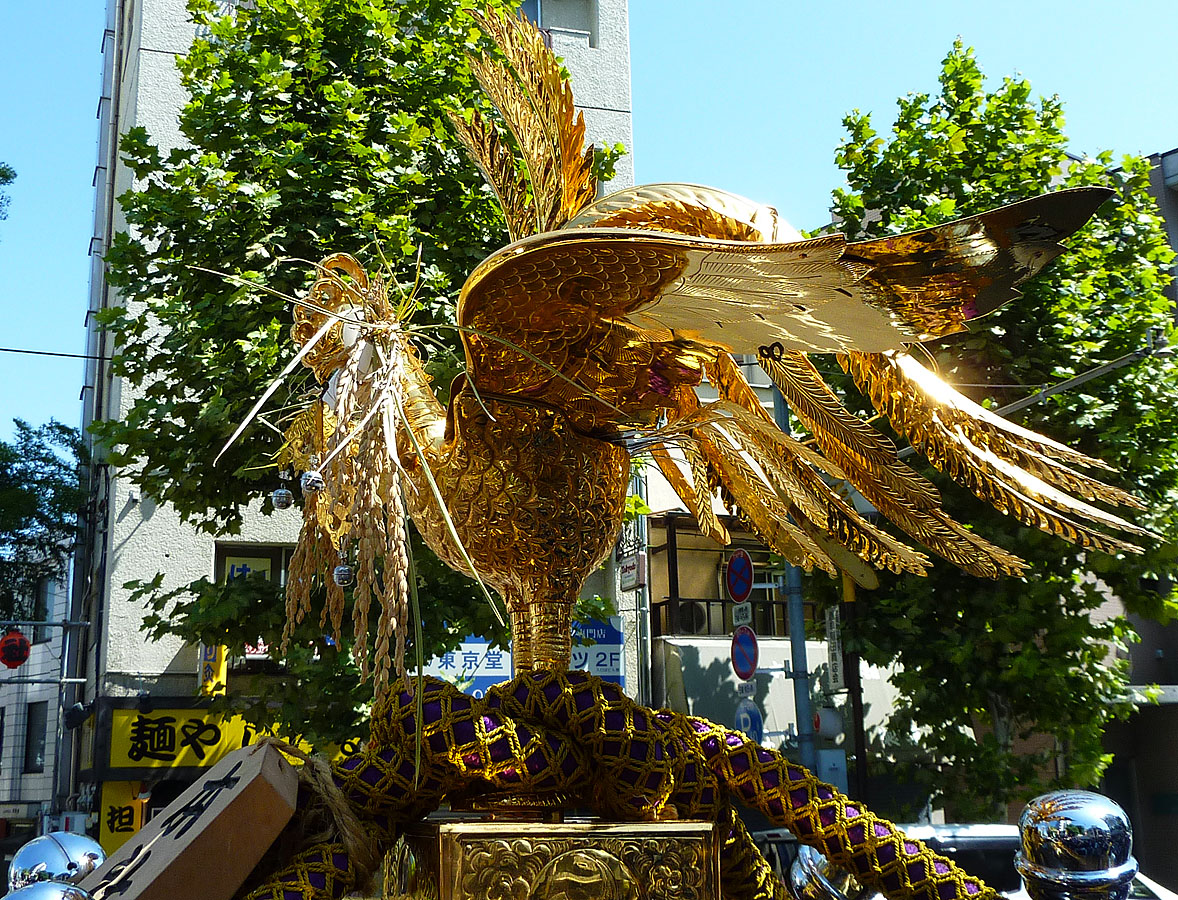
鳳輦 golden phoenix on top of omikoshi

Ever since the aforementioned Bon Odori, signs have been going up, and we have observed preparations, for our local shrine’s omikoshi matsuri. Saturday, the 5th, featured the children’s version (kodomomikoshi). While we watched the procession, the man directing the kids struck up a conversation with me and invited us to participate in the following day’s event. He told us to borrow some Happi Coats from the local sake dealer which we did.

tenso jinja omikoshi opening speech

At 9 o’clock on the morning of the 6th we arrived at 天祖神社 (our local shrine) decked out in our new Happi Coats and all ready to lift the mikoshi, bounce it up and down, and wave it back and forth through town. I wasn’t so sure we would get the chance given that there were hundreds of people looking to do the same and only space for a couple dozen lifters at a time.

The local elders (to the right of the above photo) gave speeches before we began, telling us to be safe, enjoy the great weather, and continue the tradition that had been happening for hundreds of years. They only take this mikoshi around town once every three years so we were lucky to be here at the right time.

和傘 wagasa

The procession included not only the mikoshi but also boys dressed like Shinto priests, someone in a Tengu mask, a lady dressed in a traditional Shinto outfit with the above wagasa over her, and others.

gaijin holding the omikoshi

I got my chance to carry the mikoshi at one point (that’s me on the far left) and quickly discovered that it doesn’t work so well when one person is more than half a foot taller than everyone else. Not only do the tall get stuck with far more weight, but they also tip the shrine a bit. This was a great experience, though, and I’ll post some more pictures soon…

Memories of childhood

japanese kids playing baseball in the park

When I was a kid I played some form of baseball (frequently wiffleball due to space and number-of-participants constraints) at least 200 days a year. I don’t see that anymore in the states in this age of soccer and video games. But in Japan I see kids playing baseball nearly every day.

野球 甘泉園公園

The location for these shots is the open area on the north-west corner of 甘泉園公園. I’ll be posting more pictures from and information about this park near Waseda University soon.