One of the reasons I don’t really like amusement parks is they are phony. I like my fantasies to be realistic; walking through Fantasyland at Disneyland is anything but real. Being there is anti-fantasy due to its obvious fakeness. The other reasons I don’t like theme parks are the lines, the food, and the prices. So Edo Wonderland in Nikko on a Sunday (the day when crowds in Japan are twice as large as Saturday and 10X larger than weekdays) seemed like it would be hell on earth. Boy was I wrong! This is the first time in ages that I was disappointed when we had to leave an amusement park.
The first thing that is shocking about this place is the price–4,500 yen for a place with no rides, that costs thousands of yen in transportation fees to arrive, and takes hours to get to? Really? Why would anyone bother? At least that was my thinking. After all, we visited a somewhat similar place in Denmark where admission was free.
However, once you walk around the place a bit, you will realize that the price is actually not bad. There are few customers and loads of employees in Edo-period dress making sure you are having a good time. The building reconstructions are very good; Disneyland-style craftsmanship was not used as a model, thank goodness. When you get away from other visitors (which wasn’t very hard to do on a Sunday and should be very easy to do on a weekday) and hang out with just the employees and the surroundings, it is not difficult to imagine you are back in old Edo.
The first thing we did upon arrival in the afternoon is look for which show was starting next. I was told the “Traditional Japanese Culture Theater” (日本伝統文化劇場) had just begun, but I could still get in. Looking back on that suggestion, I wonder if that person knew what they were setting me up for and were laughing inside. I didn’t bother to look at the program (which says that “one audience member is selected to play the part of the millionaire”), as we were late, so we just went to the show.
I slipped in the back and sat behind about 200 people, waiting for Ryan who was having difficulty getting his shoes off to enter. I missed what the costumed performer had said at the outset; he was now making his way through the audience. I thought he was just chatting with people before the real show was to begin. It turns out he was looking for his target. Being the only foreigner in the audience, I stood out, even though I came in late and sat in the back. He came up to me and started to chat. Before I knew it I was told to go on stage. Still, I didn’t realize what this was going to mean. Maybe they would talk to me for a minute so the all-Japanese audience could see that a foreigner can actually understand Japanese? Maybe we would do a little karaoke before the show and then I’d be allowed to go back to my seat? In any event, I didn’t imagine what was about to happen.
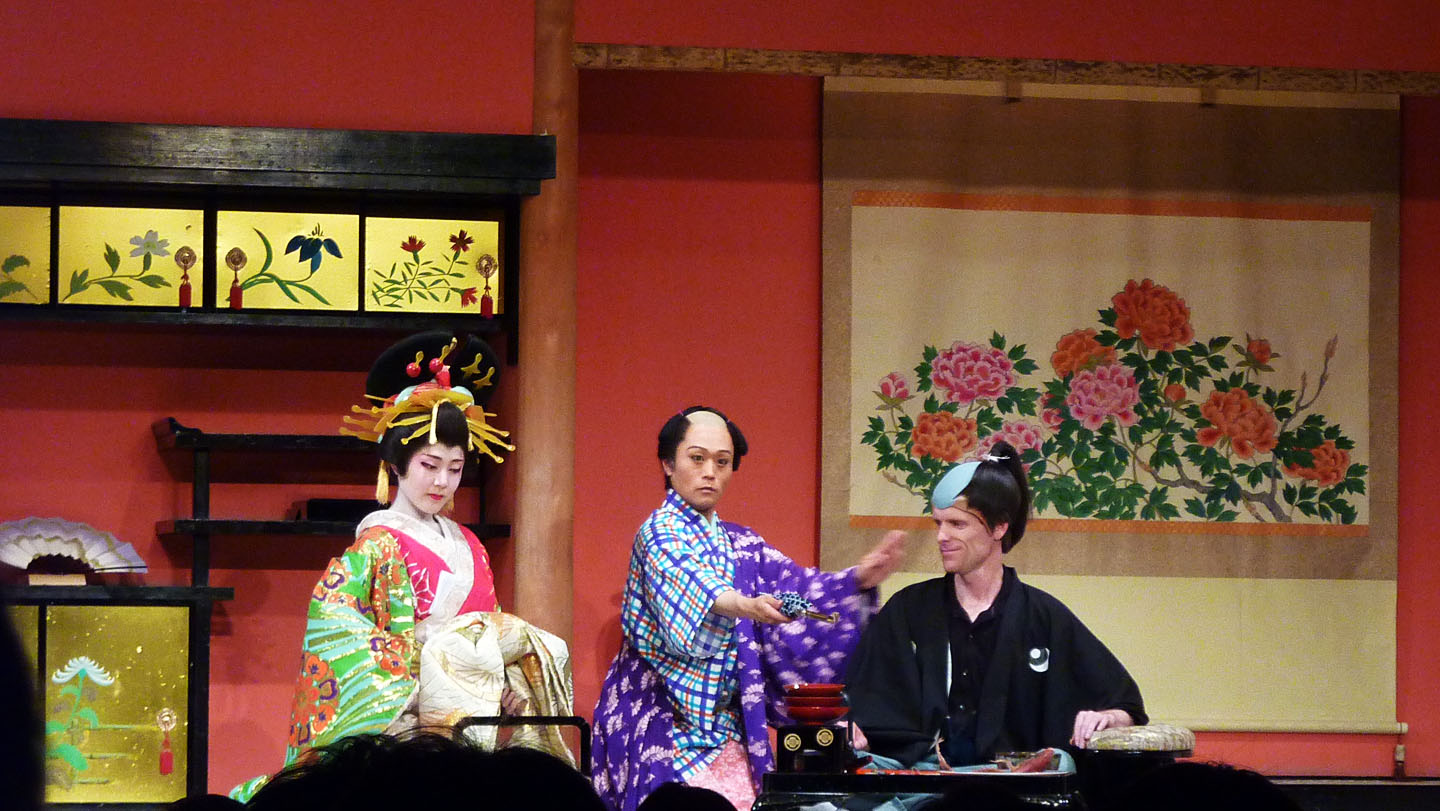
I was told to go backstage where two, kimonoed ladies put some clothes on me and something on my head. They didn’t really explain anything to me except to say that I would have cue cards (or at least that’s what I thought they said). By this point my mind had gone to mush. I felt like I was in a different world, without a clue how this world worked. My mind felt like it should be back on the bus that took me to this place or, at worst, vegging out in the back row of a theater–not being on stage doing who knows what. In this confused frame of mind, my comprehension of Japanese seemed to be greatly reduced. Or maybe it was the old Edo dialect they were using that caused my understanding to drop to about half of what was said. In any event, the curtain went up, and there I was on stage with dozens and dozens of smiling Japanese faces in the audience looking at me. I was without a clue as to what I was supposed to do; nor did I even know at that point what I looked like. I didn’t find that out until later when I saw pictures.
The guy who pulled me out of the audience said some things which I could only partly understand. I begin to realize that I was portraying an important person (お大臣様) in this play and the setting was the Yoshiwara (吉原) pleasure quarters. A beautiful oiran (花魁 pre-geisha era high-class prostitute who does more than just have sex with her customers) appeared, danced for me, and wanted my attention. I’m not sure what I was supposed to do. Should I look at her? Should I ignore her? Should I look at the audience and smile? Should I say something clever? I just didn’t know, no one was telling me, and the promised cue cards (which I was looking out over the audience for) weren’t forthcoming yet.

To make a long story a little less long, cue cards did eventually arrive. I read them with gusto (even though I didn’t understand what I was saying as they were in old Japanese). The oiran and I hooked up. I bowed countless times and was pelted with loads of yen coins by the appreciative audience. I was allowed to keep none of them. I had a great time. But in hindsight, with a little more mental preparation, I could have given a much more stellar performance.
I’m guessing they always pick a foreign (gaijin) male in the audience if there is one (whether the gaijin can speak Japanese or not). So if you want an oiran to look deep into your eyes and vie for your affections, and you are a Caucasian male, this is the place for you. Sit in front of any other Caucasian males in the audience (although there probably won’t be any), and you will likely be chosen. If you don’t want to be chosen, be sure to arrive at least 10 minutes late. I found out that 5 minutes late is not late enough to remain a mere audience member. 😉
Posted on May 14th, 2010 under Japan. Tags: amusement parks, edo wonderland, geisha, nikko. Comments: 2