For over a year (back in the late 1980s) the Bandit Roller Coaster (バンデットローラーコースター) at Yomiuri Land (よみうりランド) was the world’s tallest and fastest roller coaster. Many are now faster and/or taller, but this is still a great ride. Ryan (on the right) and Ellie (in the black and white) rode it about seven times last Sunday.
There is a sign saying that you can now see Tokyo’s Sky Tree from it on a clear day. Spot the Sky Tree and you are supposed to have good luck. I don’t see it in the above picture, but I still feel lucky.
After hanging out at the Kofu Castle for a while, I wanted to check out the parts of Kofu I was most familiar with 22 years ago–the shopping streets–before the main part of the Takeda Shingen Festival got under way. I couldn’t get far as a dance performance blocked an entire street through the Kofu shopping district.
Takeda Shingen’s motto was “Move as swift as wind, stay as silent as forest, attack as fierce as fire, and have an undefeatable defense like a mountain.” The abbreviated characters for this slogan are read merely as furinkazan (風林火山). At the festival six generals represented each of the four, for a total of 24 generals. The dancers also represented one of the four. Those in blue represented swift wind, green represented forest, red represented fire, and purple represented mountains.
The top picture in today’s entry must have been some mountain dancers. Some forest dancers are below. The best view was from the end of the street, pictured above. The dancers appeared like colorful waves from this vantage point. I should have taken a video for the full effect.
Three weeks ago Tokyo experienced one of only about two or three blue sky days of the month. It’s been a disappointing spring on the weather front so far with lots of rain, clouds, and some cold temperatures. But on that one nice day we took advantage of the good weather and rode our bikes from Nishi-Waseda to Yanaka via Gokokuji, pictured above.
The setting for my first picture in this series was the grounds of Maizuru Castle Park. Shingen’s troops gathered here before heading off in their regiments for the “parade.” The atmosphere was very good. The weather was fine, Mt. Fuji loomed in the background, and the samurai were getting drunk before heading off to battle (the pavement of Kofu’s streets).
The Japanese guy above was enjoying the mood as well. I was merely taking an incognito picture of his group when he spotted me and performed this “charge.” It was actually more of a pose than a charge, but I appreciated his willingness to provide a nice action shot for my camera without actually impaling me.
Let’s not forget this was a festival and not a battle reenactment. Therefore, there was plenty of yakisoba, takoyaki, and the like to be had, as well as monkeys doing tricks and other matsuri standards.
The guy in the middle of this group, with the tall helmet, is the president of his company and represented one of Takeda Shingen’s generals on horseback later in the evening. I chatted with him for a while earlier and had my picture taken with him. Photos of people like me in regular clothes with those of Japanese in samurai gear don’t look right though.
As each of the 24 regiments left the castle grounds they gave a battle shout like the one you can see in the above video I took. Some groups were more serious than others. Applause at the end seemed a little… wrong.
Posted on April 25th, 2010 under Japan. Tags: castle, festivals, kofu, people, video. Comments Off on More from the former Kofu Castle site (甲府城跡)
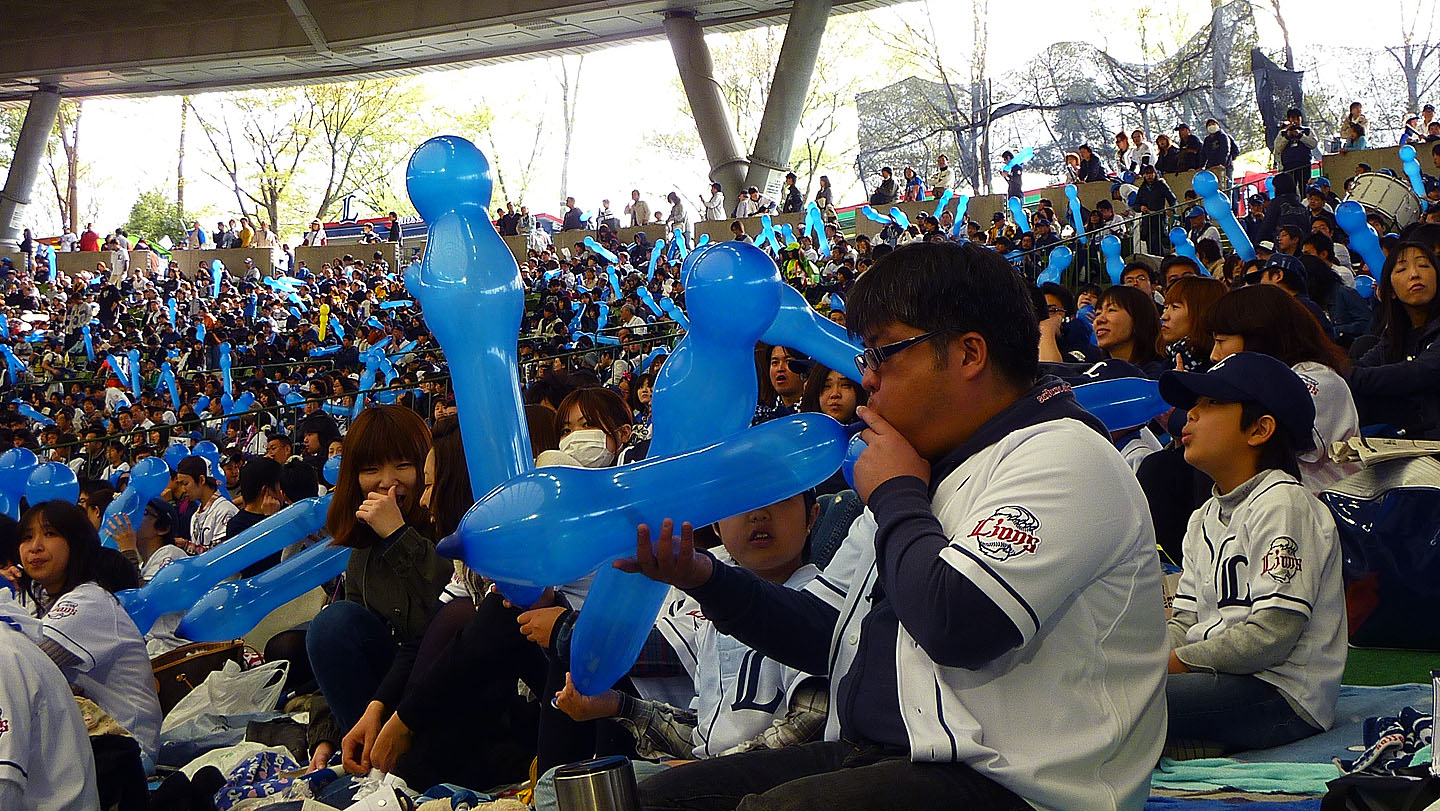
My first game of the season was a good one. My Lions beat the visiting Nippon-Ham Fighters from Hokkaido.
Half the fun at Japanese baseball games is the cheering. Above is a video I took of one of the many cheers. Get your cheers down before the game for maximum enjoyment. 😉 Here you can practice them with music, but you need to be able to read Japanese.
The words to the cheer (for a player named 久) in the video are:
光り輝く
日はまた昇る
燃える男だ
チャンスに久
かとばせ久
Go Go Let’s Go 久
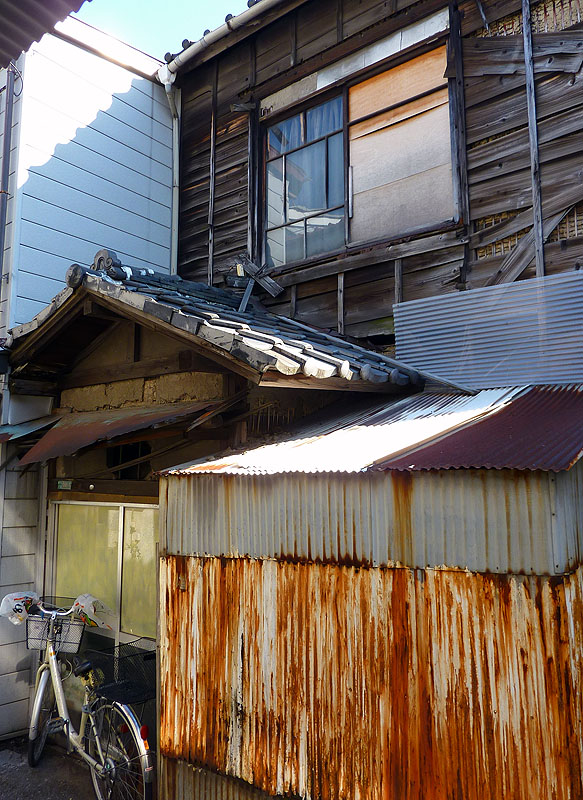
“Three old women were the only passengers on the Sunday morning tram [from the end of the line at Waseda]. They all looked at me and my flowers. One of them gave me a smile. I smiled back. I sat in the last seat and watched the ancient houses passing close to the window. The tram almost touched the overhanging eaves. The laundry deck of one house had ten potted tomato plants, next to which a big black cat lay stretched out in the sun. In the garden of another house, a little girl was blowing soap bubbles. I heard an Ayumi Ishida song coming from somewhere, and could even catch the smell of curry cooking. The tram snaked its way through this private back-alley world. A few more passengers got on at stops along the way, but the three old women went on talking intently about something, huddled together face-to-face.
I got off near Otsuka Station… None of the shops along the way seemed to be doing very well, housed as they were in old buildings with gloomy-looking interiors and faded writing on some of the signs. Judging from the age and style of the buildings, this area had been spared the wartime air raids, leaving whole blocks intact. A few of the places had been entirely rebuilt, but just about all had been enlarged or repaired in places, and it was these additions that tended to look shabbier than the old buildings themselves.” Norwegian Wood p. 84