TravelJapanBlog.com - Japan (07, 09-10, 13), Denmark (08, 11, 16-19, 21, 24), Korea (13), Poland (21), Mexico (14, 15, 19, 26), Iceland (17, 19), Hawaii (14, 17, 22), Czech Republic (16, 17, 19, 21)
The above will search Traveljapanblog.com.
Concerts - Landscapes - Sports


Posts tagged garden

Fudoin (不動院) – temple lodging (shukubo or 宿坊) on Koyasan (高野山)

photomerge panorama fudoin dinner garden koyasan

Fudoin Japanese garden (日本庭園)

The reviews and recommendations of the temples you can lodge in on Mount Koya are vague, to say the least. I looked in guidebooks and all over the internet and couldn’t find many details like you can when choosing to stay in a hotel, ryokan, or minshuku in most parts of Japan. While my review of Fudoin isn’t going to tell you which temple on Koyasan offers the best value or which temple to avoid, I can tell you about Fudoin.

The first thing to note is that if you plan to go to Koyasan (and you should), don’t make it a day trip. The best part (similar to Shirakawago) is the overnight stay. To make your overnight stay in a Buddhist temple as relaxing as possible, don’t bring all of your luggage with you. The people on the trains, cable car, and buses with a suitcase and large backpack are not happy campers. Instead, stay in the same place in Osaka or Kyoto the night before you go to Koyasan as you do on your night after visiting Koyasan. Most places will allow you to leave your luggage there if you are coming back after being away for just one night. Then you only have to bring a small backpack or camera bag for your one night on Koyasan.

There is no place to stay on Koyasan that isn’t a temple. There are many temples to choose from, but the thing that struck me when I was there is how similar they all appear to be. I somewhat randomly decided on Fudoin. The price was a bit higher than average, but there really aren’t any cheap or inexpensive places. Everything about Fudoin exceeded my expectations. The food was outstanding. The view from my room (pics here) was incredible. The morning prayers were wonderful. There really was nothing to complain about, and I felt the price was very worth every last yen.

Today’s photo, by the way, is a 180 degree panorama from the room where I ate my vegetarian monks’ cuisine (shojin ryori or 精進料理). I assumed that the meal would be served in my room or in a hall with everyone else. Instead, I was ushered into a room overlooking this lovely Japanese garden and ate by myself as the sky darkened.

Japanese Garden

I have spent the past few days in Seattle. I’ll post some photos on my other blog over the next week or two if you are interested.

The photo above is of the Japanese Garden on the edge of Washington Park. I couldn’t actually go in the Japanese Garden as it is closed in December and January, but I took a walk around it and took this photo through a fence at a distance. The sky was gray and this isn’t the best time of year for such a place, but I bet it is beautiful in spring and fall.

Benzaiten fountain in Inokashira Park

benzaiten shrine

This little, moss-covered, hand-washing station, complete with jizo, can be found on the back, water side of the Benzaiten Shrine in Inokashira Park. I wonder if it was hidden behind the main shrine almost 200 years before when Hiroshige drew the same spot from a bit more distant vantage point?

歌川広重 名所雪月花 井の頭の池 弁財天の社雪の景

Kyoto Residence & Japanese Garden (京都の自宅と庭)

These kind of residences, with large gardens, are not a common sight in a big city in Japan like Kyoto where the real estate is at a premium. This picture was taken near the southern end of the Path of Philosophy.

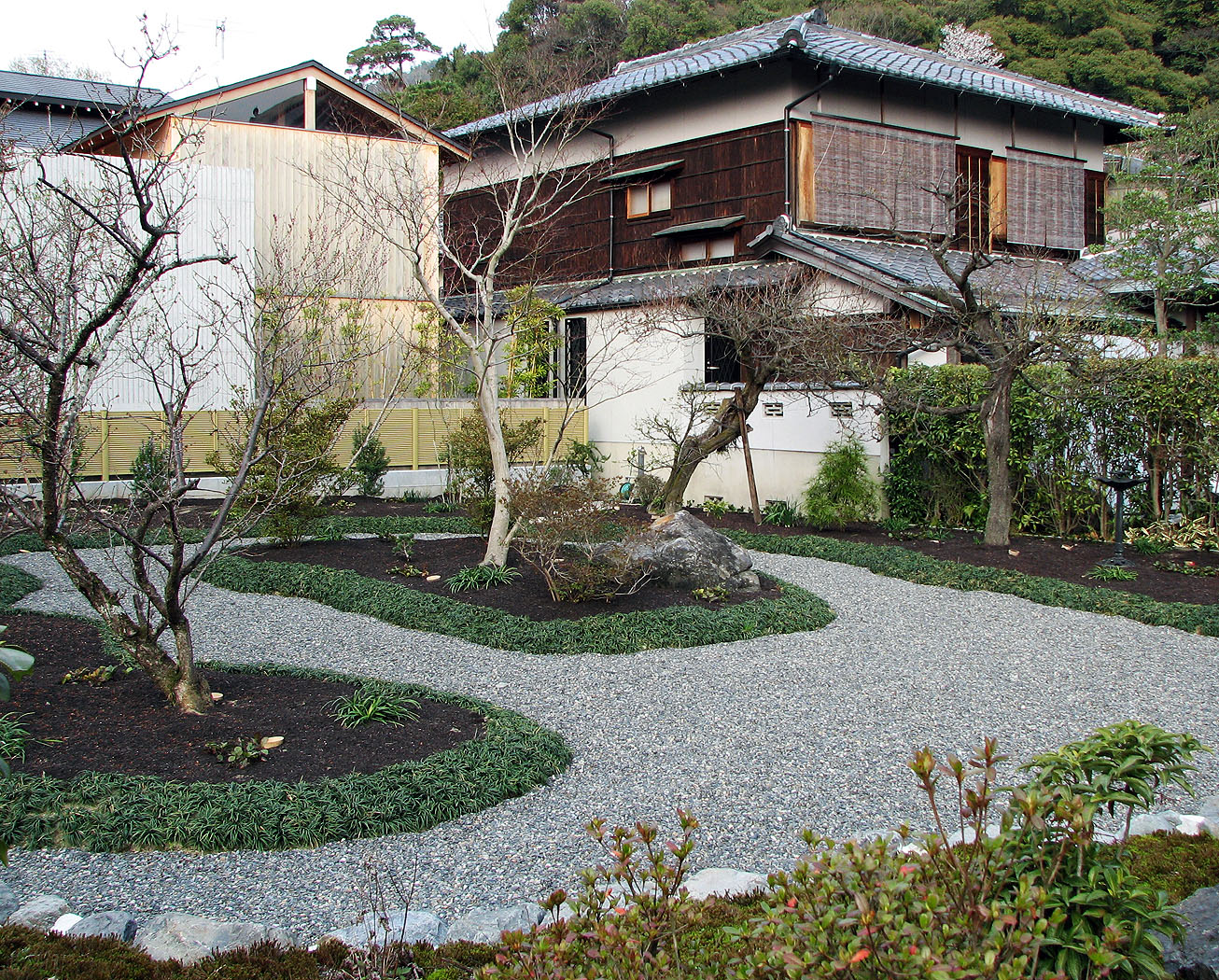
Japanese Gardens

I’m back from my winter vacation, although it seems strange calling it a vacation when I went from a cold, snowy place to a colder, snowier place. Hopefully you enjoyed the Italian offerings of the past couple weeks. We’ll turn back to Japan now.

On my trip I finished both volumes of Glimpses of Unfamiliar Japan. I’ll share a few quotes and thoughts on the book here in the next week or so. To go along with the following quote I present the above photo which I took at ginkakuji in Kyoto last year.

“Now, a Japanese garden is not a flower garden; neither is it made for the purpose of cultivating plants. In nine cases out of ten there is nothing in it resembling a flower bed. Some gardens may contain scarcely a sprig of green; some have nothing green at all, and consist entirely of rocks and pebbles and sand, although these are exceptional. As a rule, a Japanese garden is a landscape garden, yet its existence does not depend upon any fixed allowance of space. It may cover one acre or many acres. It may also be only ten feet square…  Therein are created minuscule hills with minuscule houses upon them, and microscopic ponds and rivulets spanned by tiny humped bridges; and queer wee plants do duty for trees, and curiously formed pebbles stand for rocks, and there are tiny toro, perhaps a tiny torii as well, – in short, a charming and living model of a Japanese landscape.

Another fact of prime importance to remember is that, in order to comprehend the beauty of a Japanese garden, it is necessary to understand – or at least to learn to understand – the beauty of stones… Until you can feel, and keenly feel, that stones have character, that stones have tones and values, the whole artistic meaning of a Japanese garden cannot be revealed to you. In the foreigner, however aesthetic he may be, this feeling needs to be cultivated by study. It is inborn in the Japanese; the soul of the race comprehends Nature infinitely better than we do, at least in her visible forms. But although, being an Occidental, the true sense of the beauty of stones can be reached by you only through long familiarity with the Japanese use and choice of them, the characters of the lesson to be acquired exist everywhere about you, if your life be in the interior… At the approaches to temples, by the side of roads, before holy groves, and in all parks and pleasure-grounds, as well as in all cemeteries, you will notice large, irregular, flat slabs of natural rock, mostly from the river beds and water-worn, sculptured with ideographs, but unhewn. These have been set up as votive tablets, as commemorative monuments, as tombstones, and are much more costly than the ordinary cut-stone columns and haka chiseled with the figures of divinities in relief. Again, you will see before most of the shrines, nay, even in the grounds of nearly all large homesteads, great irregular blocks of granite or other hard rock, worn by the action of torrents, and converted into water-basins (chodzubachi) by cutting a circular hollow in the top. Such are but common examples of the utilization of stones even in the poorest villages; and if you have any natural artistic sentiment, you cannot fail to discover, sooner or later, how much more beautiful are these natural forms than any shapes from the hand of the stone-cutter. It is probable, too, that you will become so habituated at last to the sight of inscriptions cut upon rock surface, especially if you travel much through the country, that you will often find yourself involuntarily looking for texts or other chiselings where there are none, and could not possibly be, as if ideographs belonged by natural law to rock formation. And stones will begin, perhaps, to assume for you a certain individual or physiognomical aspect, – to suggest moods and sensations, as they do to the Japanese. Indeed, Japan is particularly a land of suggestive shapes in stone, as high volcanic lands are apt to be; and such shapes doubtless addressed themselves to the imagination of the race at a time long prior to the date of that archaic text which tells of demons in Izumo “who made rocks, and the roots of trees, and leaves, and the foam of the green waters to speak.” (Lafcadio Hearn, 1894, Glimpses of Unfamiliar Japan, p. 345)

Botanisk Have (part 1 of 2)

The Botanical Garden in Copenhagen is perhaps the favorite park in the city for nature lovers. We were only there for a half hour or so as they were closing. It’s the only park I know of in Copenhagen with security, only one entrance, and a definite opening and closing time.

denmark nature

Everywhere you looked was teaming with loads of plant varieties. On top of the plants there were numerous other living creatures in the park. We saw cranes, various duck species, turtles, birds, carp, and more.

ryan, al, and ellie in denmark garden

denmark buildings and ponds lily pads

The above may be an image of the museum. There is a museum and a greenhouse in the park but we didn’t enter either.

mating turtles in the botanical gardens

copenhagen denmark

The views from every turn in the paths were so great that I’m going to have to turn this into a two part entry with another five photos to show you tomorrow.